GLOBALVARS
0
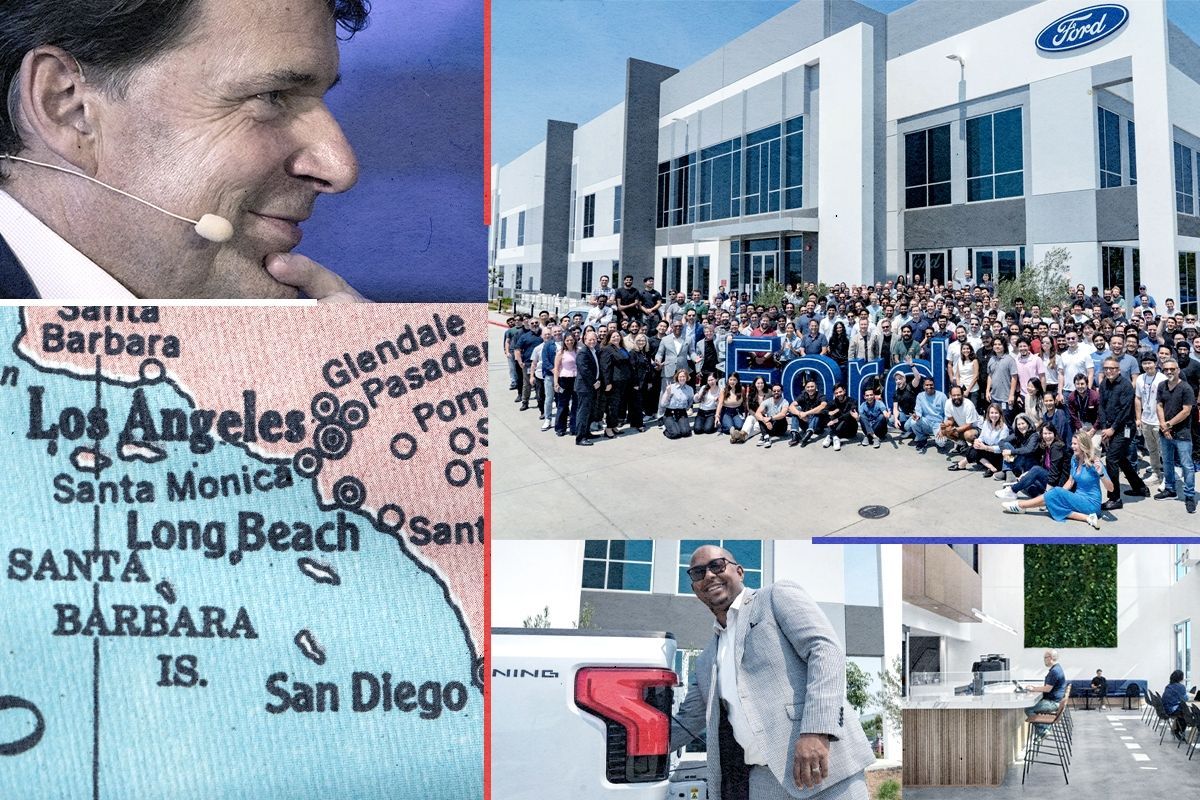
Two thousand miles from Detroit, just across the road from the runways of Long Beach Airport, the future of Ford is taking shape. What that shape is, however, the company isn’t quite ready to share yet.
Last week, the automaker invited some members of the car press inside the secret compound where Ford is developing its next battery-powered vehicle, an affordable midsize pickup truck due out next year. Although the actual appearance of that truck is a closely guarded secret, as is just about everything else about it, Ford wanted to show off its launchpad, the Electric Vehicle Development Center. The research and development campus, with its two white warehouses glimmering in the Southern California sun, is about more than one car. Inside, teams of engineers, coders, and designers are trying to reinvent how Ford makes vehicles in the hopes of turning around its fortunes in the electric era. As the company at large has canceled EV models and infrastructure and taken on billions of dollars in losses to transition some of its EV assets back to combustion, EVDC represents its one big chance to find a way forward in electric cars.
Ford knows it’s at an inflection point. The company’s first forays into making mainstream electric cars, such as the Mustang Mach-E and Ford F-150 Lightning, were quality vehicles that beat many established automotive rivals into the space. But Ford struggled to keep costs down and wound up losing billions as it tried to scale up an electric car business.
Something had to change. Last year, CEO Jim Farley said Ford would restart its electrification efforts through a skunkworks team, a small unit that would rethink how it builds EVs. “They're from all over the place,” Alan Clarke, the executive director of advanced EV development, said of the skunkworkers during our visit last week. “Some of them are from startup EV, some of them are from established EV. Many come from consumer electronics, startup aerospace companies, and you'll meet many of them today, but there's also many that have come from Ford. Many of them have waited decades for a moonshot like this.”
The group studied EV brands like Tesla and Rivian that simplified their electrical and computing architectures to strip miles of expensive wiring from their vehicles. They worked fast and leaned in a way meant to echo Silicon Valley more than Motor City. The result is the Universal EV platform that will underlie not only next year’s new truck, promised to start in the $30,000s, but also a variety of vehicles to come, creating manufacturing savings that will hopefully allow Ford to sell more affordable electric cars.
Even the California locale is no accident. It’s meant to call back to a time when the brand was the innovator, not the establishment , with the hope that the secret sauce of the past can propel Ford back into a race dominated by startups – and now by rivals like GM and Hyundai that beat Ford to the punch with better EV platforms. The facility itself is already 100 years old, built to expand production of the Ford Model A in the 1920s and 30s.
Inside, EVDC represents a full embrace of the frictionless workplace: no corner offices, just open rows of computers amid a makeshift garage brimming with 3D printers, spools of wiring, and racks of gear. Coders are a short stroll from the visual designers tinkering with clay models. Electrical engineers are around the corner from the “lab car,” a rectangular steel frame meant to suggest the general shape of a vehicle, with a complete mockup of the future car’s electrical system strung along the skeleton so that workers can test any part of it. This is about process; the closest thing to the shape of a car is a wooden one with test car seats inside, set up in the fabrication shop. The shepherds of our tour met any question about the specifics of the forthcoming truck with a quick you’ll find out next year, though a prototype dressed up in that zebra camouflage just happened to sneak by as we moved between building.
The point of all this is to innovate at speed, without the barriers inherent in the old-fashioned hierarchical struggle that governs an established business. Any idea that can make a car a little bit better, or cheaper, is welcome. It can come from something as simple as fabric on the seats. In the seating lab, Scott Anderson is using new algorithms to lay out the necessary shapes to be cut from a sheet of fabric with the least possible waste.
The more pressing concerns for an electric car lie in the battery, though, since that unit still makes up about 40% of the cost of an EV. On Ford’s campus, a chamber is coming together that will test cells under just about any climatic conditions, from about -40 degrees Fahrenheit to 150 degrees. Inside a thermal lab dedicated to battery development, engineers can build and test battery cells in the same location. As with every department at EVDC, the point is to be able to prototype, test, and move on to the next iteration within a couple of weeks rather than the months it might have taken before.
The lessons that emerge from Long Beach are meant to spread throughout the Ford ecosystem. For example, EVDC researchers are working on ways to build EVs from three modules that can be assembled separately and come together toward the end of the process. It’s a plan that’s meant to double as a life improvement for workers at the plant in Louisville, Kentucky, that will build Ford’s EV pickup truck — they can, for example, work on brake pedals while standing up rather than sitting awkwardly in the driver’s seat and reaching down to the footwell.
That is the eternal skunkworks challenge. It’s not enough to establish a small team charged to move fast and break things without the suits there to say no. Their innovations must really take root. Ford, at least, seems to understand the urgency at the very top. Farley, the CEO, has been especially vocal among industry bigwigs about the existential threat of cheap Chinese EVs, which lots of American drivers would buy if they could. EVDC will not magically allow Ford to compete at Chinese’s pricing level. But by restarting its EV program from scratch, Ford’s version of the Apollo program, it could follow a manufacturing path that’s competitive with the likes of Tesla and with the electric offerings of its longtime rivals. Compared to the status quo of losing billions every year on electrification, that would indeed be a giant leap.