GLOBALVARS
0
Current conditions: Floodwaters swept through eastern Iowa, swelling the White River to its highest level in 113 years • A southwest monsoon, or hagabat, has capped off several weeks of storms in the Philippines that, combined, killed nearly two dozen people • Temperatures in Madrid are lingering near 100 degrees Fahrenheit until midweek, when the Spanish capital will cool off into the high 80s; the Greek capital of Athens, meanwhile, is bracing for the exact reverse.
THE TOP FIVE
1. Tropical Storm Lala leaves 200,000 without electricity in Hawaii
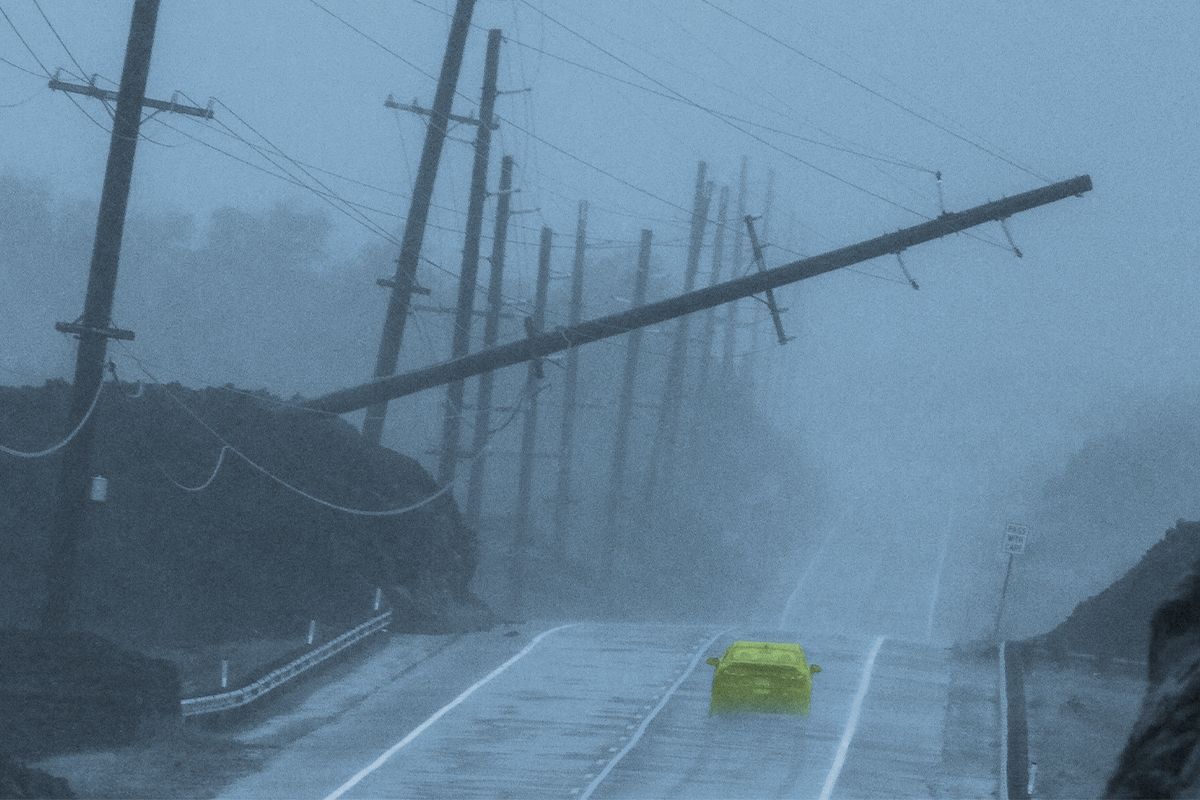
Tropical storms almost never hit the Hawaiian islands directly. The last time a tropical system struck the archipelago was in 2018, when Tropical Storm Olivia made landfall over Maui. It was, per CTV News, the first time a storm had come ashore like that since records began in the 1950s. The last full-blown hurricane to strike the state was in 1992, when Category 4 Iniki landed on Kauai, the chain’s northernmost island, as the strongest storm on record to hit the state. But the Big Island hadn’t seen a major storm make landfall since 1900. So Tropical Storm Lala, by some measures a Category 1 hurricane, left a mark. Nearly 200,000 homes and businesses — representing roughly 70% of the Big Island — remained without electricity on Sunday night as winds of up to 75 miles per hour and floodwaters hammered the state’s infrastructure. “Customers should prepare for extended outages lasting weeks or even months in the hardest hit rural areas of Hawaii island,” Hawaiian Electric, the utility that serves 95% of the state, told the Honolulu Star-Advertiser.
“It doesn’t matter how many poles we fix in your neighborhood, they’re not going to be getting any power,” Jim Kelly, a spokesman for the utility, told Honolulu Civil Beat. “So we’ve got to focus on restoring those transmission lines first.”
2. OpenAI delays data center in Georgia
Georgia has over the past decade emerged as a hotbed for cutting-edge industry in the United States. The state welcomed battery factories, solar manufacturers, and the nation’s only wholly new nuclear reactors in decades. But regulators are now cracking down on data centers. Last week, Georgia Power opted to delay the start date for a 25-year service contract to supply the ChatGPT maker OpenAI’s $20 billion data center near the state’s coast with electricity. The voluntary delay, E&E News reported, gives the utility 12 days to revise its proposal before the Public Service Commission, which had signaled its plans to reject the original pitch amid a groundswell of opposition to artificial intelligence infrastructure. The new deadline to review and approve the proposal is August 26.
The postponement comes about a week after West Virginia attempted to “clean slate” with a new set of proposals to regulate data centers aimed at undercutting the movement to block server projects across the country. Governor Patrick Morrisey, a Republican, issued a plan that calls for reducing and possibly eliminating state income taxes on the back of new revenue from AI companies. The move came after Mountain State Spotlight, a venerable investigative outlet based in West Virginia, published a report outlining how a data center developer was using the state’s patchwork of regulations to push a project with limited oversight. It’s no surprise. At least seven in 10 Americans oppose data centers being built near their homes now, according to the latest polling from Heatmap Pro.
3. Nearly 750 gigawatts of batteries are backlogged for a grid connection
Batteries are booming as lithium-ion units grow cheaper and more useful to back up the grid. The industry saw 70% annual growth last year, as my colleague Robinson Meyer wrote last week. But powering the grid off of batteries requires actually hooking them up to the power system. Across the country, some 750 gigawatts of energy storage projects — roughly equal to more than 700 nuclear reactors — are waiting in the queue for a grid connection, according to data the Lawrence Berkeley National Laboratory shared with Bloomberg. Not all the projects will be built. But the median wait time for a grid connection was five years in 2025, up from a year and a half in 2015.
Sign up to receive Heatmap AM in your inbox every morning:
* indicates required
Email Address *Our Privacy Policy & Terms Apply.
4. Record bid for a geothermal lease shows the industry heating up
Last I checked, it’s actually illegal to write about the geothermal industry’s looming boom without making a pun about heat. So you’ll have to forgive the headline. But things really are getting steamy between investors and developers. When the Bureau of Land Management held a geothermal lease sale in New Mexico in June, the agency netted more than $16.5 million, making it the second-highest-grossing sale in its history, according to Utility Dive. The record-setting bid was from Rock Canyon Resources, which paid $3.14 million for one 4,479-acre tract. Another auction is set to take place in Utah on Tuesday.
5. Canada starts digging one of the world’s largest uranium mines
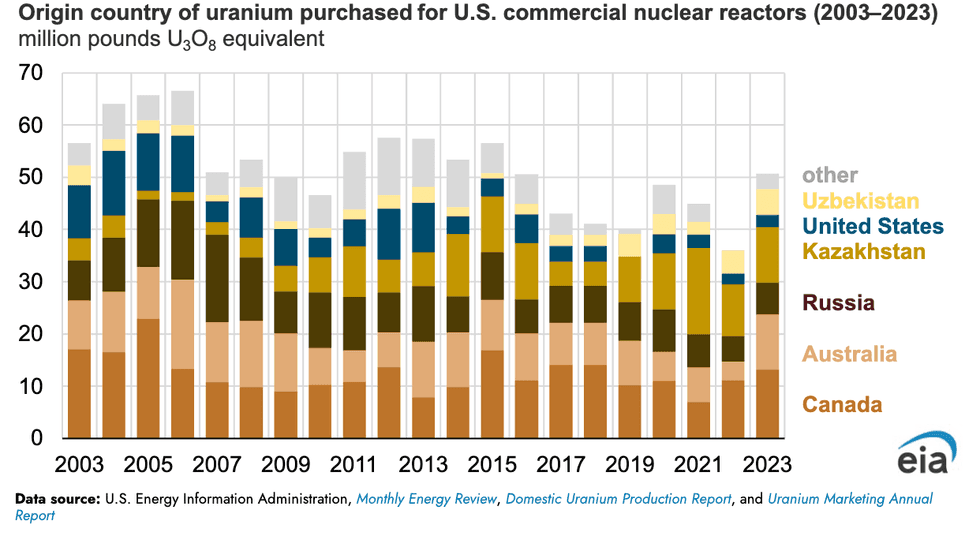
The U.S. used to produce and enrich the uranium that fueled the world’s largest fleet of nuclear power stations. In the 1990s, however, then-President Bill Clinton brokered a deal to establish the famous “megatons to megawatts” with Russia, whereby American power plants promised to buy fuel made from disassembled Soviet warheads. As a nonproliferation exercise, it was a success. But the Russian fuel undercut the domestic market, putting many American miners and enrichers — already facing dimmer prospects as the U.S. stopped building new atomic power stations — out of business. By the time the 2022 invasion of Ukraine plunged Washington’s relations with Russia to their lowest point since the Cold War, the U.S. remained heavily dependent on imports from the Kremlin-owned nuclear company Rosatom. Congress banned Russian uranium imports in 2024, but allowed for waivers until the start of 2028. That cliff is fast approaching, right as one of the other largest suppliers — Kazakhstan — lowered production at its mines.
Luckily for the resurgent U.S. nuclear industry, Canada remains America’s largest supplier of uranium. And a lot of Canadian uranium is coming to the market. On Friday, NexGen Energy broke ground on the first phase of what’s expected to be one of the largest uranium mines on Earth. The project in northern Saskatchewan was first conceived more than a decade ago. The company had started drilling for samples in 2012, but failed after 13 attempts. In winter of 2014, the company tried again. “On the very first home, we hit mineralization,” NextGen CEO Leigh Curyer told CBC News. “We didn’t know it at the time, but we were on top of what has become the world’s most important energy fuel project.” Canada isn’t the only country planning for a nuclear future. Spain, the world’s last major country still pursuing a phaseout policy, seems to be inching toward saving its nuclear plants. Last week, regulators cleared the Almaraz nuclear station to operate through 2030. But NucNet cautioned that left-wing Prime Minister Pedro Sanchez’s government still planned to shut down the reactors by 2035.
THE KICKER
Peter Thiel has invested in Facebook, SpaceX, and Palantir, where he serves as chairman of the board and co-founder. Add Argentina’s oil and gas sector to his portfolio. In a Friday filing to the U.S. Securities and Exchange Commission, the billionaire disclosed a 1% stake in Vista, one of Argentina’s largest oil companies operating in the Vaca Muerta shale formation roughly the size of Belgium, where Argentine President Javier Milei wants to ramp up fracking. Reuters reported that Thiel also recently bought a new home in Buenos Aires.