GLOBALVARS
0
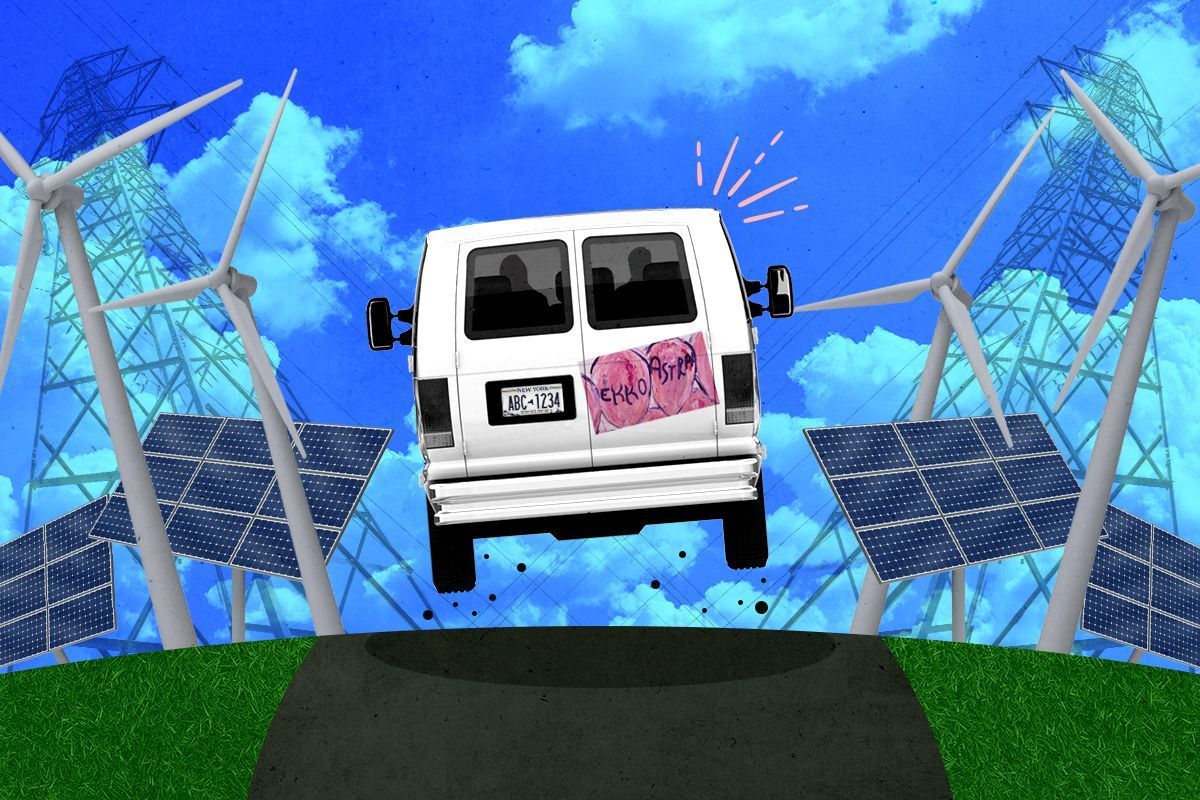
I expected touring the whole country with my rock band could change me. I didn’t think it would shatter my understanding of the U.S. energy transition.
First, a quick word about myself for any Heatmap readers who may not know: Along with delivering you scoop after scoop, I’ve been writing and playing music as the front person of a band called Ekko Astral. Last fall, we had the privilege of touring the entire U.S. opening for two of my favorite rock acts, PUP and Jeff Rosenstock. The tour itself was immensely successful, with packed-out rooms full of thousands of screaming fans. Getting to play those stages was the culmination of a dream I’d had since playing guitar at age 11 at the local coffeeshop open-mic. It was awesome.
What I hadn’t considered about this cross-country rock n’ roll tour, however, was that it would take me through the fields of wind turbines and solar projects being built across the country that I’d reported on but mostly hadn’t seen in person.
Driving across the country with my band, I saw solar and wind projects in Wisconsin, Kansas, Arizona, and Idaho. One drive from Austin, Texas to Rozwell, New Mexico, sent me through a dizzying maze of wind farms in a western portion of the Lone Star State that surrounded my vehicle on all sides with spinning blades and transmission lines — and fracking rigs, because it was Texas. It felt like some sort of twisted, magnificent energy wonk video game level.
I also drove through myriad pockets of rural America where companies have been fighting tooth-and-nail to build utility-scale renewable energy and sometimes losing to hardened opposition. I drove through open fields and farmland in the Midwest and the Great Plains, for example, including places where building solar or wind is banned outright. I drove straight through the part of central Idaho where Lava Ridge, once the largest wind farm in the country, would have been built this year if not for Donald Trump. Sure, there were counties where I could understand wanting to avoid solar farms on farmland, or wind turbines cluttering more picturesque vistas. But I can’t tell you how many times I looked out the window of my vehicle and thought, Why isn’t this a solar farm? There’s no one here!
At the same time, I was trapped in my own form of climate hypocrisy, touring the country in a gas-powered Ford Transit van. I kept longing for us to have the capacity to tour by electric van. But setting aside the limited availability of electric vans for touring purposes, the sheer logistical requirements of going electric would be difficult for any touring band. Music venues do not always have reliable charging access, and calculating when and how to charge the van on our tour probably would’ve made already time-limited logistics impossible. Sure, Ed Sheeran might be able to do it, but not an up-and-coming band on a budget.
To make matters more frustrating, it turns out band merch isn’t great for the planet. Yes, you can choose greener materials for T-shirts and record packaging, but vinyl records are produced with petrochemicals. Cleaner alternatives, known as biovinyl, have been tried but can have serious quality issues (see: the Billie Eilish experiment). Then add in the shipping required to get multiple rush orders of shirts dropped in random spots across the country and, well, you’re looking at quite a lot of potential carbon emissions.
One day, late in the tour, I walked off stage in Salt Lake City and opened my phone to a text from a source notifying me that Esmeralda 7 — the largest solar project in the U.S. — had been killed. I wrote the piece, then went back to selling more copies of Ekko Astral songs printed onto petroleum discs.
All of this made me feel angry and helpless. By the time the tour ended I wasn’t quite a doomer, but I was tired, and my views on climate action had changed in three important ways.
First, we need to rethink what kind of “permitting reform” is necessary for the energy transition. After driving through so many open areas with so little economic development and no new renewable energy generation, I no longer think that changing federal environmental laws will make much of a difference, except to make more polluting forms of energy more economical. The permitting issues delaying projects in these places are, as I have reported for Heatmap, sometimes caused by people on social media who are manipulating a decline in civil engagement and participation in municipal government to block energy projects they personally dislike, even when the developments enjoy broad community support.
This is not a federal permitting problem, it’s a local one. But national politicians could help mitigate this issue if they really wanted to. New gas pipelines need approval from just one entity — the Federal Energy Regulatory Commission — but transmission lines have to cross all the Ts with every state agency along their path. Lawmakers trying to rectify that problem should also turn their attention to the local moratoria and restrictive ordinances holding up what Heatmap Pro data shows is more than a thousand renewable energy and battery storage projects across the country. I do not know what the specific policy solution is here, but we need policy experts to start coming up with ideas.
Second, I believe that artists need to practice what we preach.
In the wake of my tour, I’ve found myself daydreaming about what a true climate-friendly tour would look like, and have spoken with fellow musicians — and climate wonks — about how to make it happen. Maybe one day I will commandeer an electric vehicle and bring only enough gear to play music off the battery in the car. Or perhaps I will put on an outdoor concert run entirely on renewable-powered generators, as the band Massive Attack did earlier this year, claiming it slashed most of the emissions from their performance. In any case, these forms of radical thinking will be crucial because culture is upstream of politics, and art is the soundtrack that defines action.
Lastly, I think more of us need to go out and see the rest of our world, because it’s frustrating it took me a rock n’ roll tour to see what was right there this whole time: the frustratingly slow pace of progress.
I’m used to hearing from all sides that renewable energy deployment in the U.S. is moving at a rapid clip, even in spite of Trump’s rise to power. Nearly half of all new power coming online this year is going to be solar and wind. Battery manufacturing investments continue to be a bright spot. Carbon emissions are going down, albeit slowly. All of this is nice to hear, but I just traveled the whole country and it didn’t feel like I was seeing or feeling the transition that is supposedly underway.
This country has a lot of potential. I want to see us go so much further towards a greener electric grid, transportation system, and arts community.