GLOBALVARS
0

Current conditions: After a brief reprieve of temperatures hovering around freezing, the Northeast is bracing for a return to Arctic air and potential snow squalls at the end of the week • Cyclone Fytia’s death toll more than doubled to seven people in Madagascar as flooding continues • Temperatures in Mongolia are plunging below 0 degrees Fahrenheit for the rest of the workweek.
THE TOP FIVE
1. Interior Secretary suggests Supreme Court could step in to kill offshore wind
Secretary of the Interior Doug Burgum suggested the Supreme Court could step in to overturn the Trump administration’s unbroken string of losses in all five cases where offshore wind developers challenged its attempts to halt construction on turbines. “I believe President Trump wants to kill the wind industry in America,” Fox Business News host Stuart Varney asked during Burgum’s appearance on Tuesday morning. “How are you going to do that when the courts are blocking it?” Burgum dismissed the rulings by what he called “court judges” who “were all at the district level,” and said “there’s always the possibility to keep moving that up through the chain.” Burgum — who, as my colleague Robinson Meyer noted last month, has been thrust into an ideological crisis over Trump’s actions toward Greenland — went on to reiterate the claims made in a Department of Defense report in December that sought to justify the halt to all construction on offshore turbines on the grounds that their operation could “create radar interference that could represent a tremendous threat off our highly populated northeast coast.” The issue isn’t new. The Obama administration put together a task force in 2011 to examine the problem of “radar clutter” from wind turbines. The Department of Energy found that there were ways to mitigate the issue, and promoted the development of next-generation radar that could see past turbines.
The Trump administration, meanwhile, is facing accusations of violating the Constitution with its orders to keep coal-fired power stations operating past planned retirement. By mandating their coal plants stay open, two electrical cooperatives in Colorado said the Energy Department’s directive “constitutes both a physical taking and a regulatory taking” of property by the government without just compensation or due process, Utility Dive reported.
2. New permitting bill would prevent Trump from yanking wind permits
Back in December, the promise of a bipartisan deal on permitting reform seemed possible as the SPEED Act came up for a vote in the House. At the last minute, however, far-right Republicans and opponents of offshore wind leveraged their votes to win an amendment specifically allowing President Donald Trump to continue his attempts to kill off the projects to build turbines off the Eastern Seaboard. With key Democrats in the Senate telling Heatmap’s Jael Holzman that their support hinged on legislation that did the opposite of that, the SPEED Act stalled out. Now a new bipartisan bill aims to rectify what went wrong. The FREEDOM Act — an acronym for “Fighting for Reliable Energy and Ending Doubt for Open Markets” — would prevent a Republican administration from yanking permits from offshore wind or a Democratic one from going after already-licensed oil and gas projects, while setting new deadlines for agencies to speed up application reviews. I got an advanced copy of the bill Monday night, so you can read the full piece on it here on Heatmap.
One element I didn’t touch on in my story is what the legislation would do for geothermal. Next-generation geothermal giant Fervo Energy pulled off its breakthrough in using fracking technology to harness the Earth’s heat in more places than ever before just after the Biden administration completed work on its landmark clean energy bills. As a result, geothermal lost out on key policy boosts that, for example, the next-generation nuclear industry received. The FREEDOM Act would require the government to hold twice as many lease sales on federal lands for geothermal projects. It would also extend the regulatory shortcuts the oil and gas industry enjoys to geothermal companies.
Sign up to receive Heatmap AM in your inbox every morning:
* indicates required
Email Address *Our Privacy Policy & Terms Apply.
3. Siemens bets $1 billion on gas turbines
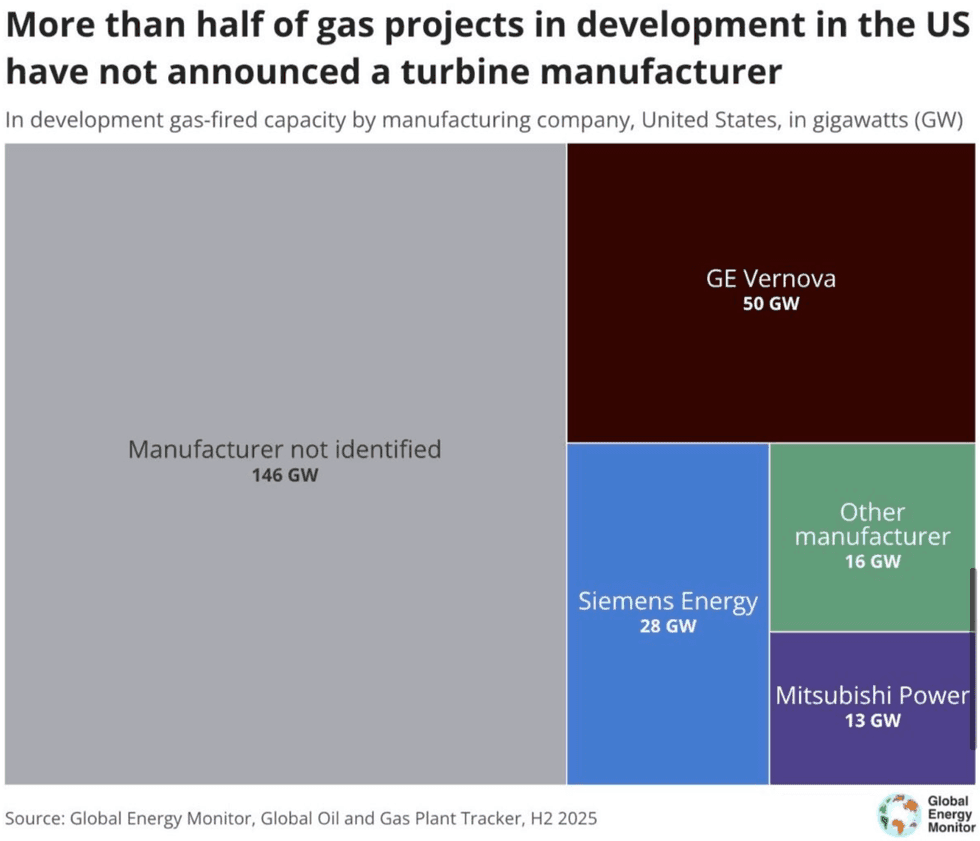
Take a look at the above chart. In the United States, new gas power plants are surging to meet soaring electricity demand. At last count, two thirds of projects currently underway haven’t publicly identified which manufacturer is making their gas turbines. With the backlog for turbines now stretching to the end of the decade, Siemens Energy wants to grow its share of booming demand. The German company, which already boasts the second-largest order book in the U.S. market, is investing $1 billion to produce more turbines and grid equipment. “The models need to be trained,” Christian Bruch, the chief executive of Siemens Energy, told The New York Times. “The electricity need is going to be there.”
While most of the spending is set to go through existing plants in Florida and North Carolina, Siemens Energy plans to build a new factory in Mississippi to produce electric switchgear, the equipment that manages power flows on the grid. It’s hardly alone. In September, Mitsubishi announced plans to double its manufacturing capacity for gas turbines over the next two years. After the announcement, the Japanese company’s share price surged. Until then, investors’ willingness to fund manufacturing expansions seemed limited. As Heatmap’s Matthew Zeitlin put it, “Wall Street has been happy to see developers get in line for whatever turbines can be made from the industry’s existing facilities. But what happens when the pressure to build doesn’t come from customers but from competitors?” Siemens just gave its answer.
4. Josh Shapiro pushes for ‘selective’ approach to data centers
At his annual budget address in Harrisburg, Pennsylvania Governor Josh Shapiro touted Amazon’s plans to invest $20 billion into building two data center campuses in his state. But he said it’s time for the state to become “selective about the projects that get built here.” To narrow the criteria, he said developers “must bring their own power generation online or fully fund new generation to meet their needs — without driving up costs for homeowners or businesses.” He insisted that data centers conserve more water. “I know Pennsylvanians have real concerns about these data centers and the impact they could have on our communities, our utility bills, and our environment,” he said, according to WHYY. “And so do I.” The Democrat, who is running for reelection, also called on utilities to find ways to slash electricity rates by 20%.
5. Consumer Reports’ top cars are all hybrids or EVs for the first time
For the first time, every vehicle on Consumer Reports’ list of top picks for the year is a hybrid (or available as one) or an electric vehicle. The magazine cautioned that its endorsement extended to every version of the winning vehicles in each category. “For example, our pick of the Honda Civic means we think the gas-only Civic, the hybrid, and the sporty Si are all excellent. But for some models, we emphasize the version that we think will work best for most people.” But the publication said “the hybrid option is often quieter and more refined at speed, and its improved fuel efficiency usually saves you money in the long term.”
THE KICKER
Elon Musk wants to put data centers in space. In an application to the Federal Communications Commission, SpaceX laid out plans to launch a constellation of a million solar-powered data centers to ease the strain the artificial intelligence boom is placing on the Earth’s grids. Each data center, according to E&E News, would be 31 miles long and operate more than 310 miles above the planet’s surface. “By harnessing the Sun’s abundant, clean energy in orbit — cutting emissions, minimizing land disruption, and reducing the overall environmental costs of grid expansion — SpaceX’s proposed system will enable sustainable AI advancement,” the company said in the filing.