
GLOBALVARS
0
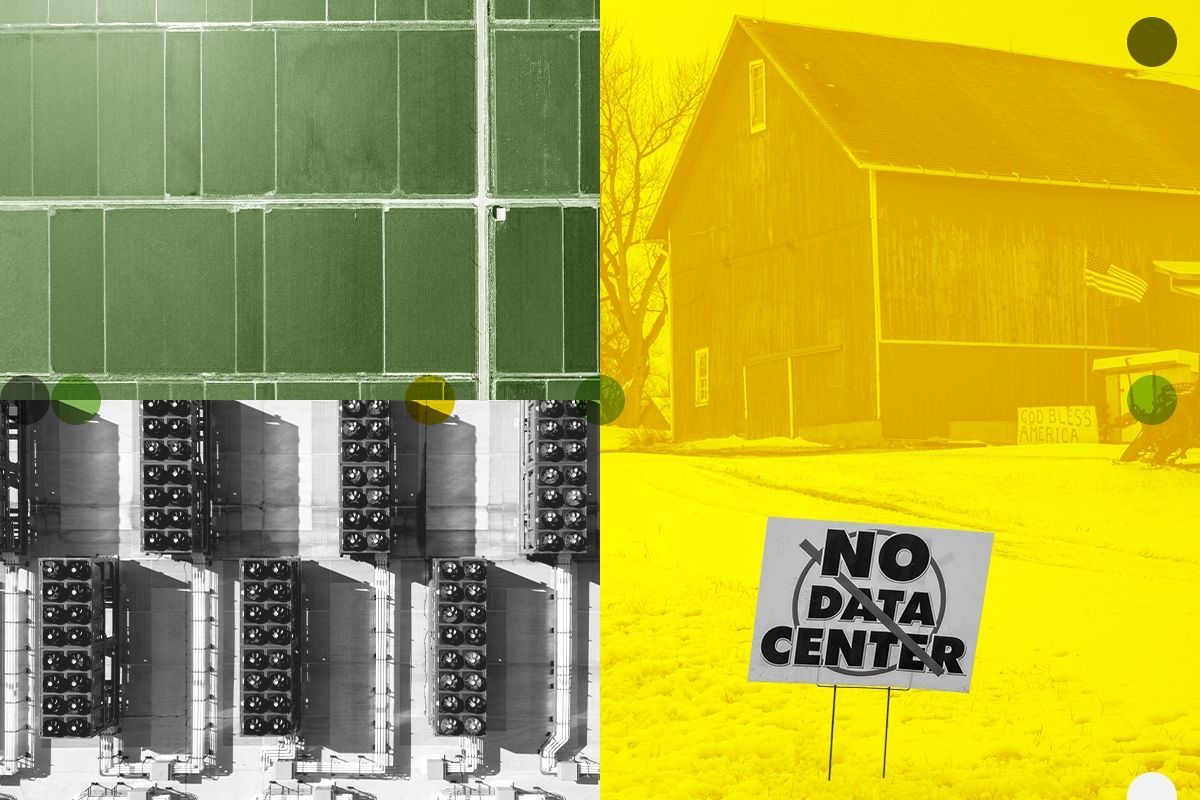
The movement against data centers is raising up a raison d'etre of the anti-renewables movement: protecting would-be farmland.
Farm owners and operators across the U.S. are winning national headlines almost every week for rejecting big dollar offers from data center developers. In Hanover County, Virginia, protestors are chanting “Grow Tomatoes, Not Data Centers.” In Pennsylvania and elsewhere, Republican legislators are mulling proposals to block the sale of so-called “prime farmland” for data center development. In Texas, the fight over data center development has engulfed the race for the state’s ag commissioner seat. In the Midwest, where agriculture reigns supreme, statewide races and congressional campaigns are slowly but surely being defined by the issue. Like in Nebraska where Austin Ahlman, an independent candidate running for Congress in Nebraska’s first district, told me he believes the data center backlash is reflective of a populist politics that broadly criticize elites and top-down control of the economy: “I think sometimes people misunderstand the anxieties of rural Americans when it comes to these data centers because a lot of their fears are about control long term.”
Unlike the farmland backlash around renewable energy development, the loudest critics are on the anti-monopolist left. On Wednesday, the prominent opposition group Food and Water Watch signaled farmland could soon be a watchword in the national data center debate – in a fashion analogous to what we’ve seen with renewable energy. The organization’s blog post entitled “The AI Data Center Boom Is Coming for Farmers” declared data centers verboten because of the threat they posed to “small and midsized family farmers.” Mitch Jones, deputy director of the campaign outfit, said he believes the threat to farmland is “a compelling reason to oppose data center development” but that his organization’s fight is primarily focused on protecting small business owners and an anti-monopoly sentiment.
“If data centers are coming into their areas, this puts even more pressure on them. It drives up the cost of their electricity, just as it does anyone else. It competes with them for water for crops, and it affects the value of their land in a perverse way,” Jones told me.
None of this should be surprising. An agricultural workforce has always been a good barometer for figuring out if a community will accept new infrastructure of any kind. We’ve seen as much time and time again with renewable energy, carbon capture, fossil energy and mining, just to name a few industries.
This same rule is true with data centers. In April, county commissioners in Kosciusko County, Indiana, unanimously rejected a Prologis data center; nearly 90% of acreage in Kosciusko County is being actively farmed, according to the Heatmap Pro database. Linn County, Iowa, in February enacted a rule severely restricting data center development in unincorporated areas; almost three-fourths of the land is used by the ag sector. A potential Amazon facility is causing heartburn in Clinton County, Ohio; nearly all land in the county is used for farming and utility-scale solar development has a recent history of conflict with landowners.
To be candid, I’m struck by the similarity in the backlash over siting data centers on farmland – a resemblance so close that some counties are starting to restrict renewable energy and data center development on farmland at the same time. This week, Eau Claire County, Wisconsin created a new “farmland preservation plan” discouraging utility-scale solar energy and data centers on any potential farmland. (More than 40% of land in this county is currently being used for farmland, according to Heatmap Pro.)
Jones at Food and Water Watch said his organization taking on the “protect farmland” mantle had nothing to do with the success this argument has had against renewable energy. “That thought never entered my head,” he told me, adding that if communities respond to the data center backlash by taking steps that short-circuit solar and wind too, that’s “a coincidence.”
I kept pressing. What if the pivot to farmland protection leads to more communities restricting renewable energy along with the data centers? “If you’re looking for a reason to oppose solar and wind, you can come up with that without having to attach data centers to it,” Jones said. “We’ve seen rural communities oppose solar and wind before data centers blew up across the country. It’s nothing new.”