
GLOBALVARS
0

Current conditions: Dangerous degrees of wildfire smoke swept into the Pacific Northwest, leaving air quality in fire-struck Spokane, Washington, at very unhealthy levels through midweek • Yesterday’s thunderstorms across the Northeast grounded flights and delayed thousands of passengers as key airports in New York City, New Jersey, and New England halted incoming arrivals for hours • Temperatures in Abu Dhabi are soaring to nearly 110 degrees Fahrenheit all week.
THE TOP FIVE
1. Rhine River’s water levels drop to lowest level since 1880
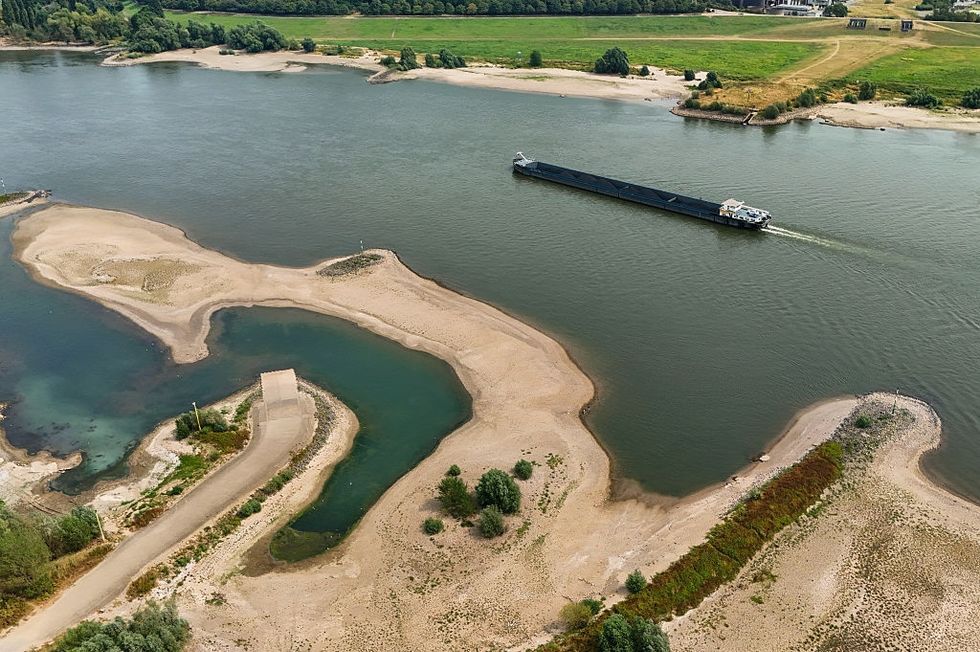
Europe’s rivers are running dry amid the prolonged drought and third major heat wave this summer. On Monday, the Rhine River’s water levels dropped to their lowest level in nearly 150 years, beaching cargo barges and jeopardizing output from the various thermal power plants that line the waterway stretching through France, Germany, and Switzerland. The water levels at Kaub, a key crossing for vessels heading to southern Germany and Switzerland, fell to 24 centimeters, the lowest level since records started in 1880, according to a Bloomberg analysis of German federal data compiled by the university ETH Zurich. In Eastern Europe, the Danube’s flow is so depleted that just one reactor at Hungary’s only nuclear station, the four-unit Paks plant, is operating — and only at 50% as cooling water dwindles, NucNet reported.
In Washington State, meanwhile, nearly 65,000 people have now been evacuated from the wildfires that incinerated almost 700 homes in the Spokane area with a “wall of flames.” As of Monday evening, the fire was still 0% contained, according to Fox 13 Seattle, a local broadcaster.
2. Texas puts a de facto data center moratorium in place
You might not think it, given the partisan politics of our age, but the governors of New York and Texas actually have a lot in common. New York Governor Kathy Hochul is a Democrat, and Texas’ Greg Abbott is a Republican. But they’re both pro-nuclear. They’re both up for reelection this year. And they’re both banning data centers, at least temporarily. Last month, New York became the first state to halt permitting on new, large data centers for a year. Now Texas has put approvals for new data centers on hold until the state’s power regulators and grid managers can audit existing facilities that are seeking to connect to the state’s grid. Until then, E&E News reported, “no more additional data centers can be approved or move forward until that process is over.” In a letter to both the Public Utility Commission of Texas and the Electric Reliability Council of Texas, Abbott wrote: “Any project that fails to comply with the requirements set forth by the PUC and ERCOT, and by state law, must be denied connection to the Texas grid. Simply put, Texans must come first.” On the local level, moratoriums on data centers blossomed in recent months, with more than 530 municipalities having slapped new restrictions on server farms, per a recent Heatmap analysis my colleague Robinson Meyer wrote.
Hochul, as our colleague Matthew Zeitlin wrote later last month, is “walking a fine line” with her moratorium, issued via executive order, especially as her administration seeks to appease renewables boosters who say she isn’t doing enough to speed up deployments of that kind of infrastructure. But blocking disfavored types of infrastructure is nothing new for the Texas GOP. Lieutenant Governor Dan Patrick is among the big names now trying to thwart a $33 billion transmission buildout in the state.
3. Exclusive: Microsoft inks another carbon removal deal, months after pause
Back in April, Rob broke news that Microsoft was pausing its carbon removal purchases. The break marked a major setback for a nascent industry that had come to rely on the tech giant as its biggest and deepest-pocketed source of demand. While the company never confirmed the pause, it appears to be ending. Last night, my colleague Emily Pontecorvo passed along a big exclusive for this newsletter: Microsoft is set to announce a big carbon removal purchase. CREW Carbon, the Brooklyn-based startup that permanently traps carbon dioxide using a limestone and wastewater mix, inked an offtake agreement with Microsoft for 23,602 “durable, verified” credits. CREW “uses strategically-sourced alkaline minerals, such as calcium carbonate, to optimize key conditions, like pH and alkalinity, in each wastewater treatment plant’s specific process to minimize the carbon footprint of plant operations,” the company said in a press release shared in advance with Emily.
Sign up to receive Heatmap AM in your inbox every morning:
* indicates required
Email Address *Our Privacy Policy & Terms Apply.
4. Valar Atomics raises $1 billion
As my colleague Katie Brigham reported last week, Commonwealth Fusion Systems made waves in the clean energy financing world for yet again raising an eye-popping $1 billion to commercialize fusion energy, notably bringing on institutional investors for the first time. Now another fission startup is bringing in a similar chunk of coin. California-based Valar Atomics just pulled in $1 billion to help bring its next-generation high-temperature gas-cooled microreactors to market. The venture capital giant Sequoia led the round, and added the firm’s Shaun Maguire to its board.
Even with progress on nuclear, the future for gas continues to look rosy. On Monday, Utility Dive reported that American Electric Power now has 13 gigawatts of gas turbine capacity in the pipeline.
5. Mexican aluminum recycler breaks ground on a new Texas plant
Zerluma, a Mexican aluminum recycler, has broken ground on a new $50 million facility in Mission, Texas, the San Antonio Business Journal reported. The deal in the city near Texas’ southern border, marks one of the largest private investments in the city’s history, according to the Rio Grande Valley Business Journal.
The agreement comes as the Trump administration seeks to support the opening of the first new American aluminum smelter in half a century, a project that — as you may recall — has attracted scrutiny from state Republicans in Oklahoma. The effort is facing yet more criticism. The Muscogee Nation’s National Council voted unanimously to approve a resolution opposing aluminum smelters on tribal land following the Trump-backed proposal for a $4 billion plant by Emirates Global Aluminum. Last month, city leaders in Port of Inola approved a 60-day moratorium on smelter-related construction, according to the Tulsa broadcaster News On 6.
THE KICKER
The United Kingdom has a coke problem: The snortable white stuff is too good and too cheap. So, what is a criminal enterprise that needs something tradeable of high value to do? Well, increasingly, they’re going for gold. Illegal gold mining has replaced cocaine as organized crime’s most profitable business, according to Mining.com. That has grave implications for human rights — and for communities in places such as the Amazon.