GLOBALVARS
TEST TEST TEST
0
Products
Current conditions: Heavy rain is overflowing rivers in the Dominican Republic’s eastern inland towns, including Monte Plata, where floodwaters are washing away cars • With weeks to go before the Atlantic hurricane season officially ends, a new tropical storm may be forming between the Bahamas and Bermuda • It’s cloudy and 51 degrees Fahrenheit in London, where the British are marking Guy Fawkes Day, a holiday commemorating the 421st anniversary of the failed plot by English Catholics to assassinate King James VI of Scotland and I of England by blowing up the House of Parliament.
THE TOP FIVE
1. What to make of Democrats’ blue tsunami
It’s a rebuke of President Donald Trump! A new era! A sign that President Lyndon B. Johnson’s prediction that the Democrats would lose the South until the end of young Bill Moyers’ lifetime (he died last year) was true! Maybe it’s all of these things. But one thing is certain: Democrats’ big victory Tuesday night halts what my colleague Robinson Meyer called “Trump’s energy revolution,” meant to defy the economics of renewables. There’s still much to dissect — we don’t even know who won shockingly competitive U.S. Senate races in Mississippi and Alaska. But my colleagues have a nice slate of stories to help us get started:
- Emily Pontecorvo and Jael Holzman took on the biggest question that now faces Congress: What will come of the bipartisan permitting deal?
- Matthew Zeitlin took stock of Wall Street’s winners and losers, as nuclear stocks suffer and solar stocks take off.
- It’s a Zeitlin double-header: Here’s his second piece from yesterday on the double-edged sword of high gas prices for Democrats.
- And Katie Brigham looked at what climate-tech investors who trained themselves not to call it “climate tech” are thinking now.
2. Oil prices plunge below $100 a barrel
Vice President JD Vance is openly blaming the Trump administration’s war with Iran for Republicans’ midterm shellacking, and Democrats are formulating a new approach after campaigning against the conflict and its associated energy shock. Iran, meanwhile, is signaling its openness to peace talks, even as Tehran turns to guerrilla tactics to regain control over the Strait of Hormuz. All that looks to oil traders like more crude hitting the market. On Wednesday, the price of West Texas Intermediate crude, the U.S. benchmark, fell more than 8% to $88 per barrel. Brent crude, the global price measure, plunged nearly 9% to just under $95 per barrel. Murban crude, the stuff that leaves a Persian Gulf port in the United Arab Emirates, dropped 1% to just under $101 per barrel.
3. Data centers’ electricity demand is mostly an American problem
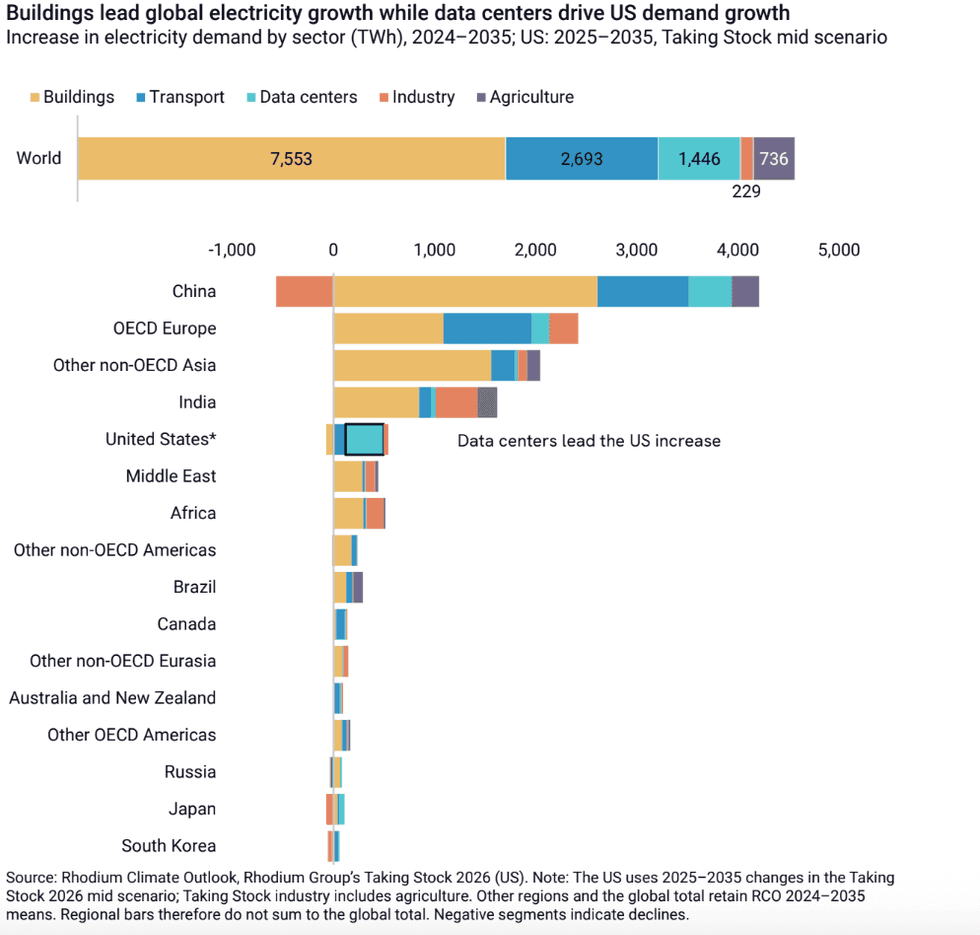
Big meals, big trucks, big computers — it’s the American way. Only one of those is a problem for electricity prices — a problem that’s also uniquely American. New projections from the Rhodium Group suggest that the U.S. is the only major market where data centers are the primary driver behind surging electricity demand, constituting between 62% and 77% of gross demand growth. In China, Europe, India, and the Middle East, residential and commercial buildings are by far the biggest new sources of demand for electricity to power air conditioning, heating, and appliances. Meanwhile, according to data from the consultancy Cleanview, upward of 41% of planned data centers in the U.S. are in states where newly elected governors are considering moratoria on new projects
.
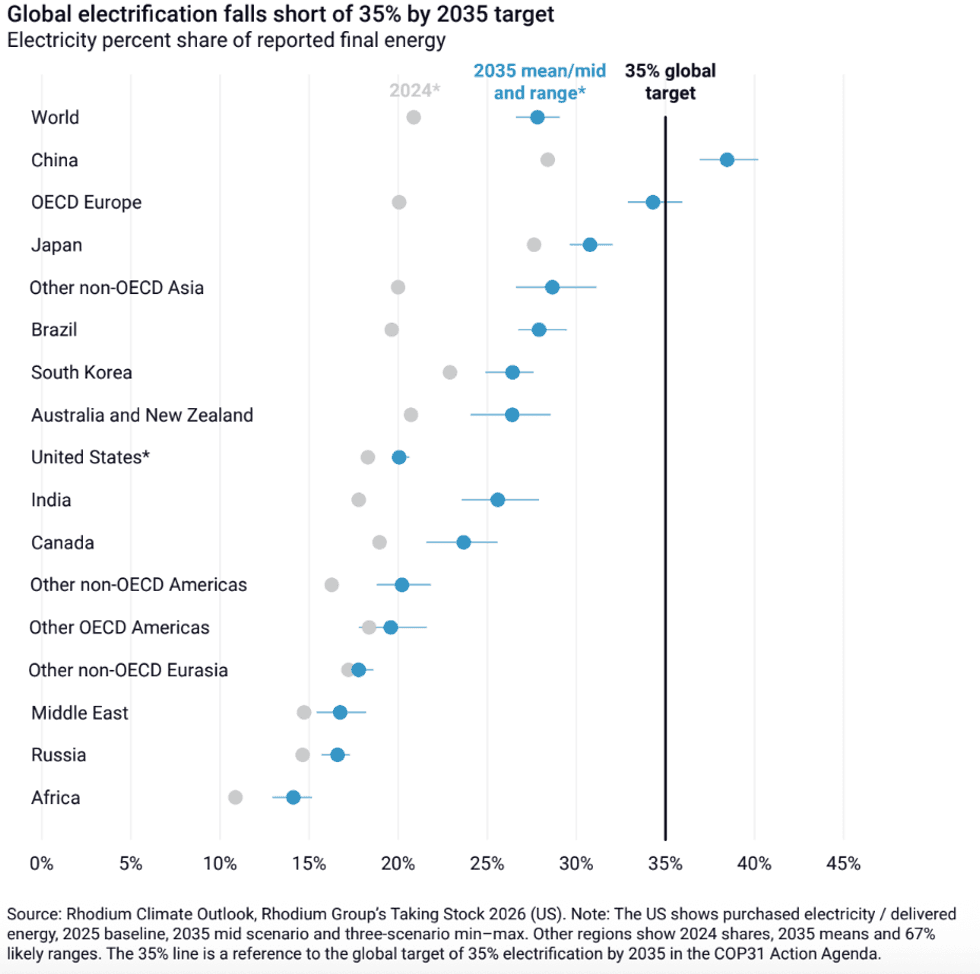
The Rhodium forecast also shows big global challenges for the fight to slow global warming. Electricity serves just 21% of the world’s end-use energy; by 2035, countries pledged to raise that figure to 35%. But the global average for electrification is on track to hit just 28% in the next nine years, threatening to maintain planet-heating pollution levels even as renewables surge and power emissions fall. Low-carbon sources of electricity are on track to generate upward of 80% of the power in China and the world’s richest economies, with variable renewables such as wind and solar producing the bulk of the output. Clean firm sources such as nuclear power and geothermal maintain a steady share of total output as variable sources eat into fossil fuels’ market. As a result, emissions shift to the parts of the world where fossil fuels will remain dominant. China and rich countries will account for 37% of emissions in 2050, down from 54% in 2024. India’s emissions will rise 26% by the middle of the century, and the entire African continent’s output by 37%. Worldwide industrial emissions are on track to stay static as the benefits of low-carbon steel are offset by the spike in production from coal-fired blast furnaces.
Sign up to receive Heatmap AM in your inbox every morning:
Email Address *Our Privacy Policy & Terms Apply.
4. Exclusive: U.S. creates a benchmark for testing what AI can do in a nuclear power plant
Whenever OpenAI or Anthropic releases a new model, the healthcare industry, say, can measure its capabilities by seeing how quickly it can pass a medical board test. Last year, the AI startup Atomic Canyon — which formed to help nuclear plant operators sift through mountains of documents using large language models — inked a deal with the Idaho National Laboratory to create a test that can check the software’s ability to work with a nuclear plant. Fourteen months later, the partnership has yielded results. On Thursday, I can report exclusively for this newsletter, Atomic Canyon is set to launch what it calls NuclearBench, the first open-source benchmark designed specifically to evaluate how LLMs perform on questions related to nuclear energy. “Think about it like an open-book exam for AI models,” Trey Lauderdale, Atomic Canyon’s founder and chief executive, told me. The company worked with INL to design a 280-question exam, which can then be administered to AI models, whose answers are judged by accuracy and context.
“As you’d expect, the more advanced models perform better. You’ve got OpenAI, Google, and Anthropic all vying at the top,” Lauderdale said. “Nothing we wouldn’t expect, but it’s nice to have actual metrics and information that validate general hypotheses you might have. You could instinctively say, This model is doing better. But it’s really important as an industry that you start benchmarking what these models can do.” Atomic Canyon’s test is not yet at the level of a medical board exam, he said. But the company plans to continuously update its exam to account for the growing sophistication of LLMs. Eventually, Lauderdale hopes to roll out more targeted tests focusing on safety and risk, reactor engineering, emergency preparedness, radiation, and other factors. “It’s the equivalent of the tests to become a general physician or those to become a cardiologist, dermatologist, or gastroenterologist,” he said.
5. Exclusive: U.S. startup eyeing 1.2 gigawatts of nuclear uprates gets a big endorsement
Last month, I told you when tech giants announced a series of deals to help fund “uprates” at existing nuclear plants, renovations that potentially squeeze hundreds of megawatts of new generation out of reactors that are already running. The deals with Google and Amazon looked to generate more than a gigawatt of new power through uprates across PJM Interconnection, the most stressed grid system in the U.S. Now a startup specifically designed to affordably uprate reactors is considering projects to generate as much as 1.2 gigawatts of new power out of existing plants — and it just received a major endorsement from a utility industry heavyweight. I can exclusively report that, on Thursday, the developer Alva Energy plans to announce that Jeff Lyash, the former chief executive of the Tennessee Valley Authority and Ontario Power Generation, would join its board of directors. Lyash has plenty of nuclear experience. OPG, owned by Canada’s most populous province, operates the second-largest nuclear fleet in North America after the U.S.-based Constellation Energy. It’s also building the continent’s first small modular reactor, the first of GE Vernova Hitachi Nuclear Energy’s 300-megawatt units. The federally owned TVA, from which Lyash retired last year following Trump’s return to the White House, operates three nuclear plants and is building what’s expected to be America’s first SMR, the second GE-Hitachi BWRX-300 after OPG’s project at its Darlington plant. Lyash will be the fifth member of Alva’s board. After former Intel CEO Pat Gelsinger, he’s the second to come from outside the company; the other three board members are Alva’s co-founders.
“What’s been pretty amazing is that we’re starting to attract top-tier industry talent,” James Krellenstein, Alva’s chief executive and co-founder, told me. “Jeff joining the board has been pretty transformational because he brings a massive amount of experience in modifying existing plants.” At OPG in particular, Krellenstein said, Lyash oversaw refurbishments of the utility’s CANDU reactors. He also sits on the boards of the utility Dominion Energy, the Canadian construction giant Aecon, the industrial conglomerate Curtiss-Wright, and the European reactor startup Newcleo, which Krellenstein said lends Alva greater insight into other sectors’ large-scale project management. “What the economy of the United States is looking for is sources of clean, 24/7 power. Nuclear power uprates are a way in the short term to get that demand fulfilled in the United States while simultaneously rebuilding the execution capability necessary to create new plants. That’s the exact scaling strategy that Alva is working on.”
THE KICKER
It’s no Norway, where electric vehicles make up nearly 99% of new car sales. But EVs’ share of Germany’s new car market soared to a record 37% last month, according to data from the country’s national motor vehicle authority, the Kraftfahrt-Bundesamt. That, according to Electrek, equates to 94,086 new battery-electric vehicles, up nearly 80% from the 53,425 sold a year earlier.