GLOBALVARS
0
Current conditions: More than 200 damaging wind reports from Missouri to Indiana came in so far this week as a series of storms wraps up over the Central United States • South Sudan’s capital of Juba is roasting in temperatures nearing 100 degrees Fahrenheit as heavy storms threaten to add to existing floods • Gale warnings are in effect in the Philippine Sea and the South China Sea as a northeasterly monsoon churns up winds of up to 40 knots.
THE TOP FIVE
1. Vineyard Wind enters into full service
And then there were three. Last month, Dominion Energy’s Coastal Virginia Offshore Wind started generating electricity for the mid-Atlantic grid just days after Orsted’s Revolution Wind entered into service off the coast of Rhode Island. Now a third U.S. offshore wind project is fully up and running. On Monday, Massachusetts Governor Maura Healey announced that Vineyard Wind had activated its electricity contracts with utilities, setting fixed prices for the 800-megawatt project 15 miles south of Martha’s Vineyard and Nantucket over the next 20 years. In a press release, Healey said the power purchase agreements will save Massachusetts ratepayers roughly $1.4 billion in electricity costs throughout these next two decades. “Throughout one of the coldest winters in recent history, Vineyard Wind turbines powered our homes and businesses at a low price and now that price goes even lower with the activation of these contracts,” Healey said in a statement. “Especially as President Trump is taking energy sources off the table and increasing prices with his war in Iran, we should be leaning into more American-made wind power.” Vineyard Wind first began selling power to the market in 2024, but at what The New Bedford Light called “fluctuating and at times higher prices.” As of this week and for the next year, the price will be set at $69.50 per megawatt-hour.
That hasn’t stopped the Trump administration from finding new ways to terminate other offshore wind projects. As I wrote yesterday, the Department of the Interior announced that two more projects — Bluepoint Wind off the coast of New Jersey and Golden State Wind off California — had taken the administration up on its offer to pay back the leasing costs up to a combined nearly $900 million in exchange for the developers abandoning the bids and agreeing not to pursue other offshore wind deals in the U.S. “We did not take this decision lightly,” Michael Brown, the CEO of Ocean Winds North America, told Heatmap’s Emily Pontecorvo in an emailed statement. “But when the underlying conditions in a market change, we must adapt. In this case, receiving a refund for the lease payments we had invested and exiting on agreed terms was the right outcome for our shareholders and partners.”
2. The UAE quits OPEC
The United Arab Emirates said Tuesday it would withdraw from the Organization of the Petroleum Exporting Countries, shrinking the world’s biggest oil-producing cartel to just 11 nations. The decision takes effect on May 1. The announcement came ahead of Wednesday’s latest OPEC meeting in Vienna. Abu Dhabi said it will also quit the broader OPEC+ supergroup that includes non-members led by Russia. In a post on X, Sultan Al Jaber — who serves as the UAE’s minister of industry and advanced technology, the chief executive of the Abu Dhabi National Oil Company, and the chairman the country’s leading clean energy firm Masdar — said his nation had “taken a sovereign decision in line with its long-term energy strategy, its true production capability, and its national interest.” The National, Abu Dhabi’s state-owned English-language newspaper, wrote that “independence from OPEC will give the UAE, which accounts for roughly 4% of global oil production, more flexibility and responsiveness in managing the oil market.”
Get Heatmap AM directly in your inbox every morning:
* indicates required
Email Address *Our Privacy Policy & Terms Apply.
3. Federal regulators carve out a new exemption for geothermal
The Interior Department’s Bureau of Land Management has issued a new categorical exclusion for geothermal, freeing developers from the requirement to carry out environmental reviews at yet another key step in the drilling process. The regulatory change marks the third new categorical exclusion for geothermal issued in the past two years. That comes after what Joel Edwards, the co-founder of the geothermal startup Zanskar, said in a post on X was a period of about 20 years “without any new” exclusions. In April 2024, pre-leasing and surveying got a categorical exclusion. In January 2025, a new categorical exclusion covered postleasing, drilling, and flow-testing on areas of up to 20 acres. Now this latest step will allow for an exemption on pre-leasing activities such as drilling up to 10 acres. “Very nice to see the agency continuing to streamline permitting,” Edwards wrote. “Still more bottlenecks to work out, but we’re moving in the right direction.”
On Tuesday, meanwhile, Senators Catherine Cortez Masto, a Democrat from Nevada, and Lisa Murkowski, a Republican from Alaska, introduced legislation to boost federal funding for next-generation geothermal research, development, and commercialization. “The U.S. is at the forefront of geothermal energy innovation, and this bill has the potential to strengthen global leadership, boost competitiveness, and accelerate the next generation of clean firm technologies,” Terra Rogers, director for superhot rock energy at Clean Air Task Force, said in a statement. “This nation has vast, underutilized next-generation geothermal and superhot rock potential.”
Sign up to receive Heatmap AM in your inbox every morning:
* indicates required
Email Address *Our Privacy Policy & Terms Apply.
4. The world’s largest battery maker inks biggest sodium-ion deal ever
CATL, the world’s largest battery market, has signed the world’s largest-ever order for sodium-ion batteries, the technology widely discussed as a potentially cheaper and more abundant alternative to the lithium power packs that propel electric vehicles and increasingly back up the grid. The Chinese giant inked a deal for 60 gigawatt-hours of batteries with the energy storage integrator HyperStrong. The deal marks what CATL calls proof that it has “overcome the challenges of the entire sodium-ion battery mass production chains,” prompting some experts to describe the agreement to Electrek as a potential “DeepSeek moment,” a reference to the Chinese artificial intelligence model that shook up the global industry with its affordability and nimbleness.
Sodium-ion batteries have seemed like the “next big thing” for years now, but as Heatmap’s Katie Brigham has reported, the industry has faced something of a curse when it comes to manufacturing, though new startups are attempting to overcome that problem.
5. Bangladesh’s first nuclear plant is getting ready to start up
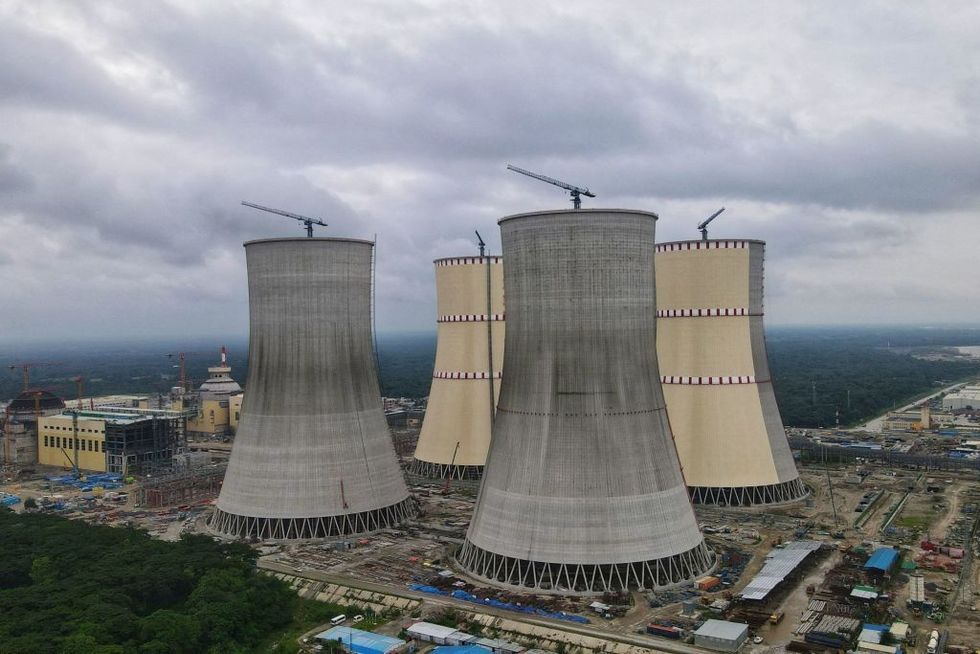
Fuel loading has begun at Bangladesh’s first nuclear power station. The uranium rods could be in place in the Rooppur Nuclear Power Plant, made up of two VVER-1200 reactors designed and built by Russia’s state-owned Rosatom, in as little as 45 days. The plant will vault Bangladesh into the group of 31 nations that harness the power of splitting atoms for electricity production. “Today, Bangladesh joined the club of countries using peaceful nuclear energy as a reliable source of sustainable development,” Rosatom Director General Alexei Likhachev said in a statement to World Nuclear News. “The Rooppur Nuclear Power Plant will undoubtedly become a vital element of the country's energy system. For Rosatom, this project is another important step in the development of global nuclear energy and in strengthening friendly relations with our international partners.” When the plant generates its first power for the grid later this year, it will complete a project first planned when the country was known as East Pakistan.
THE KICKER
When my high school girlfriend made my first Facebook account, I never imagined that, about 20 years later, the social network’s parent company would be trying to harvest electricity for its servers from outer space. But this week, Meta announced a deal with the startup Overview Energy, which aims to beam light from thousands of satellites to solar farms that power data centers at night, effectively making solar a 24-hour power source. Overview CEO Marc Berte said the goal is to launch the satellites by 2030, with what TechCrunch called “a goal of flying 1,000 spacecraft in geosynchronous orbit, a high orbit in which each satellite remains fixed above the same point on Earth.”