0

Current conditions: Illinois far outpaces every other state for tornadoes so far this year, clocking 80, with Mississippi in a distant second with 43 • Western North Carolina’s Blue Ridge Mountains face high wildfire risk during the day and frost at night • A magnitude 7.4 earthquake off the coast of Honshu, Japan, has raised the risk of a tsunami.
THE TOP FIVE
1. Whistleblowers allege big problems with corporate carbon standards-setter
The nonprofit that sets the standards against which tens of thousands of companies worldwide measure their greenhouse gas emissions is secretive and ideologically tilted toward industry. That’s the conclusion of a new whistleblower report on which Heatmap’s Emily Pontecorvo got her hands yesterday. The problems at the Greenhouse Gas Protocol “are systemic,” and the nonprofit “seems to be moving further away from its commitment to accountability,” the report said. Danny Cullenward, the economist and lawyer focused on scientific integrity in climate science at the University of Pennsylvania’s Kleinman Center for Energy Policy who authored the report, sits on the Protocol’s Independent Standards Board. Due to a restrictive non-disclosure agreement preventing him from talking about what he has witnessed, he instead relied on publicly available information to illustrate the report. “Not only does the nonprofit community not have a voice on the board,” Cullenward wrote, but the absence of those voices “risks politicizing the work of scientist Board members.” Emily added: “While the Protocol’s official decision-making hierarchy deems scientific integrity as its top priority, in practice, scientists are left to defend the science to the business community.” The report follows a years-long process meant to bolster the group’s scientific credibility. “Critics have long faulted the Protocol for allowing companies to look far better on paper than they do to the atmosphere,” Emily explains. But creating standards that are both scientifically robust and feasible to implement is no easy feat.
2. Federal court appears to end Trump’s renewables permitting embargo
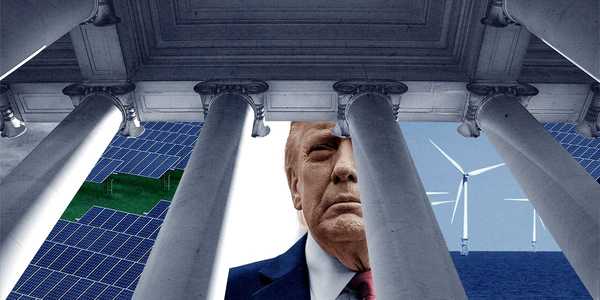
The Trump administration’s efforts to paralyze wind and solar permits are once again withering in the cold light of the court room. On Tuesday, U.S. District Judge Denise Casper ordered the end to a series of delays on renewable energy permits, delivering a victory to regional trade groups that had argued the administration was violating the Administrative Procedures Act by holding up approvals. Per Heatmap’s Jael Holzman, the ruling “is a potentially fatal blow” to “key methods the Trump administration has used to stymie federal renewable energy permitting.”
Sign up to receive Heatmap AM in your inbox every morning:
* indicates required
Email Address *Our Privacy Policy & Terms Apply.
3. GE Vernova says North America’s leading SMR project is on track for completion in 2030
In the race to build North America’s first small modular reactor, GE Vernova Hitachi Nuclear Energy is in the lead. Work is already underway on the world’s first deployment of the American-Japanese joint venture’s 300-megawatt boiling water reactor, the BWRX-300. The project at Ontario Power Generation’s Darlington plant is 38% done, and it’s on track to produce electricity by 2030, said Roger Martella, GE Vernova’s head of government affairs and policy. The remark, which Heatmap’s Matthew Zeitlin highlighted on X, came one day before the energy giant reports its latest earnings.
Meanwhile, one of Barack Obama’s early moves as president was to halt construction of the Yucca Mountain nuclear waste repository, effectively blocking any plan by the federal government to deal with radioactive spent fuel. Since then, no state has stepped up as an alternative; either way, federal law stipulates that the site in Nevada must be the United States’ first permanent tomb for nuclear waste. But what if nuclear waste wasn’t treated as waste at all? That was the Trump administration’s new pitch earlier this year when it invited states to submit applications to host so-called nuclear innovation campuses, sites where reactors, fuel enrichers, and waste recyclers can all set up shop. It’s a good sell. At least 28 states have so submitted applications, according to Exchange Monitor.
4. The U.S. government’s critical mineral reserve readies first funding
Project Vault, the effort the Trump administration set up to create a critical minerals reserve for U.S. manufacturers to weather Chinese trade restrictions on key metals, will soon close its first funding tranche. The program, announced in February, will combine $2 billion in private funding with a $10 billion loan from the Export-Import Bank of the U.S. The project “was not designed to be a stockpile alone,” John Jovanovic, the head of the Ex-Im Bank, told Reuters. “What it was designed to do was actually solve problems that the market faces … What we want to do is let it be dynamic and let it help try to solve a bunch of these problems.”
5. A California manufacturer may finally make perovskite solar a thing

“Perovskites hold a place of honor in the pantheon of much-heralded clean energy breakthroughs that have yet to actually arrive, alongside small modular nuclear reactors and solid-state batteries,” Canary Media reporter Julian Spector wrote yesterday. “In theory, these crystal structures could radically improve solar panels’ capabilities by absorbing wavelengths of light that conventional silicon cells can’t catch. But the stunning advances in R&D specimens have yet to infiltrate the cold, hard world of commercial solar manufacturing.” Until now, at least. On Tuesday, the startup Tandem PV officially opened its new factory in Freemont, California. The company aims to produce large panels of glass treated with a photovoltaic perovskite crystal coating that can increase how efficiently panels convert the sun’s rays into electricity by nearly 40%.
“We’re going to emphasize quality and speed over cost,” Tandem PV CEO Scott Wharton told Matthew last year. “If we do this right, then the theory is, we’ve become the next First Solar — that’s our intention. We want to take back solar leadership from China, which is a bold statement, but I think we’re on the journey.”
THE KICKER
Over the next three nights, an eye-popping 723 million birds are expected to be migrating across the U.S. In Michigan alone, at least 5.3 million birds are likely to fly overhead. “Most of these birds will be in flight while we sleep. They are guided by stars, the magnetic field, and sounds,” a meteorology account called Michigan Storm Chasers wrote on X. “You can help these birds migrate by turning off any unnecessary outdoor lighting, especially between the hours of 11 p.m. and 6 a.m.!”