0
President Trump’s Day One moratorium on offshore wind leasing and permitting was vacated by a federal judge in December. Weeks later, the president issued stop-work orders on five offshore wind projects that were under construction, citing unspecified national security concerns, but those orders were also soon rejected one by one by the courts.
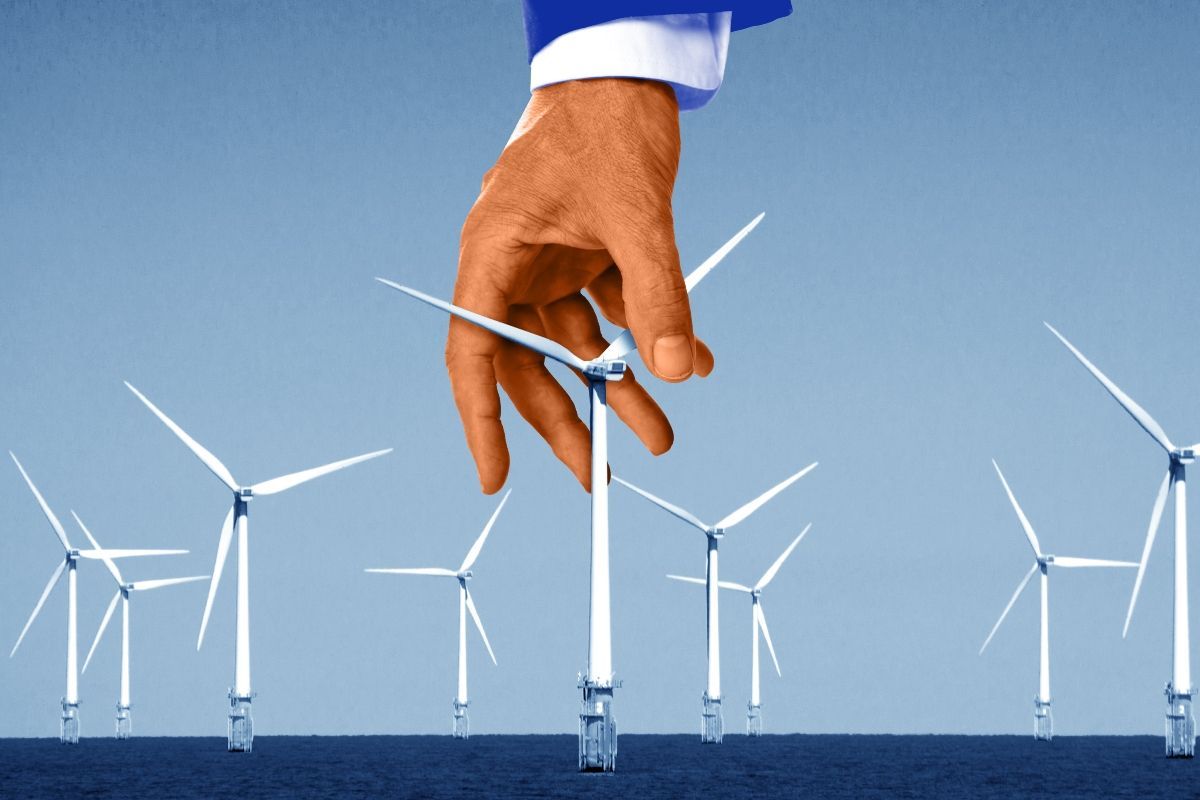
Trump’s agreement with TotalEnergies this week to buy back the company’s offshore wind leases appears to represent a new tactic to destroy the industry — by paying it to go away.
Total’s CEO, Patrick Pouyanné told CNBC yesterday that the company was the “first to open the door” to such a deal, and that he suspects the administration “will do other deals with other companies.” The U.S. has sold roughly 40 leases for offshore wind development since 2012, but only eight wind farms have gotten to the construction phase.
Even if other companies were willing to sell their development rights back to the federal government, however, there’s no reason to believe this strategy is any more legally sound than Trump’s stop work orders or permitting pause.
“In virtually all of the instances so far, they are taking steps that are unlawful and certainly unprecedented,” Elizabeth Klein, who served as director of the Bureau of Ocean Energy Management under President Biden, told me, referring to Trump’s efforts to obstruct offshore wind development. “So I don't think they should be given any benefit of the doubt that what they’re doing here is a lawful approach, or that they have the authorization to do what they are doing.”
Key details about the deal have yet to be disclosed, including under what authority the Department of the Interior has agreed to pay Total and where the money is coming from. Here’s what we know and don’t know about the agreement, and the questions it raises about whether this deal was lawful and whether it can be replicated. Neither TotalEnergies nor the Department of the Interior responded to questions for this story.
There’s nothing normal about a refund
According to the Department of the Interior’s press release announcing the deal, Total will invest $928 million — the amount it paid for two offshore wind leases in 2022 — in oil and gas production in the United States. Following those investments, the government will terminate Total’s wind leases and reimburse the company for the $928 million.
But the revenue the Department brought in from the 2022 lease sale is not just sitting in the agency’s coffers waiting to be refunded. It went to the Treasury’s General Fund, Klein, told me. The question, then, is what money is the agency using to reimburse Total?
“Has Interior been appropriated $1 billion to refund Total?” Klein asked. “Is there litigation that we all don't know about, and this is part of a settlement? There's a number of questions about how Interior is authorized to take this action.”
On its face, canceling a lease isn’t so extraordinary. The Secretary of the Interior is allowed to terminate a lease agreement if, say, the leaseholder violates the terms, and leaseholders are also allowed to voluntarily relinquish their leases. But in neither case does the law say they are entitled to their money back.
“There's no regulatory authorization that I am aware of that allows Interior to just refund the amount that a lease cost,” Klein said. She noted that Shell, the oil company, let go of almost all of its oil and gas leases in the Chukchi and Beaufort Seas during Obama’s presidency because it determined it could not economically develop them. The company had spent more than $2 billion on the leases and did not get any of that back.
All signs point to a legal dispute
A straightforward reading of the Interior Department’s press release sounds like the agency is taking revenue from an offshore wind lease sale and using it to subsidize oil and gas investments. That would be violating the U.S. Constitution, which says that “No money shall be drawn from the Treasury, but in consequence of appropriations made by law.” The Interior cannot just pay out $928 million in lease refunds or oil and gas subsidies to a company without Congress appropriating funds for that purpose.
That does not appear to be what’s happening here, given that Representative Chellie Pingree of Maine, the ranking member on the House Appropriations subcommittee that oversees the Interior Department’s funding, issued a statement saying that she has “serious questions about where this money is coming from.”
That leaves the other possibility Klein raised — a settlement. TotalEnergies does, in fact, describe the deal as a “settlement” in its own press release. During Pouyanné’s CNBC interview, the CEO claimed that after Trump paused permitting for offshore wind projects, Total issued an ultimatum.
“We went to the government: ‘Look, we could either go to litigate with you. I’d hate that. It is not at all our philosophy,’” he said. “‘Or we enter into a deal. The deal is quite simple. We propose to give you back this license. We paid the Treasury $930 million. You give us back the $930 million, and we are ready to commit that we will invest them in U.S. energy.”
If Total did indeed threaten to sue the Interior Department for halting permitting, the agency may have been authorized to pay Total out of the “judgement fund,” an essentially bottomless fund overseen by the Department of Justice intended for agency settlements. Use of the judgement fund requires evidence of litigation or imminent litigation and approvals from the Department of Justice and the Treasury Department. Considering that Attorney General Pam Bondi was quoted on the Interior Department’s press release, this appears to be the most likely source of the funds.
A settlement requires a valid claim
There are problems with this version of the story, too, however. Pouyanné said the company threatened litigation over Trump’s permitting pause, but again, a court tossed out that permitting pause in December. While the administration is appealing the court’s decision, the judgment weakens Total’s claim and raises questions about the Interior Department’s need to settle, let alone for $928 million. The court’s decision also undermines the case for future settlements with other leaseholders.
Tony Rich, a former solicitor in the Interior Department’s Division of General Law, told me that Pouyanné’s story brings to mind a tactic known as “sue and settle.” The term, which has historically been lobbed at environmental groups, describes a situation in which an interest group sues an administration — typically one friendly to its cause — as a way to advance policy goals without public input. Rather than try to dismiss the claim, the administration settles with the group behind closed doors, often agreeing to initiate new rules as a result. More conspiratorial critics of this practice contend that federal agencies have even colluded with outside groups to file such lawsuits.
There’s been more than a decade of debate over whether this perception of “sue and settle” cases is a real phenomenon or not. Nevertheless, Secretary of the Interior Doug Burgum vowed to address the issue by increasing transparency of agency settlements. Last summer, he issued an order stating that the department’s settlements would be subject to public disclosure. The order describes the creation of an online “litigation transparency portal” where the agency will post all ongoing and resolved settlement agreements, including finalized agreements.
That website has not yet been created, however. To date, nothing related to the Total settlement, if it is a settlement, has been posted to the Bureau of Ocean Energy Management webpages for the leases or in the Federal Register.
Without having access to that documentation, it’s impossible to scrutinize the circumstances that led the Trump administration to settle for such an exorbitant fee. To Rich, the available evidence is consistent with a misuse of power. “It upends the rule of law for agencies to selectively pay off favored parties negatively impacted by a policy choice by just calling it a legal settlement and using an unlimited account of taxpayer funds,” Rich said.