GLOBALVARS
0
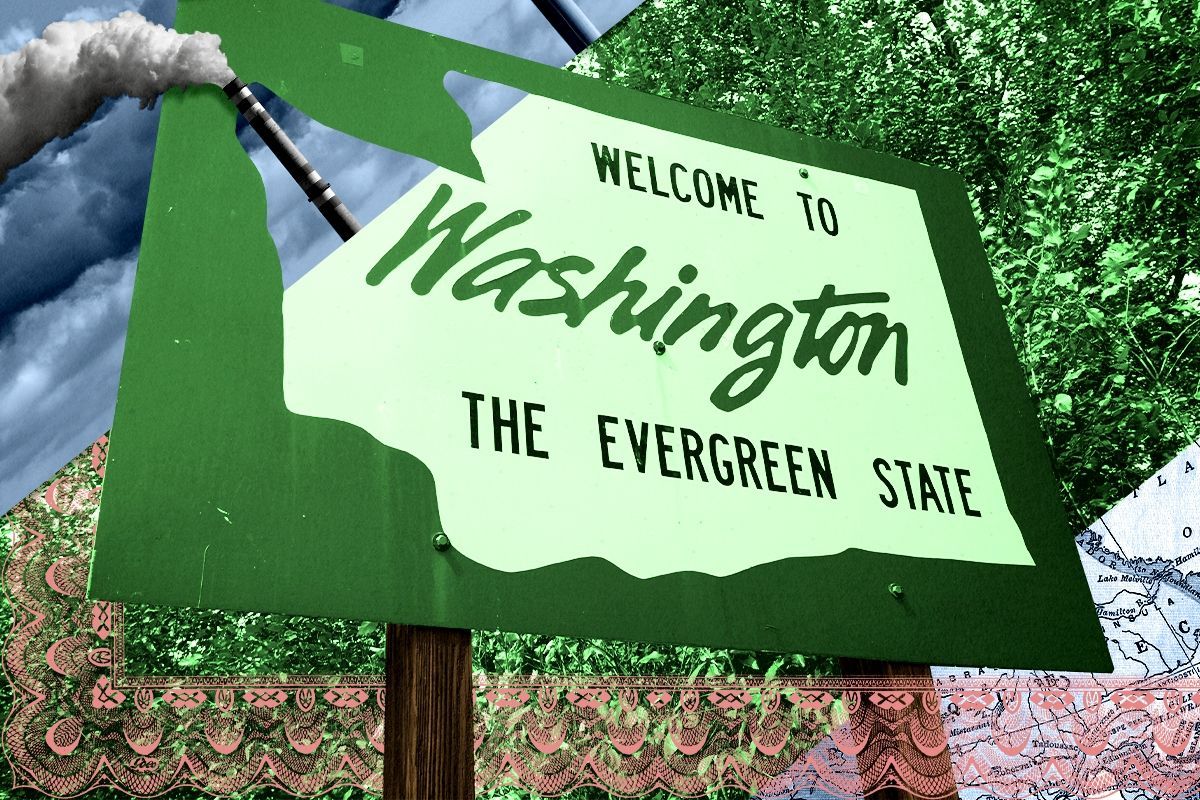
Washington State’s carbon market is about to get much bigger — and much cheaper.
In June, the state signed an historic agreement to link its cap-and-invest program with the California-Quebec market, which has operated jointly since 2014. The deal will further expand what’s already the world’s largest subnational carbon market, a move climate advocates are celebrating even as they expect it to lower Washington’s carbon price, and in turn the revenue it generates for statewide climate-related initiatives.
“Climate pollution does not stop at state borders or national borders, and so the more jurisdictions can work together, this is only a benefit for the climate,” Katelyn Roedner Sutter, California’s senior director at the Environmental Defense Fund, told me. “When you have a larger market, it is much more stable, it’s much more efficient, and you can achieve emission reductions at lower prices.”
At a moment when the Trump administration is actively rolling back federal climate policy, the linkage offers a glimpse of what states and regional governments can accomplish via cooperation. The newly expanded market is set to go live next year, once the jurisdictions complete a series of regulatory steps that will enable joint auctions. This involves regulators from all three regions selling an ever-declining number of emissions allowances — i.e. permits to emit a certain amount of greenhouse gas — at a single price to a shared pool of bidders spanning the U.S.-Canada border. Ultimately, the Western Climate Initiative — a name that’s stuck even as it’s expanded geographically — will cover 80% to 85% of each market’s total emissions, including those from transportation, heating, power plants, and industrial facilities.
While emitters aren’t thrilled by the idea of carbon pricing, Dallas Burtraw, a senior fellow at the nonpartisan think tank Resources for the Future, told me businesses in these regions are generally enthused by the market stability linkage provides. “They want reduced oscillations, reduced variability in what’s happening in climate policy,” he told me. “And I think linking with Washington adds a degree of credibility and certainty also to the California program.”
The idea is that the larger and more deeply integrated the markets become, the more durable they’ll be. Or as Burtraw put it, “it’s like joining rafts together in a storm.” Once businesses begin making long-term investments and building compliance strategies around a shared market — and state budgets come to depend on its expected revenue — it becomes much more difficult for a new leader to simply pull out.
Such a thing is not unprecedented — Ontario pulled out of the California-Quebec market at the beginning of 2018 after joining just six months earlier when a new conservative government took office and scrapped the program. But that type of political flip-flopping is unlikely in staunchly liberal Washington state, and the longer any jurisdiction remains part of a linked market, the more difficult it will become to unwind.
That’s proven true for the country’s only other major carbon market, the Regional Greenhouse Gas Initiative, which covers fossil fuel power plant emissions across 11 Northeastern and Mid-Atlantic states. The initiative, which has been in place since 2009, has weathered multiple gubernatorial transitions and party turnovers, as well as state exits and reentries. New Jersey and Virginia, for example, have each left only to later rejoin. But through all the churn, the core market has remained intact.
For its part, Washington has been ideologically committed to a regionally linked carbon market since it passed the Climate Commitment Act, its cap-and-invest law, in 2021. The legislation explicitly directed the state’s Department of Ecology to “seek to enter into linkage agreements with other jurisdictions” to expand emission-reduction opportunities and lower compliance costs. But because the market didn’t formally launch until 2023, after which the state spent years modeling the effects of linkage and gathering community input, the agency wasn’t ready to formalize the linkage agreement until this summer.
“We’ve never thought that Washington was a big enough economy on its own to sustain the kind of greenhouse gas reductions that our statute calls for,” Washington State Representative Joe Fitzgibbon told me. Those ambitious goals include complete decarbonization of the electricity sector by 2045 and a 95% cut in economy-wide emissions by 2050, compared to 1990 levels. “That was really only going to be possible in a linked market.”
Fitzgibbon, like most climate advocates in Washington, has been a vocal supporter of market linkage — even though it will mean less revenue for Washington. Analysts expect the state’s relatively high carbon price, which currently hovers around $60 to $70 per metric ton of greenhouse gas emissions, to converge with the much lower price in the California-Quebec market, which sits at around $28. Since the latter market is roughly five times larger than Washington’s, modeling indicates the combined price will settle far closer to California and Quebec’s current level than Washington’s.
Whatever the final figure, it is sure to be strikingly different from Resources for the Future’s estimate of the true social cost of carbon: $185 per metric ton. But while climate advocates might theoretically favor higher energy prices to incentivize emissions reductions, Burtraw argues that achieving climate targets as cheaply as possible is critical, particularly at a time when affordability concerns dominate the political conversation.
“Linking will help identify the most cost-effective way to achieve emission reductions, and that’s going to reduce the cost for households,” he told me.
Legislators like Fitzgibbon knew Washington’s model wasn’t tenable in the long run, which was why the state planned to link its market from the beginning. But in the meantime, it’s certainly enjoyed the revenue generated by these costly allowances, which have helped fund billions of dollars in clean energy and electrification projects, public transit, EV incentives, and targeted investments in the low-income communities hit hardest by pollution. Once linkage takes effect, a report by Resources for the Future indicates that Washington’s cap-and-invest revenue could fall by as much as $25 billion cumulatively by 2045, compared with a scenario in which the markets remained separate.
That’s something the state has long anticipated. “The goal of the program was always to be first and foremost an emissions reducing program, not a revenue generator,” Fitzgibbon told me. “We expected that the windfall that the state of Washington received in 2023 and 2024, when the program was new and when allowance prices were really high was a temporary thing, and we tried to spend the money on one-time expenditures.”
While he interprets the loss in revenue as a sign that the program is working as intended, he does acknowledge it will force some difficult decisions, likely involving cuts to the state’s Department of Transportation, which he told me has been the single largest beneficiary of allowance auction revenue.
The linkage tradeoff also extends to regional emissions. RFF projects Washington will emit an additional 8 million to 14 million metric tons by 2045 compared with an unlinked market, as lower prices encourage businesses to buy allowances rather than funding long-term emissions reductions strategies. The think tank forecasts that the state’s emissions will still decline overall, however. And because higher prices in California will drive deeper emissions cuts there, RFF estimates the linked markets will ultimately deliver more than 50 million additional tons of reductions overall, producing a substantial net climate benefit.
“Anything that one jurisdiction does by itself as an island will be important, will be valuable, but it will be insufficient to achieve the goal that motivates Washingtonians or Californians to take this policy initiative in the first place,” Burtraw told me, referring to slowing climate change overall. Progress on this front, he said, “can only be successful if these leadership jurisdictions are successful in propagating climate policy to other jurisdictions.” When I asked people which states they thought would be next to join, the most common answers were Oregon and New York.
Not all climate advocates are fully onboard with the linked market, though. Some environmental justice advocates argue it does little for the air pollution burdening their communities — because while regional CO2 emissions may improve overall, merging markets doesn’t guarantee reductions in pollutants with more localized effects, such as PM2.5, sulfur dioxide, or nitrogen oxides. That’s especially true in Washington, where emitters will soon have the option to purchase cheaper out-of-state allowances instead of cutting local carbon emissions — and the co-pollutants released alongside them.
The Department of Ecology’s report laying out the legal and technical case for market linkage states that the agency “did not find evidence that carbon markets exacerbate air quality disparities generally, nor that linkage specifically would exacerbate air quality disparities.” It also points out that Washington’s Climate Commitment Act still requires that at least 35% of its revenue benefits vulnerable populations in the communities most affected by pollution — though as noted, that revenue is set to decline sharply under the combined market.
At any rate, now that Washington, California, and Quebec have all signed the formal linkage agreement, the focus has largely shifted to the remaining regulatory to-do list. Washington’s rulemaking, which will make its program technically compatible with the shared market, is expected to wrap up next month. California has a longer process ahead: The governor must first certify that the state meets the legal requirements for linkage, triggering a review and rulemaking process at the California Air Resources Board, which could stretch into 2027. Quebec, meanwhile, must complete its own regulatory steps to formally recognize Washington’s allowances.
Legislators aren’t saying exactly when in 2027 they expect the market to launch. Caroline Halter, a communications manager at the Department of Ecology, told me it should happen before November, the deadline for Washington emitters to submit their allowances and offset credits from the previous four-year compliance period.
But the finish line is coming into view. And while debate over details remains, there’s broad agreement among market economists and most climate advocates that a larger, linked system is a net win for the planet. And the case for cooperation is only getting stronger.
“States and provinces working together to address climate pollution when we have this complete lack of leadership at the federal level — it is more important than ever,” EDF California’s Roedner Sutter told me. “This is the time for climate ambitious states to be joining forces.”