Current conditions: A nor’easter dumping as much as a foot of snow on parts of the Upper Midwest is set to dust New York City on its way to deliver heavier snow to northern New England • Temperatures nearly topped 90 degrees Fahrenheit in Charlotte Amalie, U.S. Virgin Islands, as America’s third-most populous overseas territory endures a record December heatwave • South Australia, Victoria, and Tasmania are all under severe fire warnings.
THE TOP FIVE
1. U.S. solar installations in 2025 set to beat previous year
It was the best of times, it was the worst of times, it was the age of smashing solar installation records, it was the age of phasing out the federal tax credits that so successfully spurred the boom in the first place. The United States added 2 gigawatts of utility-scale solar in September, bringing the total installed this year to 21 gigawatts. That, as Utility Dive noted of newly released Federal Energy Regulatory Commission data, is slightly above the 20 gigawatts installed in the same period last year. Of the 28 gigawatts of new generation the U.S. installed so far in 2025, 75% was solar, followed by wind at 13% and gas at 11%. Still, natural gas makes up the largest share of the U.S. grid’s electricity capacity, with 42% compared to the combined 31% that wind, solar, and hydro comprise. And the picture isn’t getting better. As Heatmap’s Jael Holzman wrote yesterday, the solar industry is “begging Congress for help with Trump.”
2. Idaho National Lab picks corporate partners for the government’s MARVEL microreactor
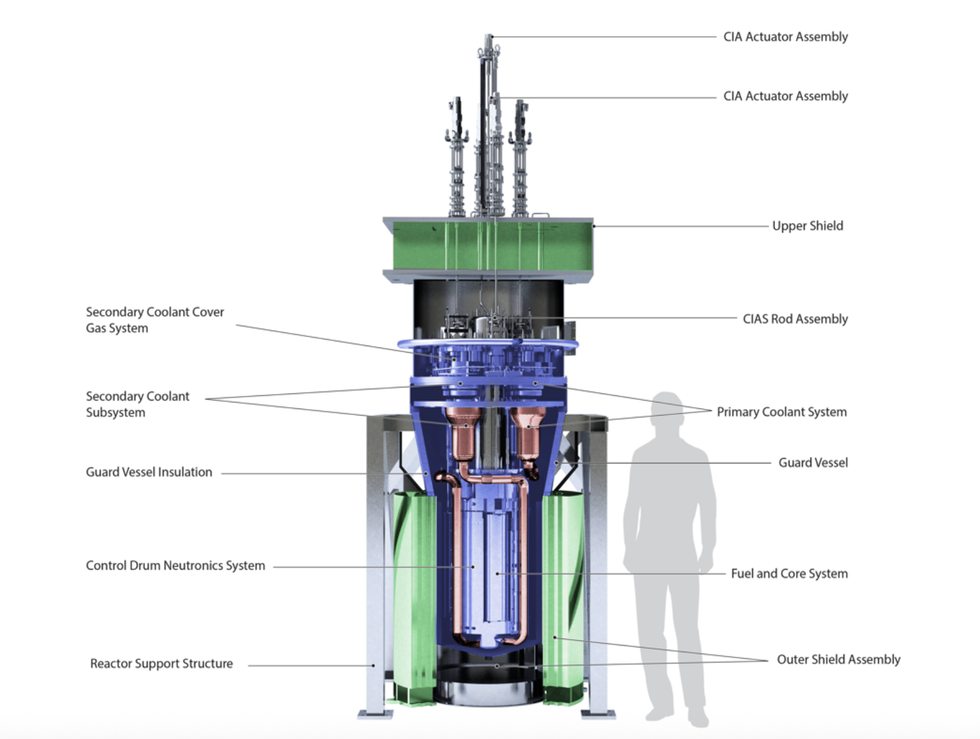
For the past four years, the Department of Energy has been developing its very own microreactor. The Microreactor Application Research Validation and Evaluation, or MARVEL, is a 10-kilowatt, liquid-metal cooled microreactor currently under construction at the Idaho National Laboratory. On Thursday, the lab unveiled the “first potential end users for MARVEL,” including Amazon Web Services, energy equipment giant GE Vernova, oil giant ConocoPhillips, and the data center operator DCX. “With access to MARVEL, companies can explore how microreactors will potentially help us win the global AI race, solve water challenges, and so much more,” John Jackson, national technical director for the microreactor program at the Energy Department’s Office of Nuclear Energy, told Power magazine. “The MARVEL testbed exemplifies how nuclear energy can open the door to a stronger, safer and more prosperous future for our country.”
It’s part of the strides the Trump administration has taken on nuclear power recently. Earlier this week, as I wrote here, the Energy Department awarded $400 million each to two small modular reactor projects aiming to build the first lower-powered versions of third-generation units based on the light water reactors already in operation today. Last month, as I covered in this newsletter, the agency put up a $1 billion loan to fund the restart of the working reactor at the Pennsylvania plant once known as Three Mile Island. There is, after all, what Heatmap’s Katie Brigham called a very “real” nuclear dealmaking boom afoot.
Get Heatmap AM directly in your inbox every morning:
3. Top journal retracts landmark study warming of climate catastrophe
The prestigious journal Nature has retracted a study published last year that concluded that climate change would cause a catastrophic drop in economic output of 62% by the end of the century, a jarring finding taken so seriously that central banks worked the warning into risk-assessment models. But a team of economists noticed an error in data from Uzbekistan. Excluding the Central Asian republic from the calculation pegged the predicted plunge in economic activity at 23%. That doesn’t mean climate change isn’t an economic threat, as the papers detractors noted to The New York Times. “Most people for the last decade have thought that a 20% reduction in 2100 was an insanely large number,” said Solomon Hsiang, a professor of global environmental policy at Stanford University who in August co-wrote the critique of the original study. “So the fact that this paper is coming out saying 60% is off the chart.”
Sign up to receive Heatmap AM in your inbox every morning:
4. Data centers could spur 600,000 jobs in home energy upgrades
The advocacy group Rewiring America is out with an interesting new thought experiment on the potential benefits of making the country’s households more energy efficient as a means of clearing space on the grid for data centers. Upgrading U.S. houses, condos, and apartments with efficient appliances, solar panels, and batteries could create enough capacity to meet the rising electricity demand of large data centers over the next five years. Doing so would create more than 600,000 jobs for carpenters, electricians, and others involved in the supply chain. Virtual power plants — software systems that allow utilities to pay homeowners for the right to tap into rooftop solar panels, batteries, plugged-in electric vehicles, and smart thermostats to balance the grid — are, advocates say, emerging as a potential source of large-scale power that can be harnessed in the next few years, a timescale relevant to many data center projects that are expected to complete construction before new power plants can come online.
5. Eavor’s next-generation geothermal plant enters into commercial operation
Back in October, I told you the next-generation geothermal startup Eavor was on the brink of completing its first power plant south of Munich, Germany. Now the Calgary-based company has entered into commercial operation. Eavor officially delivered its first electrons to the German grid from its facility in Geretsried. Eavor hailed the milestone as proof not just of its potential to operate a generating plant but a victory for its in-house drilling technology designed to carve a closed-loop well deep underground. “With Geretsried now on-stream, we’re more confident than ever that our closed-loop geothermal system, designed for adaptability and suited to the world’s diverse regions, will secure its place as the leading solution for commercial geothermal application,” CEO Mark Fitzgerald said in a statement. It’s not the only geothermal startup making waves. As I wrote in yesterday’s newsletter, Zanskar, the Salt Lake City-based company using artificial intelligence to find new conventional geothermal resources, just claimed one of the biggest discoveries in the U.S. in more than 30 years.
THE KICKER
You may also recall another newsletter from October where I told you that all Trump’s nominees to serve on the board of the Tennessee Valley Authority vowed to stand against privatizing the federally-owned utility, easing fears that the president’s recent boardroom meddling wasn’t an attempt at selling off the power provider on which more than 10 million Americans depend for cheap electricity. If you agree with analyses showing public ownership as the best way to keep prices down, then I have good news for you. When businessman and Republican megadonor Lee Beaman came before the Senate for a confirmation Wednesday, the nominee for the board said his preference for private enterprise came with an exception for the TVA. “Although I generally believe that the private sector is more efficient than government, in the case of TVA, I think TVA is more uniquely, appropriately operated as a government entity,” Beaman told the Senate Environment and Public Works Committee, per E&E News.