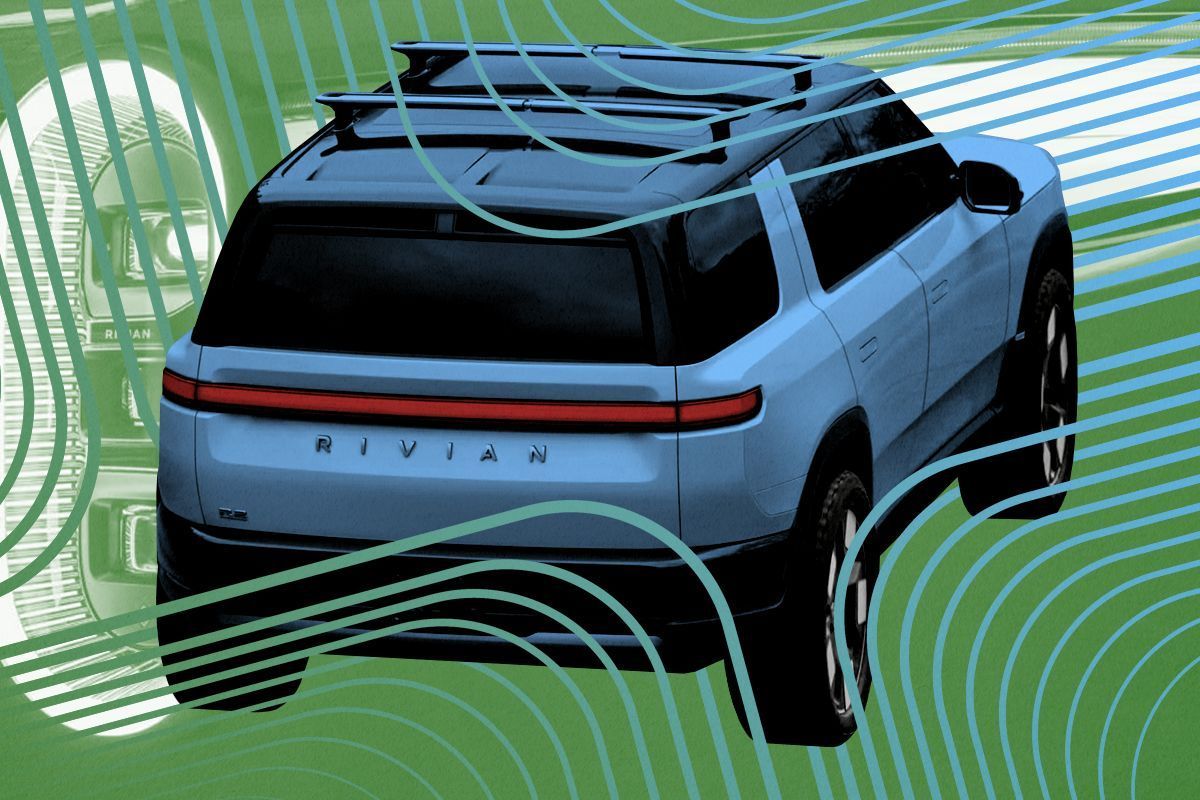
When Rivian revealed the R2 back in the spring of 2024, the compelling part of the electric SUV was price. The vehicle looked almost exactly like the huge R1S that helped launch the brand, but scaled down to a true two-row, five-seat ride that would start at $45,000. That’s not exactly cheap, but it would create a Rivian for lots of drivers who admired the company’s sleek adventure EV but couldn’t afford to spend nearly a hundred grand on a vehicle.
But at the company’s “Autonomy and AI Day,” held on Thursday at Rivian’s Palo Alto office in the heart of Silicon Valley, company leaders raised the expectations for their next vehicle. R2 wouldn’t just be the more affordable Rivian — it would be the AI-defined car that vaults them into the race to develop truly self-driving cars.
First, the hardware. Rivian said that the R2 will come with 11 camera and five radar units spread around the vehicle to improve the car’s ability to comprehend the world around it. But the crucial, headline-grabbing addition is a lidar, or light-based radar, unit. Lidar shoots laser pulses and measures the time it takes for the reflected light to return, thereby building a three-dimensional picture of the environment it surveys.
Those twirling bobs you might have seen on the top of Waymo’s driverless cars as they roam the streets, mapping the world around them, are lidar. The technology’s ability to see the world in detail across distances is necessary for the upper levels of automotive autonomy — the ones where the car can basically do it all and the humans can take their hands off the wheel and their eyes off the road.
Lidar units to date have been large and expensive, which is one reason they’re seen in pods that protrude from the top of a vehicle. Rivian, however, figured out how to mount one within the vehicle, in the area at the top of the front windshield near the rear-view mirror. The forward-facing lidar gives the vehicle 300 meters of forward vision. Demos the company showed during autonomy day revealed just how much more a constellation of cameras, radar, and lidar can see than a system without lidar, especially in dark or foggy conditions.
The other “wow” reveal on Thursday was that the R2 will process all that camera data on a chip that Rivian built from scratch to handle the AI and autonomous driving workload of its vehicles, rather than sourcing chips from some other tech company. CEO R.J. Scaringe said during his presentation to open the event that this kind of vertical integration was meant to allow the company to keep pace with the AI race as opposed to having to work with whatever third-party components it could get.
The result is a leap forward in capability over what Rivian offered with the R1S SUV and R1T pickup truck. Those vehicles had a hand-free system that let the EVs drive themselves with minimal human oversight on a little more than 100,000 miles of roads that were well-marked and well-mapped. James Philbin, the vice president of autonomy and AI, promised on Thursday that the lidar and processing improvements would allow hands-free driving on more than 3 million miles of roads — basically anywhere that the lines on the highway are clear enough for the R2’s cameras to see. And what’s next, Rivian promises, is true autonomy. The SUV will drive itself entirely from point to point when the conditions allow, and as the AI continuously improves over time, you might eventually see driverless Rivians out there competing with the likes of Waymo.
All this stuff costs money, of course. The Rivian Autonomy+ package would add $2,500 or a monthly fee of $50 to the purchase price. But the fact that this tech is coming to a car that starts in the $40,000s is telling. It is how many people will get their first taste of true vehicle autonomy.
Thursday’s event wasn’t all about self-driving, either. Rivian also built an AI software assistant for the cabin that can be summoned with a “Hey Rivian” and perform all kinds of in-car functions, such as changing the driving mode or adjusting the climate control. The achievement here is one of natural language. In Rivian’s demos, the assistant could ably fulfill the driver’s wishes with a command like “make it a little toastier in here” as opposed to formal instructional language like “turn the driver’s temperature to 70 degrees and set the seat heater to level one.”
At times this feels unnecessary, like AI looking for something to do to justify its existence. It doesn’t take that many button-pushes to alter the climate, after all. I admit, though, that having test-driven Rivians on road trips this summer, one of their weak points is my struggle to remember exactly which menu contains which controls. AI, in a way, helpfully solves a problem created by the modern EV that has amazing capability, but routes that capability through a large touchscreen that’s annoying (and dangerous) to navigate while driving.
Rivian is playing catch up with Tesla when it comes to autonomy, of course, as Elon Musk’s company has been touting its Full Self Driving feature for years and is now building the Cybercab, which is meant to be a car that humans will never drive. But Tesla has struggled to meet its timelines and targets for autonomous systems, giving rivals like Rivian a window to develop their own technology.
And so, what’s clear after Rivian’s event is that car companies, especially EV makers, are going to be key players in this autonomy and AI age. Nowhere was it written that electric vehicles had to be synonymous with self-driving vehicles. Battery-powered cars could be dumb and not smart, ruled by buttons instead of touchscreens. It just so happens that EVs are finally coming of age during the simultaneous ascent of artificial intelligence — and that the leading EV-only startups are Silicon Valley tech companies, or at least started out that way.
Tesla has forgotten about acting like a car company and staked its future on being the one that will crack true self-driving and reap the windfall. Rivian, which hadn’t made nearly as much noise about AI and autonomy before this week, has put forth a compelling case for its in-house autonomous systems and AI models, ones that will continue to improve as they’re trained on data provided by thousands of R2s hitting the road starting in 2026.