GLOBALVARS
TEST TEST TEST
0
Products
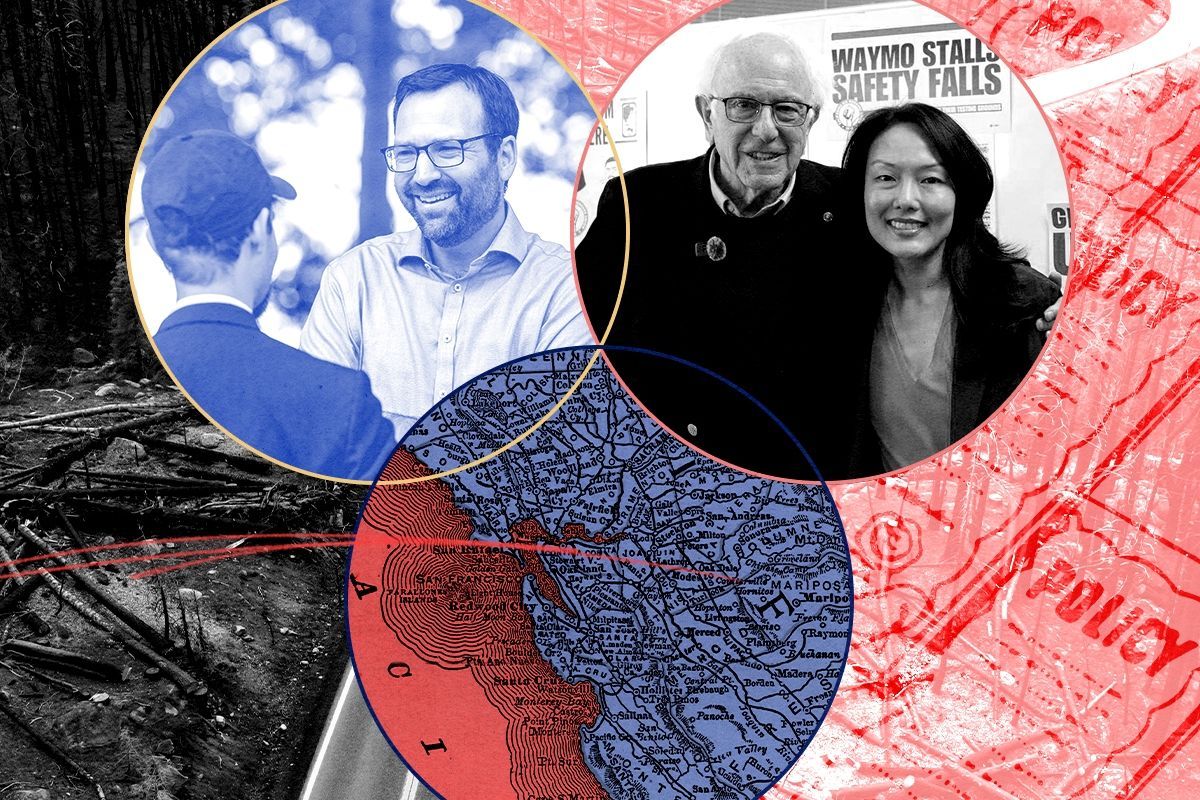
From Crescent City to Coronado, California voters are facing decisions on a down-ballot strewn with over a dozen propositions and a series of statewide Democrat-versus-Republican races with mostly foregone conclusions.
And then there’s the insurance commissioner.
In the race to oversee California’s insurance market, a $452 billion-in-premium-volume monster imperiled by insurer defections and disaster risks, Democratic State Senator Ben Allen, whose district includes Pacific Palisades, is facing off against Jane Kim, a progressive former San Francisco supervisor.
Kim has the support of Vermont Senator Bernie Sanders — it’s the first thing you see about her when you Google her campaign. She previously served as his California political director during the 2020 presidential race, and she appeared earlier this month at an event with the senator in support of the state’s proposed billionaire wealth tax.
Allen, by contrast, won the endorsement of the state’s Democratic Party and its two incumbent senators.
There has been little public polling of the race, but one September survey showed Kim leading Allen 25% to 18%, with more than half the electorate undecided.
“My opponent and I are not even running for the same office,” Kim told me. “He’s running for what this office used to be, and I’m running for what this office could be.”
Allen wasn’t worried about Kim’s characterization in my interview with him, telling me, “I want to fix the market that we have and make it work. My opponent wants to build a new state insurer that nobody has priced.”
Nowhere are the stakes of insurance regulation higher than in California. On its own, the state’s insurance market would be the third largest in the world, according to the National Association of Insurance Commissioners. Homeowner insurance premiums have risen 84% from the end of 2020 to March 2026, according to research from Stanford’s Climate and Energy Policy Program. Several large insurers have either left the market entirely or stopped writing new policies.
California’s creaky and complex regulatory environment for insurers has combined with its famously flammable environment (all beset by a warming climate) to put regular policyholders at risk of losing their policies or bailing out those who can’t get covered. “Climate risks grow, and our mechanisms for dealing with it lag behind,” Matt Weiner, the chief executive of the wildfire policy group Megafire Action, told me. (Weiner said he was supporting Allen in his personal capacity).
Rates for homes insured by the FAIR Plan, the barebones insurer of last resort, have more than doubled from about 2% to 5% over that same period, with FAIR Plan coverage spreading from just high-risk areas to even areas with low and moderate wildfire risk. The plan required a $1 billion assessment from the state’s insurers in 2025 following major Southern California fires. “This trend is a symptom of many homeowners’ inability to secure insurance in the conventional market,” according to the Stanford researchers.
Allen seeks to make the insurance market work better, building on reforms implemented by current Insurance Commissioner Ricardo Lara. Allen described the reforms, which encourage insurers to write policies in high-risk areas and allow them to use forward-looking projections, as a “bit of a band-aid” that doesn’t “actually get to the core of the problem, which is making these communities less risky.”
Allen’s plan for the California insurance market involves both reviewing rate proposals more quickly, incorporating more data into those rates (which may push rates up, but also keep insurers in the market), and mobilizing the whole of government to invest in home hardening and resilience to lower risk and bring premiums down. Allen wants to, well, insure “that risk reduction is actually incentivized and rewarded by the insurance market,” he told me.
This would mean that “there will continue to be certain properties that are going to be so high risk that they really will and ought to be paying significantly more than everybody else,” he added.
When I asked him to elaborate on his vision for California’s insurance future, he told me, “My hope is that when a family and a neighborhood commit to hardening defensible space and community-scale mitigation, that should show up on the bill.”
Jane Kim, on the other hand, is interested in an insurance revolution, which would require — as her most famous supporter might put it — a political revolution as well. Her centerpiece proposal will be familiar from anyone who has followed Sanders’ career: a single-payer disaster insurer.
The plan, which she told me was a “concept and a proposal,” would be funded by a levy placed on insurers, and then a public insurer would invest in the market, buy reinsurance, and pay out claims. (Her opponents have criticized her for not being forthcoming enough with details). She says her plan would not be able to cover a Palisades- or Altadena-level fire in its first year, “but no insurance company can cover a catastrophe of that level.”
The nonprofit nature of the program, she adds, would let the state fund mitigation work directly. While such a program would require legislative action, “the great thing about campaigns is that this is trying to debate big ideas with voters,” Kim said.
In response, Allen cited a report from the California Earthquake Authority, which modeled a state disaster insurer (albeit not Kim’s plan specifically) could require $25 billion in capitalization. A more thinly capitalized insurer could mean $2,000 assessments on every policyholder in the state to cover an extreme wildfire disaster, the report said. “That’s the honest price of what she’s proposing,” Allen said.
“I also have a plan that’s actually grounded in reality and fixing the problems right now. It's not based on some pie-in-the-sky set of ideas that have no precedent, that have no real meat on the bones,” Allen told me.
One of Allen and Kim’s former opponents, Patrick Wolff, who fell short in the top-two primary election in June, told me that “the charitable interpretation of Kim’s platform is she does not think the current system can be made to work, and so she essentially wants to redesign and reimagine the entire system.” (Wolff has endorsed Allen). But, he added, “she’s coming at it from a set of solutions that were baked-in before she started, and then she's fitting [those] into her campaign.”
Moira Birss, a senior fellow at the Climate and Community Institute who said she had “provided input” to Kim’s campaign, but wasn’t speaking on its behalf, told me she “really recognizes that we are yet again in a situation where the private insurance market is not responding to a need that we as communities and as society have for this financial safety net of disaster insurance, and that we need a public approach.” She said the plan would build on lessons learned from New Zealand, which has public natural disaster insurance funded through a levy on fire insurance, and from the National Flood Insurance Program and the FAIR Plan.
Kim is happy to embrace the more ideologically charged vision of her campaign, telling me, “I am talking about transforming this office to be a place where we are leading on, and taking on, economic inequity, a wealth gap, and the climate crisis.
“I don’t even view my opponent as Ben Allen — I’m not running against Ben Allen,” she went on. “I’m running against the status quo.”