
GLOBALVARS
TEST TEST TEST
0
Products
Current conditions: An ill-timed and dense fog blanketed Toledo yesterday amid an industrial chemical leak, with the low-lying cloud acting to trap the toxic glycidyl methacrylate in the air, forcing an evacuation • Super Typhoon Champi has become the most powerful storm of 2026 as it roars westward across the Pacific to Taiwan, leaving a damaged Guam in its wake • After Polo, Simon, Rachel, and Trudy, yet another tropical depression capable of striking western Mexico as a major hurricane has formed in the eastern Pacific.
THE TOP FIVE
1. ‘This is how you blow up a permitting deal’
That’s the money quote Politico nabbed Wednesday from Senator Sheldon Whitehouse, the Rhode Island Democrat who helped broker the Senate’s grand compromise to ease federal permitting on energy projects. The statement came a day after the Department of Justice filed a petition to reopen the permits on New England Wind, the 2.6-gigawatt offshore wind project from Avangrid. Just over a week ago, the Trump administration restarted a legal fight with Orsted over Revolution Wind, which is already generating electricity off the coast of Rhode Island. At the time, some White House observers saw the effort as President Donald Trump’s hard-nosed negotiating, designed to pressure skeptical Democrats into voting for the legislation lest the administration continue going after projects that the bill, if passed, would protect. But Ira Joseph, a fellow at Columbia University’s Center on Global Energy Policy, saw the latest move as evidence Trump can’t control his impulse toward vendetta. “An inevitable turn. It’s always personal and never about what policy would either benefit or hurt the public,” he wrote in a post on X. “Wind will always be associated with harming the family business. It’s always a King Claudius situation and he or she who whispers last, whispers loudest.”
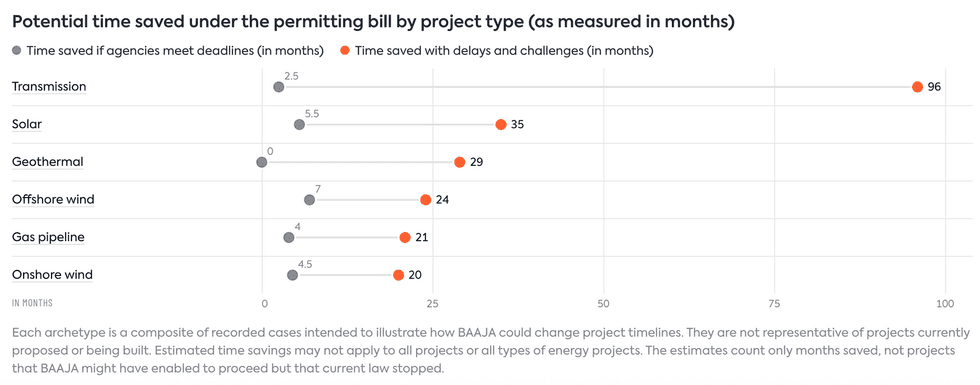
Joseph’s colleague at CGEP, Jack Andreasen Cavanaugh, is out with a new tool to estimate how much time the Bipartisan American Affordability and Jobs Act would save various kinds of clean energy projects. The results are pretty staggering. Transmission lines alone could save eight years by avoiding the delays and challenges opponents can currently lob against a project.
2. Commerce Department cracks down on dozens of solar importers
When the Department of Commerce enacted new trade restrictions on polysilicon in August, the agency gave the industry a 120-day head start to prepare for the policy to come into force. To prevent importers from stockpiling foreign solar panels and components, the Commerce Department promised to remain vigilant. The crackdown is underway. In a note to investors this week, Roth analyst Philip Shen said the agency has blocked roughly 60 importers over the past several weeks, including 10 just this past week. Prior to the Commerce Department’s Section 232 decision, the U.S. had roughly 200 approved importers bringing in solar panels.
The number of solar importers more than doubled over the past few months to more than 400 total. Roth’s memo highlighted speculation that the Commerce Department could dampen its 232 policy, giving utility-scale developers a carveout or delaying the implementation on December 3, when the 120-day waiting period ends. Shen said his sources “with direct access to the Commerce Department” say any such carveouts are “not being worked on” by the agency. A spokesperson for the Commerce Department did not respond to my email requesting comment last night.
3. Hungary is reconsidering its next Russian nuclear plant
In April, Hungarian opposition leader Péter Magyar defied the odds and ended nearly two decades of quasi-authoritarian rule by Prime Minister Viktor Orbán. Among the biggest differences between the two leaders is Magyar’s desire to realign Hungary, which had been Russia’s most reliable partner in the European Union, with Brussels. No one expects Budapest to wean off Russian gas any sooner than other addicted EU nations such as Austria and Italy. But the energy elephant in the room was the new Russian nuclear reactors Hungary was building. The Paks Nuclear Power Plant, Hungary’s only atomic station, generates roughly half the country’s electricity. Orbán had commissioned Rosatom, the Kremlin’s state-owned nuclear company, to expand the facility in 2014 without a competitive bidding process. On Wednesday, Reuters reported that Prime Minister Magyar is considering new vendors to replace Rosatom.
The U.S. could be a potential player in the mix. Over the past few years, Westinghouse, America’s nuclear champion, has started producing fuel assemblies for Russian-made VVER reactors in Bulgaria, Czechia, Finland, Slovakia, and Ukraine. Westinghouse is also making deals to build its AP1000 reactors across Eastern Europe, starting with Poland but ultimately expanding to at least Bulgaria and Ukraine. On Wednesday, the company announced a plan to invest $1 billion into expanding its fuel manufacturing into LEU+, a slightly more potent version of low-enriched uranium that Southern Company started experimenting with last year. “As we advance the next generation of fuel, we are positioned to create more value for our customers and unlock new nuclear generation to support the growing demand for baseload power,” Dan Sumner, Westinghouse’s chief executive, said in a statement.
Sign up to receive Heatmap AM in your inbox every morning:
Email Address *Our Privacy Policy & Terms Apply.
4. Big-name backers ink deals for virtual power plants, sodium batteries, and solar
In June, Google inked a deal with the virtual power plant provider Voltus to deliver 100 megawatts of flexible distributed power to PJM Interconnection, the electricity market covering the Mid-Atlantic and Midwest. On Thursday, the companies announced an expanded agreement to build a 1 gigawatt network of renewable and storage assets that can be tapped to balance out the nation’s second-largest and arguably most-stressed grid. The deal “represents one of the largest known distributed capacity portfolios deployed by a hyperscaler to date,” according to the companies’ press release. “Distributed energy resources are powerful tools for managing a modern, reliable grid while keeping energy affordable,” Ellen Zuckerman, Google’s head of energy market development for the Americas, said in a statement. “Expanding our initial commitment tenfold demonstrates our core effort to actively bring our own capacity to the grids that serve us.”
Meanwhile, General Motors led a $108 million Series B funding round for Peak Energy to help ramp up production of its sodium-ion batteries, Bloomberg reported Wednesday. That same day, Optivolt, a startup behind a device meant to make solar panels more efficient, raised $32 million in a Series A with backing from heavyweights in the solar industry, including former SunPower CEO Tom Werner and ex-Enphase CEO Paul Nahi.
5. Sage Geosystems CEO: Stop comparing geothermal to solar
Next-generation geothermal promises to generate 24/7 renewable power while tapping into the workforce and industrial knowhow the U.S. oil and gas industry built up during the fracking boom. But that won’t ever make geothermal wells as cheap as mass-manufactured solar panels — and the sector’s hypemen need to stop insinuating otherwise. That’s the take from Cindy Taff, the chief executive of the geothermal startup Sage Geosystems. In a Wednesday post on LinkedIn, the former Shell fracking executive, whose company is now a strong contender for the nation’s No. 2 next-generation startup behind fellow Houston-based Fervo Energy, accused rivals of telling “a compelling story” but not necessarily “an accurate one.” A solar panel made for Arizona “is fundamentally the same as those installed in Athens,” the Greek capital. But the unit in geothermal is a well, “and every well is drilled into rock with differing characteristics, temperature profiles, and operational challenges.” In other words: “We tell investors that geothermal will follow solar’s cost curve. I understand why the comparison is attractive. I’m not convinced it helps us. Solar got cheap by manufacturing millions of near-identical units, with improvements compounding across a global supply chain.” The industries, she went on, are on fundamentally different trajectories. “If we promise one curve and deliver another, we risk looking like we’ve underperformed even when we’re making real progress,” she wrote. “I’d rather we make the harder, more credible argument that geothermal costs come down through repetition in the field. And repetition requires a steady pipeline of projects and capital.”
The wake-up call came shortly after Fervo faced its first major short-seller report. When my colleague Emily Pontecorvo talked to experts on the bearish take on Fervo, she found few industry insiders who took the claims very seriously, but many who feared that, if the company stumbled, raising more money for next-generation geothermal could prove difficult.
THE KICKER
The best art, in my humble and dilettantish opinion, can be interpreted multiple ways. The most obvious way to read the latest stunt from the climate activist group 350 Action should require little explanation for a Heatmap reader. The group hired an advertising agency to help construct and place a statue of Florida Governor Ron DeSantis, who has rejected the science behind the climate change so severely impacting his state, cast in gallium, a metal that melts at 85.6 degrees Fahrenheit. When temperatures in Tallahassee, the state capital, reached 90 degrees last Thursday, the statue’s face, which closely resembled the former Republican presidential contender, oozed away, revealing a skull. But here’s another way to look at it: The U.S. is facing a severe shortage of gallium, which is needed for power electronics, solar cells, and electric vehicles. As Noah Gordon, a policy fellow at the European Council on Foreign Relations, put it: “Hilarious way to use scarce US supplies of gallium.” Take from that what you will.