GLOBALVARS
TEST TEST TEST
0
Products
This is Heatmap Daily, a weekday digest written by our executive editor. Subscribe here.
Americans know why they like data centers, and they know why they don’t like them. They just can’t decide what to do about it.
That’s one takeaway from Heatmap Pro’s new poll, conducted by Embold Research, which earlier this month surveyed Americans’ fast-changing sentiment about data centers.
The poll asked more than 2,500 Americans about their views on data centers, clean energy, and economic development during the first half of October.
As I wrote yesterday, it found public opinion about data centers has rebounded slightly since the late summer. While more than 70% of Americans still say they would oppose a hypothetical data center slated for their area, support for the projects increased in our survey for the first time in more than a year.
The new results we’re releasing today add to that story. They reveal what pro- and anti-data-center arguments Americans find convincing, at least according to registered voters themselves, and they reveal the fissures over how to move forward.
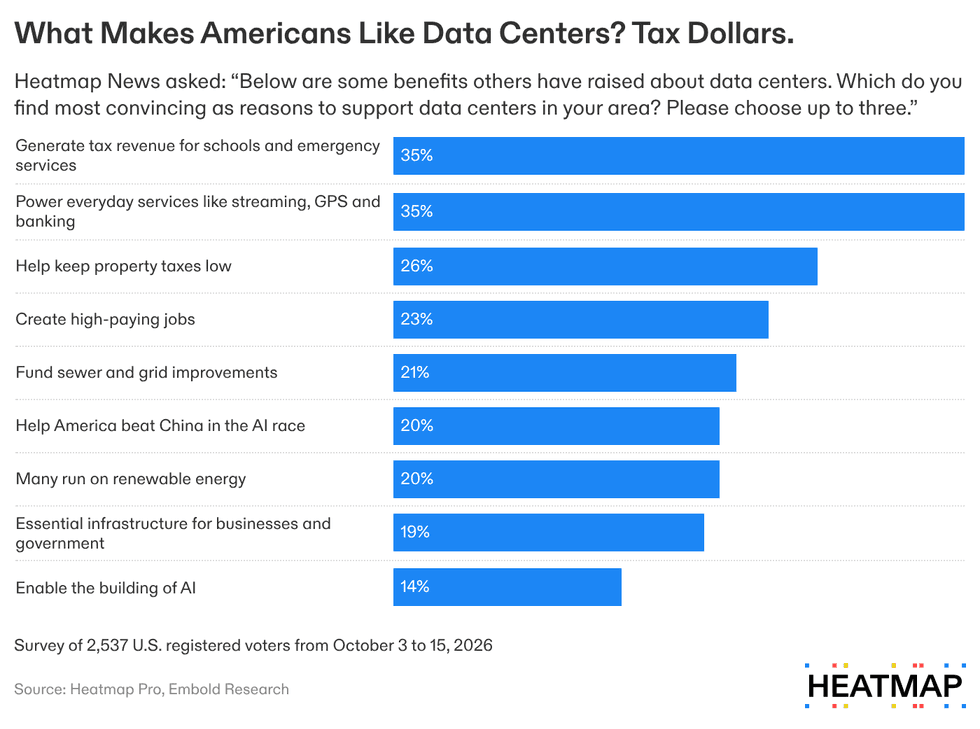
Let’s start with what Americans say motivates them most to support data centers. When allowed to select up to three reasons why they might support a data center project, respondents gravitated to a few answers. Voters’ No. 1 reason to support a project is that it can generate huge amounts of tax revenue, our polling shows. Other popular answers are that data centers can help keep property taxes low or improve local sewer systems or the power grid.
Americans also seem to admire what data centers do for the economy … as long as they’re not the kind that is involved in AI. When a data center runs traditional cloud-based services like streaming, online banking, and GPS, Americans are much more likely to be in favor of it.
As you might expect, the arguments against data centers that Americans find most convincing also have a lot to do with money. The No. 1 reason to oppose a data center, respondents told us, is that it could raise power or water bills. Americans also dislike when a community has little transparency into a data center deal, when there’s a risk of local environmental harm, or when their own tax bills could go up to pay for the project.
It’s worth noting that these arguments don’t necessarily align with what actually dooms projects. Heatmap Pro’s market intelligence data suggests that loud noise is one of the biggest drivers of data center cancellations. But only about one in 10 Americans told our poll that a data center being “noisy” would cause them to oppose it.
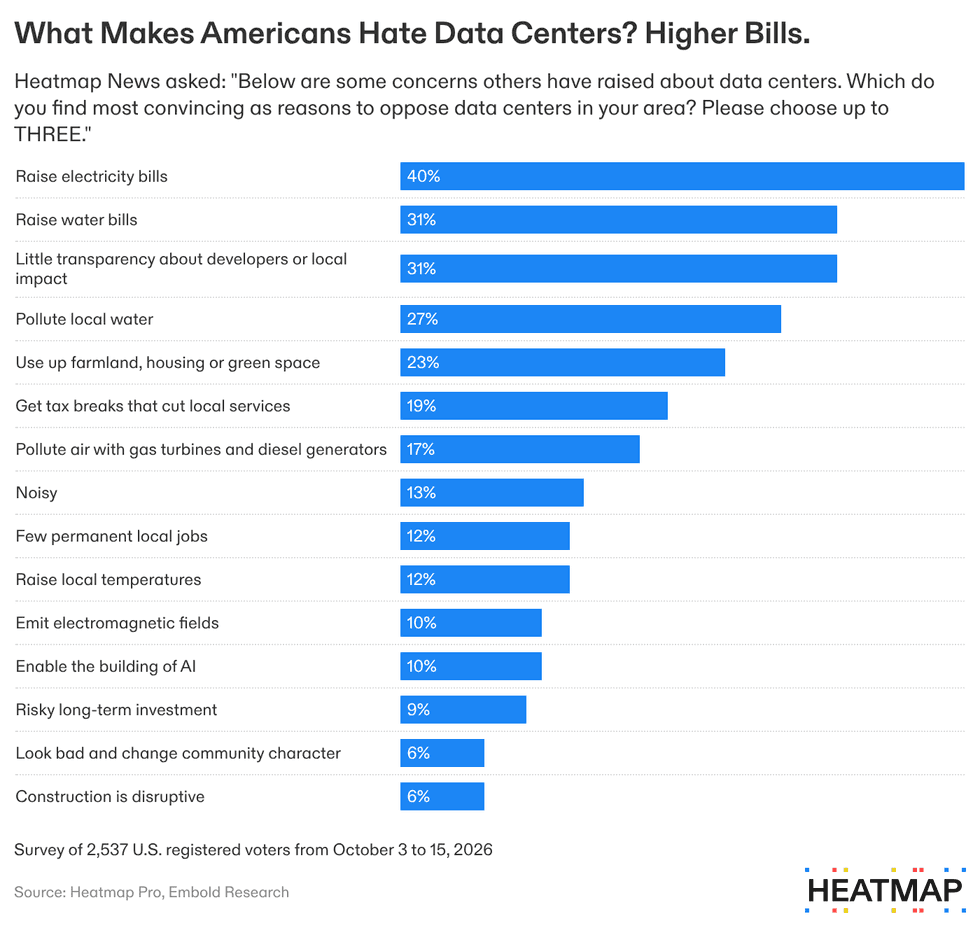
One takeaway from these results: Americans aren’t very motivated in either direction by progress in artificial intelligence. That data centers “enable the building of AI” convinces the smallest share of Americans to support a given project. Yet it’s also among the worst-performing reasons to opposedata centers. People just don’t seem particularly exercised about AI as a technology, at least when they’re thinking about the infrastructure that might house it.
So what does all this mean for national policy, and the federal government’s outlook on data centers? Voters are split over what to do, but most prefer slowing down or restricting the boom in some form.
The plurality of Americans believe the country should keep building data centers, but “require stronger protections for electricity customers and nearby communities.” At the same time, about half of the country wants to hamper the buildout through either a temporary pause or a more aggressive permanent restriction.
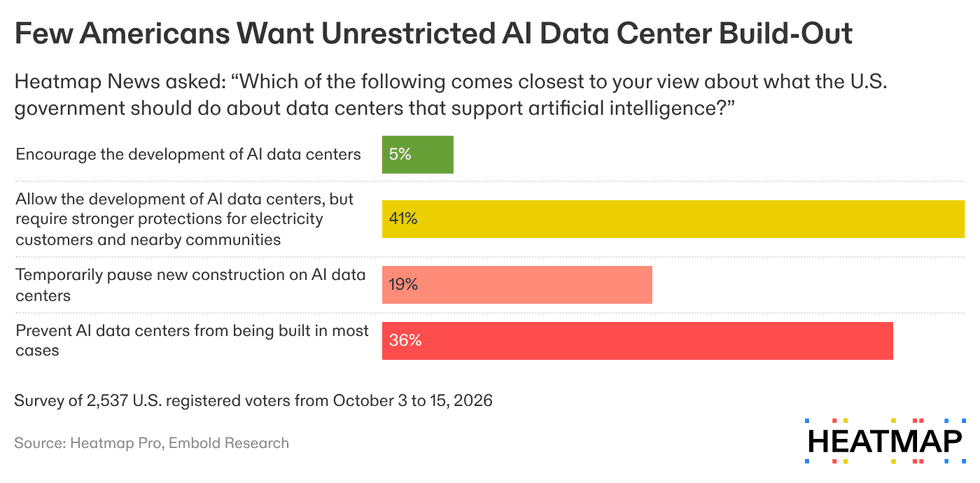
Reading these results, I can’t help but think of the bipartisan Senate permitting reform bill, which, as I’ve written, would force AI data centers to pay for grid expansion and lock in protections for normal ratepayers. The debate over that proposal — and the relative importance of those provisions vis a vis the broader package — seems to get at these questions in miniature. Many climate advocates are happy about a policy that would “require stronger protections for electricity customers.” Others just want the boom to stop — at any price.
The Heatmap Pro poll of 2,537 American registered voters was conducted by Embold Research via text-to-web responses from October 3 to 15, 2026. The survey included interviews with Americans in all 50 states and Washington, D.C. The margin of sampling error is plus or minus 2.1 percentage points.