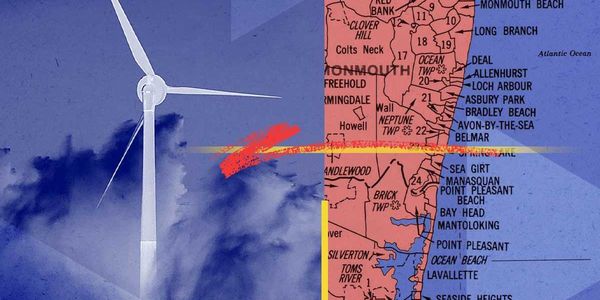
Electricity prices are the biggest economic issue in the New Jersey governor’s race, which is perhaps next month’s most closely watched election. Mikie Sherrill, the Democratic candidate and frontrunner, has pledged to freeze power prices for state residents after getting elected. Can she do that?
On this week’s episode of Shift Key, Rob talks to Skanda Amarnath, the executive director of Employ America, a center-left think tank that aims to encourage a “full-employment, robust-growth economy.” He’s also a nearly lifelong NJ resident. They chat about how New Jersey got such expensive electricity, whether the nuclear construction boom is real, and what lessons nuclear companies should take from economic history.
Shift Key is hosted by Robinson Meyer, the founding executive editor of Heatmap, and Jesse Jenkins, a professor of energy systems engineering at Princeton University. Jesse is off this week.
Subscribe to “Shift Key” and find this episode on Apple Podcasts, Spotify, Amazon, YouTube, or wherever you get your podcasts.
You can also add the show’s RSS feed to your podcast app to follow us directly.
Here is an excerpt from our conversation:
Robinson Meyer: Is there a nuclear bubble? … As people who are interested in long-term decarbonization, number one, this is quite reminiscent of the environment that hit clean energy companies right as Biden was taking office. And number two, is there a nuclear bubble, and what does this mean for how we should think about nuclear going forward? Because at the end of this, I think the only way that any of this helps the climate is if we build a lot more plants.
Skanda Amarnath: We are definitely in a moment when there’s a lot of froth. I don’t want to say everything — it’s always like, it’ll feel unfair and not accurate to go after every single proposition that’s in markets. Like for example, Rick Perry’s Fermi America, they did an IPO and raised a lot of capital pretty successfully. And they have a plan for how they want to build a lot of stuff out — gas, solar, batteries. They want to build four AP1000s, the large, light-water reactors that are seen as the most recent that we’ve built in the United States, and they think they could do them at the same speed that China builds those same reactors.
On the surface of it, there are parts of it that seem interesting and promising. On the other hand, there’s also parts of it that feel very much wrapped up in the speculative frenzy. It gets more exaggerated when you get to like examples like Oklo. They seem to be very politically connected, specifically to Chris Wright. That plus some very small milestone successes in the fuel supply chain are now being sort of magnified into, They’re going be very successful in building out there first of a kind technology. And even in the space of small modular reactors, what they’re offering seems at least substantially more risky than what may be — outside of the space, so even compared to GE’s proposition for a small boiling water reactor, the technology that’s involved with like Oklo is kind of out there.
And one of the things, the lessons of nuclear, if you look through the history, is the more new stuff you’re doing, the harder it is, the more likely it is that you will get heartburn in terms of cost, in terms of schedule, and you never want to do this again. And it’ll involve a lot of bankruptcy, as it did with the case of the Georgia reactors that were built in the last decade. And so this is a sign that there’s clearly a lot of hype and a lot of willingness to take risk, and it’s not really backed up by fundamentals. That can be sometimes overrated in a boom. But that is something that people will look to in a bust and say, what were we doing here? Why was the price of the stock so high?
Mentioned:
How Electricity Got So Expensive
New Jersey’s Next Governor Probably Can’t Do Much About Electricity Prices, by Matt Zeitlin for Heatmap
Previously on Shift Key: The Last Computing-Driven Electricity Demand Boom That Wasn’t
Meta lays off 600 workers
Amazon lays off 14,000 workers
This episode of Shift Key is sponsored by …
Hydrostor is building the future of energy with Advanced Compressed Air Energy Storage. Delivering clean, reliable power with 500-megawatt facilities sited on 100 acres, Hydrostor’s energy storage projects are transforming the grid and creating thousands of American jobs. Learn more at hydrostor.ca.
A warmer world is here. Now what? Listen to Shocked, from the University of Chicago’s Institute for Climate and Sustainable Growth, and hear journalist Amy Harder and economist Michael Greenstone share new ways of thinking about climate change and cutting-edge solutions. Find it here.
Music for Shift Key is by Adam Kromelow.