
The United States is different when it comes to energy and fossil fuels. While it’s no longer the world’s largest greenhouse gas emitter, no other country combines the United States’ production and consumptive capacity when it comes to oil — and, increasingly, natural gas. And no other country has made such a substantial recent policy U-turn in the past year, turning against renewables deployment at the same time as it is seeing electricity demand leap up thanks to data centers.
All of this is mirrored in the International Energy Agency’s 2025 World Energy Outlook, released Wednesday, which reflects a stark portrait of how America’s development of artificial intelligence and natural gas has made it distinct from its global peers. In combination, the effects of the One Big Beautiful Bill Act and the U.S.’s world-leading artificial intelligence development have meaningfully altered the group’s forecasts of global fossil fuel usage and emissions.
Much of the report compares two different scenarios for global energy usage and emissions — one looking at what governments are actually doing, and the other at what they say they want to do. The difference between the two is in the pace of the renewables buildout, and especially the pace at which fossil fuels’ place in the energy supply is wound down, if it is at all.
For example, the Current Policies Scenario (the stricter scenario) shows “demand for oil and natural gas continu[ing] to grow to 2050,” while the Stated Policies Scenario, or STEPS (the more optimistic one) shows oil use flattening “around 2030.” But in both cases, “gas demand continues growing into the 2030s, due mainly to changes in U.S. policies and lower gas prices.”
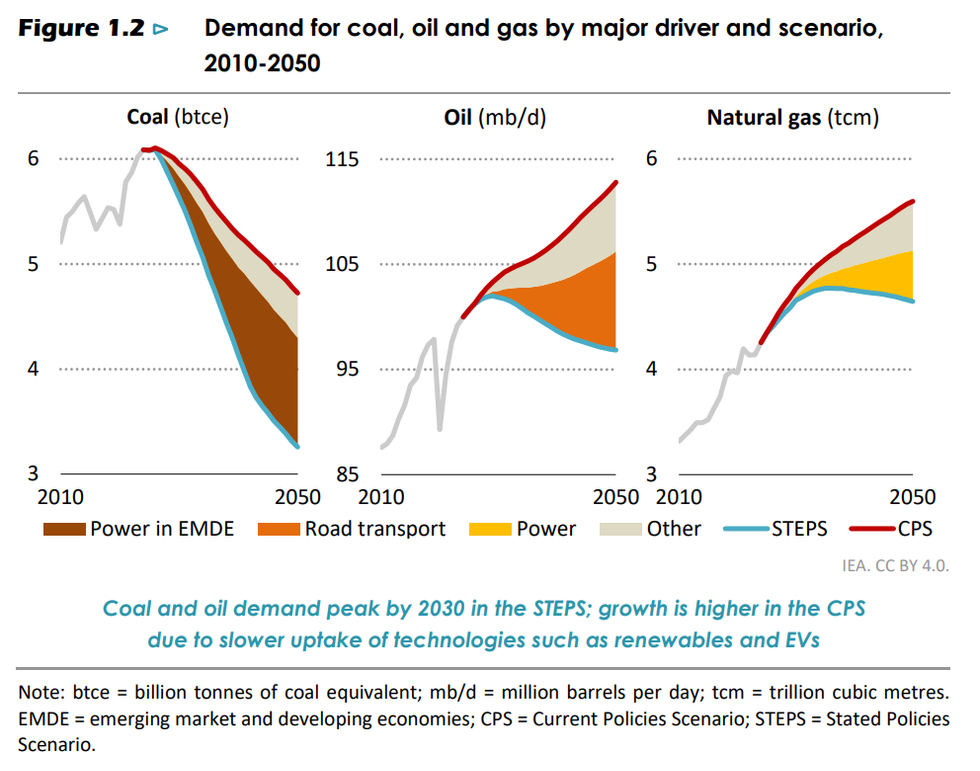
Even in the more optimistic outlook, natural gas use peaks later than it did in earlier forecasts. In 2035, the IEA projects, gas output will be 350 billion cubic meters greater than it projected last year, which is roughly equal to the annual gas production of Texas — and that’s in the optimistic scenario. “Three-quarters of this is for electricity generation, mainly in the United States, Japan and the Middle East, and reflects higher electricity demand and slower progress in adding renewables to the generation mix than projected,” the report says.
But the U.S. is not the whole story — the tide of renewable deployment continues apace. The clean energy analytics group Ember argues that the report’s “downgrades on clean growth in the U.S. are offset by rises in other countries,” especially as electric vehicles grow in popularity everywhere else. While the STEPS forecast shows a 30% drop in renewables capacity compared to last year’s projection in 2035 in the US (and a 60% drop in EVs on the road in 2035), “there are 20% more EVs projected in emerging markets outside China and the renewables forecast was also upgraded outside the U.S,” Ember said in a statement.
Ember attributes this to an “increasing focus on energy security,” with more countries following China in electrifying broader swathes of their economies in order to reduce their dependence on fossil fuel imports like natural gas, coal, and oil — including from the United States.
Similarly, Ember is sanguine about artificial intelligence throwing off projections for the wind-down of fossil fuels, which the IEA has and continues to portray generally as largely a U.S. phenomenon.
The IEA estimates that over 85% of global data center capacity growth will take place in the United States, China, and Europe, and that data centers will be responsible for only 6% to 10% of electricity demand growth in the EU and China through 2030. In the U.S., however, they’re responsible for about half of projected growth.
But it’s not just data centers that are causing the IEA to revise its figures. The IEA upped its forecast for electricity use in 2035 by 4% compared to last year, which amounts to some 1,700 terawatt-hours, a bit south of India’s annual electricity generation today. The group attributes this upward move in its forecast not just to “electricity demand to serve data centres” — which dominates discussion of energy use and climate change — but also to “higher demand for air conditioning in the Middle East and North Africa.”
While the economic benefits of artificial development are still necessarily speculative — with trillions of dollars of investment leading us potentially to a singularity of exponentially increasing technological development, machine-led human extinction, or somewhere in between — the benefits of air conditioning are far less so. With increased AC usage, even as temperature rises, heat-related mortality could fall.
And as the Global South heats and grows economically, its demand for and ability to procure air conditioning will grow, leading to higher energy usage and putting more pressure on the climate. The IEA figures square with another recent report from the climate and energy think tank Rhodium Group, which predicts a rise in emissions after 2060 due to economic development in the Global South.
In short, the energy consumption that feeds economic development all over the world is making the hottest parts of the world hotter while also enabling them to use more energy to cool their homes. At the same time, the richest parts of the world are increasing their electricity usage — and therefore their emissions — in order to develop a technology they hope will supercharge economic growth. The climate hangs in the balance.