
Current conditions: Tropical Storm Gabrielle is intensifying as it travels northwestward through the Atlantic, and may strengthen into a hurricane near Bermuda over the weekend • A trio of tropical storms — Mitag, Ragasa, and Neoguri — is barreling toward East Asia, threatening to build into typhoons as they approach China, the Philippines, South Korea, and Japan • A magnitude 7.8 earthquake struck off Russia’s Pacific coast, triggering a tsunami advisory.
THE TOP FIVE
1. New York regulator greenlights controversial gas pipeline
All but one member of New York’s Public Service Commission voted Thursday to endorse a plan from the gas utility National Grid that depends on construction of a controversial natural gas pipeline, the Albany Times-Union reported. The state has yet to approve the pipeline plan. In 2019, then-Governor Andrew Cuomo rejected the Northeast Supply Enhancement project, better known as the Williams Pipeline, on the grounds that it threatened too much environmental damage. Soon after, Cuomo shuttered the nuclear power plant that once supplied a significant portion of New York City’s energy, and the offshore wind projects meant to generate much of its carbon-free electricity stalled out. The only major power project to bring clean electricity into the city, the transmission line designed to connect the five boroughs to the hydroelectric system in Quebec, is underway, but at peak capacity will only supply about half of what the Indian Point nuclear station once produced. As a result, the New York City region on the state’s grid system depends on gas and oil for nearly 90% of its electricity.
The decision drew swift blowback from climate groups such as the Natural Resources Defense Council, which called the pipeline a “climate and affordability boondoggle.” The utility’s “own demand forecasts confirm there is no imminent reliability need — capacity is more than sufficient to meet peak demand well into the 2040s, even under unusually cold temperatures,” Chris Casey, the New York utility regulatory director at NRDC, said in a statement. “The Commission’s decision to signal its support for this fracked gas pipeline very likely contradicts state law, is not in the public interest, and will be vigorously challenged.”
2. California Democrat says Interior Department halted solar approvals
Representative Scott Peters, the Democrat who represents part of San Diego, accused the Department of the Interior’s Bureau of Land Management of halting permitting on solar projects in California. At a press conference Thursday to promote a bipartisan proposal he drafted along with the Colorado Republican Representative Gabe Evans to ease federal energy permitting, Peters said he had just been told that the agency would not approve any more panels. “It’s hard to get a deal unless we resolve that,” Peters said, according to a post on X from Politico reporter Joshua Siegel.
The proposal is a framework for a bill, essentially a blueprint of what members of the House Problem Solvers Caucus feel constitute reasonable compromises. For Republicans, the agreement offers fewer bureaucratic roadblocks to all kinds of new infrastructure, including gas pipelines. For Democrats, it charts a path for building more of the transmission lines that are key to adding more renewables to the grid. “It’s a big step to have our caucus, which is a pretty significant number of Republicans and Democrats, sign on to a pretty detailed set of policy principles,” Peters said. But as Heatmap’s Matthew Zeitlin wrote last month, “unless Democrats trust the Trump administration to actually allow renewables projects to go forward, his proposal could be dead on arrival.”
Get Heatmap AM directly in your inbox every morning:
3. New climate tech coalition forms
On Thursday, a new coalition that includes Bill Gates’ Breakthrough Energy, consulting giant McKinsey, and Stanford University’s Doerr School of Sustainability launched the Climate Tech Atlas. The proposal maps out ways to decarbonize different sectors of the economy, and lists priorities for innovation. The idea is not to eliminate potential solutions, Heatmap’s Katie Brigham reported in her scoop about the project, but rather “to enable the next generation of innovators, entrepreneurs, researchers, policymakers, and investors to really focus on where we felt there was the largest opportunity for exploration and for innovation to impact our path to net zero through the lens of technology,” according to Cooper Rinzler, a key collaborator on the initiative and a partner at the venture capital firm Breakthrough Energy Ventures.
4. Google unveils ‘the world’s most powerful AI data center’ in Wisconsin
Google has announced “the world’s most powerful AI data center” in southeastern Wisconsin. The project, called Fairwater, “is a seamless cluster of hundreds of thousands of NVIDIA GB200s, connected by enough fiber to circle the Earth 4.5 times,” CEO Satya Nadella wrote in a post on X. “It will deliver 10x the performance of the world’s fastest supercomputer today, enabling AI training and inference workloads at a level never before seen.” He said Google would match “all of the energy that is consumed with renewable sources.”
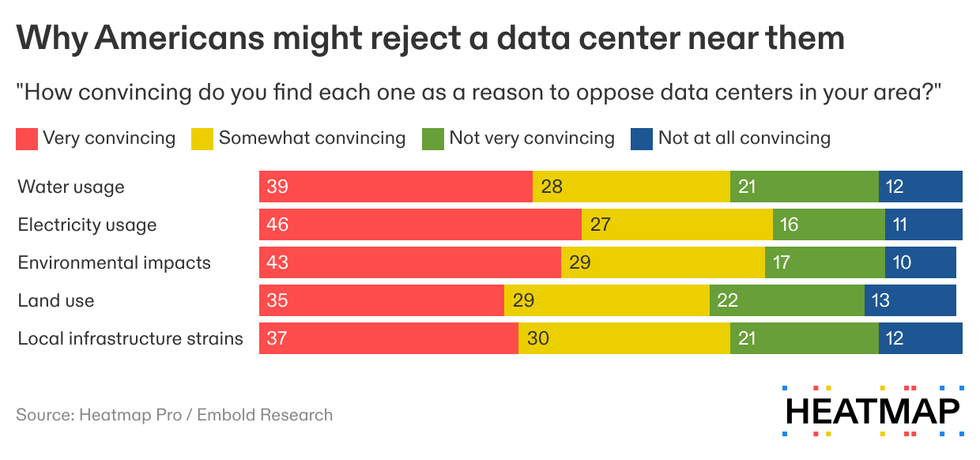
That power generation could prove more popular than the data center itself. Just 44% of American voters would support or strongly support a data center being built near them, while 42% would oppose or strongly oppose it, according to a Heatmap Pro poll Matthew covered last week. That mere 2% of net support compares to net support of 34% for a gas plant, 19% for a wind farm, 34% for a solar project, and 11% for batteries.
5. Climeworks inks largest-ever carbon removal deal with Schneider Electric
The carbon removal startup Climeworks just signed its largest-ever deal. By 2039, the Switzerland-based company, one of the biggest direct air capture developers in the world, agreed to suck 31,000 tons of CO2 from the atmosphere on behalf of Schneider Electric, the French industrial giant. Schneider said it remains committed to slashing the direct emissions from its operations by 90% in the next 25 years, and that this deal addresses “future neutralization needs while pursuing aggressive emissions reductions, and supporting the scale-up of an industry crucial for achieving net zero.” In a statement, Schneider’s sustainability chief Esther Finidori said that “both carbon removal and carbon reduction are fundamental to achieving our climate goals, as well as those of the planet.” For Climeworks, the deal is a “milestone,” said CEO Christoph Gebald.
THE KICKER
The speed of climate change may be throwing the insect world out of whack. But a new study has put offshore oil rigs in the North Sea to work identifying the vital role a migratory insect plays. University of Exeter researchers studied 121 marmalade hoverflies that landed on an oil rig in the Britannia oil field. The rig off the coast of Scotland was far from any vegetation or land, so the pollen found on 92% of hoverflies “shows they can transport pollen over great distances, potentially linking plant populations that are hundreds of kilometers apart,” according to a press release. “By analysing the pollen samples and wind patterns, we estimate that many of the hoverflies had flown from places including the Netherlands, northern Germany and Denmark — over 500 kilometers away,” Toby Doyle, Exeter’s Centre for Ecology and Conservation in Cornwall, said in a statement.