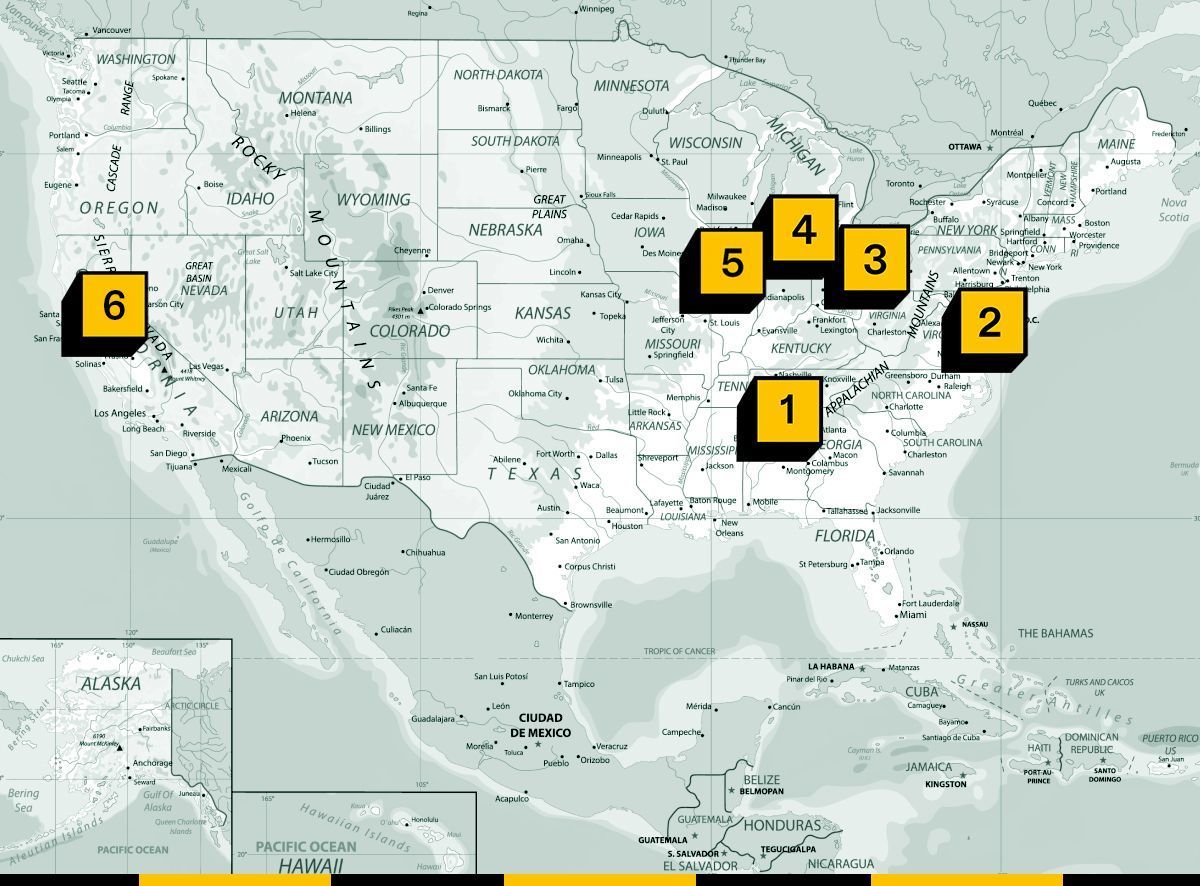
1. Lawrence County, Alabama – We now have a rare case of a large solar farm getting federal approval.
- The Tennessee Valley Authority last week quietly published its record of decision formally approving the 200-megawatt Hillsboro Solar project. The TVA – a quasi-federal independent power agency that delivers electricity across the Southeast – completed the environmental review for the project in June, prior to the federal government’s fresh clampdown on permits for renewables, and declared the project essential to meeting future energy demand.
- It’s honestly sort of a miracle this was even able to happen. The Trump administration has sought to strongarm the agency into making resource planning decisions in line with the president’s political whims, and has successfully browbeaten the TVA’s board into backing away from certain projects.
2. Virginia Beach, Virginia – It’s time to follow up on the Coastal Virginia offshore wind project.
- Unlike Empire Wind and other projects to the North, Dominion Energy’s much-debated foray into offshore wind has been moving full steam ahead with pile-driving and has faced very little backlash in public.
- But I am hearing a bigger fight may be brewing. As I previously reported, the Trump administration has been considering whether to capitulate to anti-wind activists in a lawsuit over the offshore wind project’s hypothetical impacts to the endangered North Atlantic Right Whale. In June, the lawsuit was stayed so the federal government could determine its approach in the case.
- Yesterday, Craig Rucker of CFACT – one of the anti-wind organizations who brought the lawsuit – told me that he anticipates the government will revisit the decision to approve Coastal Virginia and have a fresh view of the case sometime next month. He insisted that he has no first-hand knowledge of their feelings and that his prediction is based off “the little bit we’ve been able to tell” about how the administration has approached offshore wind in recent days.
- “They’re not indicating to us exactly what their concerns are but we find it to be a very positive development that they’re looking at the problems,” he told me. “We’re going by their actions and their direction to try and clamp down on [other] existing permits.”
3. Fairfield County, Ohio – The red shirts are beating the greens out in Ohio, and it isn’t looking pretty.
- Solar opponents came out in full force this week at an Ohio Power Siting Board public hearing on Geronimo Power’s Carnation project. The hearing is a prelude to any OPSB decision on the project.
- Activists on the ground say hundreds of locals piled into the auditorium where the hearing took place. Although public reporting indicates there were supporters who testified, it is unclear how many there were based on news photographs of the event, which show mostly a sea of red shirts signifying opposition. I was unable to find a video of the hearing.
- This kind of show-of-force can be devastating for a project going through the OPBS process given officials’ tendency to determine the public good of a project based in part on whether they believe residents actually want it constructed. I’d note Fairfield County itself has voted to oppose Carnation.
4. Allen County, Indiana – Sometimes a setback can really set someone back.
- Allen County commissioners voted to enshrine a 1,000-foot property setback for all solar projects amidst rising discontent about solar on farmland and other concerns around land use. The rule will come into effect in November.
- Commissioners have sought to paint the setback requirement as a compromise that would still allow development in the county because some of the loudest locals wanted a complete moratorium. However, EDP Renewables – which is trying to build projects in the county – is not enthused at all, and the company’s director of development for North America has told the commissioners it will “eliminate the ability for any large-scale solar energy development to happen.”
5. Adams County, Illinois – Hope you like boomerangs because this county has approved a solar project it previously denied.
- We’ve previously explained how hard it is to build solar in this county, where concerns about maintaining a rural way of life have superseded property rights arguments, leading to project denials in local townships.
- In this case, the fight was before the county board, where officials had previously rejected a special use permit for Pivot Energy’s Ghost Hollow solar project. But this week, officials on the board claimed they changed their mind because of some “strongarm[ing]” by the state government. Multiple board members voted yes while claiming they were under “duress” doing so.
- It is unclear exactly what regulators could’ve done, though it is true that Illinois has an alternate permitting process that may have allowed Pivot Energy to circumvent local opposition. Reports indicate there were also concerns about the county being vulnerable to legal action if it rejected the permit.
6. Solano County, California – Yet another battery storage fight is breaking out in California. This time, it’s north of San Francisco.
- County officials are trying to move forward with a restrictive ordinance on battery energy storage projects that would allow officials to reject BESS on “prime farmland.”
- At least two companies, including NextEra, are attempting to develop BESS in the county, but, to officials’ chagrin, are already pursuing an alternate permitting pathway by going directly to the state under its new permitting law.
- I’m not really sure there is anything this county will be able to do here because, as their own staff are now acknowledging, any regulation that unduly blocks BESS facilities is overridden by the state law.