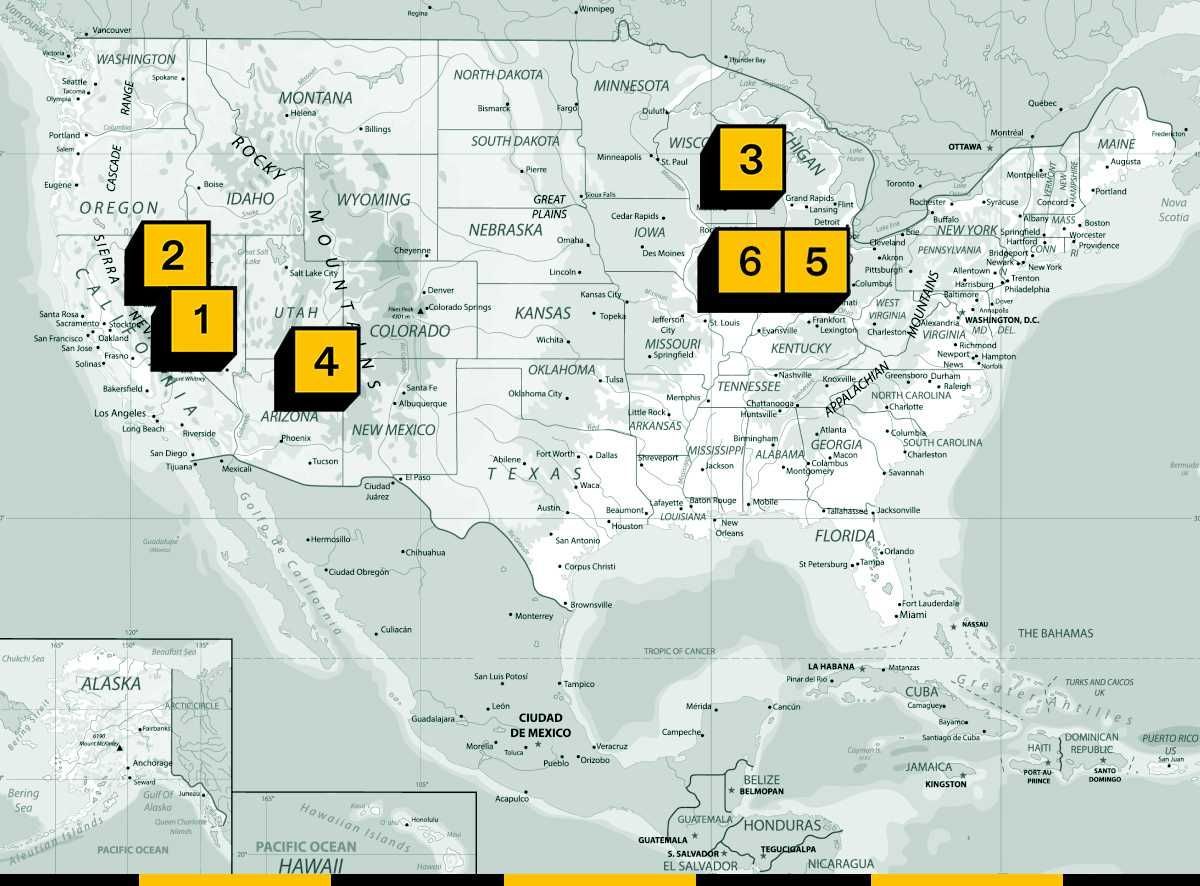
1. Western Nevada — The Esmeralda 7 solar mega-project may be no more.
- Last night I broke the news that the Bureau of Land Management quietly updated the permitting website for Esmeralda 7 to reflect project cancelation. BLM did so with no public statement and so far, none of the companies involved — NextEra, Invenergy, ConnectGen, and more — have said anything about it.
- Esmeralda 7 was all set to receive its record of decision as soon as July, until the Trump administration froze permitting for solar projects on federal lands. The roughly 6.2 gigawatt mega-project had been stalled ever since.
- It’s unclear if this means all of the components within Esmeralda 7 are done, or if facilities may be allowed to continue through permitting on a project-by-project basis. Judging from the messages I’ve fielded this morning so far, confusion reigns supreme here.
2. Washoe County, Nevada – Elsewhere in Nevada, the Greenlink North transmission line has been delayed by at least another month.
- As a reminder, Trump’s war on federal permits for solar caught the NV Energy project in a bind. Greenlink North, which would connect to solar farms on federal lands, was all set to receive a record of decision from the Bureau of Land Management. That was, until the agency was ordered to stop issuing permits to solar farms … and then suddenly moved back its deadline to finish the process by 18 days, to the end of September.
- I predicted that BLM would use the end-of-month date as boilerplate and that the timing would slip again. Hate to say I told you so, but in an update to the project’s website, a record of decision is now expected by the end of October.
3. Oconto County, Wisconsin – Solar farm town halls are now sometimes getting too scary for developers to show up at.
- This past week, NextEra Energy representatives were supposed to speak at a town hall for their Fox Solar facility, which requires only state permits from the Wisconsin Public Service Commission to advance to construction. NextEra was still seeking public buy-in, though, as it is increasingly considered a best practice in the sector.
- Concerns about “online threats” led NextEra to skip the event, sending employees instead to other pre-scheduled meetups at local coffee shops. The company reportedly declined to share the social media threats, but the Oconto Sheriff’s Office did tell local news it was aware of them.
- My best guess is the intense reaction to NextEra is happening for the same reasons Oconto County has an incredibly high opposition risk rating.
4. Apache County, Arizona – In brighter news, this county looks like it will give its first-ever conditional use permit for a large solar farm, EDF Renewables’ Juniper Spring project.
- This is significant because Apache County is also the site of Repsol’s Lava Run wind farm, a project that has galvanized such strong opposition to wind energy that it helped spur an effort in the Arizona legislature to all but ban utility-scale turbine fields. That a large solar farm could survive the gamut of loud opposition mounting in this county and elsewhere in rural Arizona is a feat unto itself.
- Juniper Spring was approved by the Apache Planning and Zoning Commission with several conditions, including significant decommissioning and bonding rules, a move to assuage locals upset about the risk of stranded assets.
- Now the permit will have to be approved by the county’s board of supervisors, who get the final say.
5. Putnam County, Indiana – After hearing about what happened here this week, I’m fearful for any solar developer trying to work in Indiana.
- After a raucous three-hour hearing, a chorus of anti-solar activists got the county commission to undo a previous rezoning request that would’ve allowed EnergyRe to build a 2,000-acre solar farm. The county’s planning commission denied a separate request key to constructing the project last month.
- Litigation is likely in the offing here, and may have been inevitable. During the hearing, an attorney representing landowners adjacent to the project threatened to sue the county if it allowed the rezoning. EnergyRe left the door open to suing the county over an undone approval. “We will look at all the options,” Paul Cummings, senior vice president of EnergyRe, told the room.
6. Tippecanoe County, Indiana – Two counties to the north of Putnam is a test case for the impacts a backlash on solar energy can have on data centers.
- Reed Davisson and Nicole Duttlinger are two Indiana residents involved in the fight against solar farms – one against solar, and the other in favor. Together, they published a lengthy op-ed in the Lafayette Journal & Courier this week calling for Tippecanoe County to restrict data center development as it has solar farms.
- The op-ed notes that the county could become a hotbed for future data center development given its electricity and water supplies, as well as its proximity to Purdue University.
- “[Tippecanoe] commissioners paused new solar projects to review the ordinance governing them. That same caution, transparency and foresight must now be applied to data centers,” the pair declares.
- To be honest, if we start seeing more op-eds and joint statements like these, data centers might start becoming political pariahs. If it’s hard to build solar in places like these, what could that mean for this new tech infrastructure?