GLOBALVARS
0

Current conditions: The Northeast heatwave is breaking, with temperatures set to crash by as much as 50 degrees Fahrenheit over the Memorial Day weekend • The Sandy Fire just north of Los Angeles has now prompted mandatory evacuation orders for more than 10,000 homes in Ventura County, California • It’s the United Nations’ International Tea Day, and Myanmar’s Shan State — widely considered the birthplace of Camellia sinensis — is in the midst of intense rainstorms expected to last through at least the beginning of June.
THE TOP FIVE
1. Oil prices drop 6% after two China-bound tankers cross the Strait of Hormuz
The blockade at the heart of the global energy crisis right now appears to be softening. On Wednesday, the Financial Times reported that two supertankers shipping Iraqi oil to China made it through the Strait of Hormuz. A third megavessel carrying Kuwaiti crude to South Korea also appeared in shipping data to be crossing the narrow waterway at the mouth of the Persian gulf before its transponder went offline. The three ships are ferrying a combined 6 million barrels of crude, which the newspaper noted may be the largest volume to leave the Gulf in a single day since the end of February, when the U.S. and Israel began bombing Iran. An analyst from the data company Kpler said the ships steered through a route designated by Iran, suggesting “there was a deal done” with Tehran. If, as analysts told Heatmap’s Matthew Zeitlin back in March, “the time lag in global arrivals also helps explain why the physical market is only now starting to bite,” the latest shipments may loosen the jaws a bit.
2. An American solar manufacturing boom has arrived
Nearly 30 new utility-scale solar factories started production in the U.S. last year, reaching a high enough capacity to supply nearly twice the expected demand for photovoltaic modules through the end of the decade. That’s according to the latest report out this morning from the American Clean Power Association, the biggest trade group representing the renewable energy industry. The country now has the capacity to produce more than 60 gigawatts of panel modules per year, enough to meet forecast demand through 2030 of just over 35 gigawatts per year nearly twice over. The increase in module manufacturing capacity over the last five years topped 1,600%. But it’s not all rosy. Upstream, solar cell manufacturing has seen a far slower uptick, with just three active factories. The number of factories in the pipeline between now and 2030 falls just below projected demand. Thanks to tariffs, the One Big Beautiful Bill Act’s repeal of solar tax credits, and tight new eligibility restrictions on the use of foreign products in federally-supported projects, solar imports last year fell 33% compared to 2024 levels. The U.S. is also growing self-sufficient on batteries. Last year, the country expanded its manufacturing base enough to meet battery demand with domestic modules, putting the industry on track to do so with domestic cells as well by the end of this year. The five new active anode material plants set to come online by December — one of which is already in operation — could meet total U.S. demand for battery storage by 2028. “We haven’t attracted all of the supply chain yet, it’s still a work in progress, but so far the signs are quite good,” John Hensley, ACP’s senior vice president of markets and policy analysis, told Heatmap’s Emily Pontecorvo in an exclusive interview.
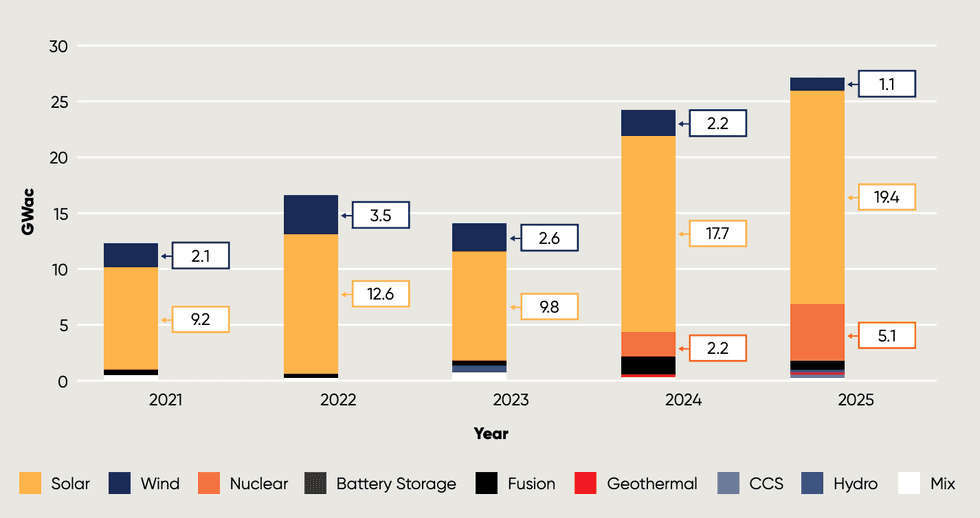
For the past five years, solar has been king among corporate energy buyers. Wind, then, could be considered the crown prince, trailing behind photovoltaics but undeniably the second in line for the throne. Not anymore. In 2025, nuclear surpassed wind as the second-largest technology in corporate deals, with over 5 gigawatts of capacity announced in a single year, according to the latest data from the Corporate Energy Buyers Association. It’s not just about fission, either. “Beyond nuclear, 2025 saw buyers procure more geothermal and hydropower capacity than in any previous year tracked, as well as growth in fusion and the first-ever natural gas with CCS deal, reflecting growing attention to reliability and system adequacy,” the report stated.
3. The federal government is chipping in $8 billion to rebuild New York’s Penn Station
New York culture is full of stark rivalries. Artists versus finance bros. Yankees versus Mets. Islanders versus Rangers. Puerto Rican mofongo versus Dominican mofongo. West Side versus East Side. But between the city’s two great train stations, there has long been a clear winner: Grand Central. By comparison, Penn Station, as I can tell you from countless commutes, has long been the armpit of the Metropolitan Transportation Authority, a complex maze of perpetually sticky floors, fluorescent lighting, and bathrooms so dirty that even a nauseatingly tipsy teenager thinks twice about entering. And yet the 2021 opening of the Moynihan Train Hall marked a serious upgrade. Now the Trump administration is chipping in another $8 billion to remake the rail hub.
The announcement, according to Gothamist, marked the first time the federal government has publicly disclosed how much it will spend to reconstruct the station since the White House took over control of the project from the MTA last year and turned the work over to the facility’s owner, Amtrak. “When it comes to our rail, we’re making generational improvements to the Northeast Corridor,” Secretary of Transportation Sean Duffy said under oath during his opening testimony at a Senate hearing Tuesday morning. “That means … a transformative investment in New York’s Penn Station — $8 billion, by the way.”
Sign up to receive Heatmap AM in your inbox every morning:
* indicates required
Email Address *Our Privacy Policy & Terms Apply.
4. Green steelmaker Boston Metal secures new funding to get into critical minerals
Back in February, I told you the cautionary tale of Boston Metal. The Massachusetts-based green steel startup faced an unexpected equipment accident at its plant in Brazil, making it impossible to meet a key development milestone needed to unlock another tranche of funding from its financiers. As a result, the company had to lay off much of its workforce. Now it’s mounting a comeback. On Wednesday, the firm announced a new $75 million funding round to support the scaling of its operations worldwide. Combined with previous financing deals, the company has now raised a total of more than $500 million. The latest funding will allow Boston Metal to expand its business into metals such as niobium, tantalum, vanadium, and nickel — all of which the U.S. wants to secure more supplies of from domestic sources or allied countries. “This financing marks a pivotal step for Boston Metal,” Rick Cutright, a venture capitalist whose firm, Climate Investment, joined the latest round, said in a statement. “The company has built a new metallurgical platform and demonstrated its ability to produce high-quality metals from complex feedstocks; now the focus is commercial production. Critical metals are the right first market because the need is immediate.”
In South Dakota, meanwhile, the world’s largest producer of biofuels just inked a major energy storage deal. POET agreed to buy a 5-gigawatt-hour, multi-day thermal energy storage system from the startup Antora Energy. The technology will back up POET’s bioprocessing facility in Big Stone City. “Homegrown energy sources create good-paying jobs, support our agriculture producers, and provide affordable options for consumers,” Senator John Thune, the South Dakota Republican, said in a statement. “I’m grateful for this impressive addition to South Dakota’s budding biofuels industry, and I can’t wait to see the benefits for South Dakota producers and families across our state.”
5. Wildfire-focused VC firm raises new $85 million fund
Convective Capital is not your usual venture capital firm. The San Francisco-based company, which Heatmap’s Katie Brigham has written about repeatedly, formed around a parochial specialty with ubiquitous appeal to Californians: wildfire technology. The startups financed through its first fire-focused fund have so far attracted hundreds of millions of dollars in investment. Now Convective is launching a second fund. On Thursday morning, the firm announced $85 million for a fund focused on resiliency. In a blog post, Convective founder Bill Clerico said the company has already launched a media channel to tell stories about companies finding novel ways to shore up infrastructure against extreme weather disasters and assembled a network of more than 10,000 resiliency-focused professionals. “There’s $60 trillion of real estate that's at high risk from disaster,” Clerico told Katie in an interview yesterday. “While we spend as a nation a trillion dollars a year preparing to fight enemies overseas, we spend comparatively very little at home protecting our neighborhoods and cities. I think the silver lining in this is that it’s gotten so bad that I think the private markets can now take over.”
THE KICKER
It’s been almost exactly a year since the rooftop solar giant Sunnova went bankrupt. Now its former chief executive is back with a new startup called Otovo that’s focused on servicing and fixing solar panels, batteries, and generator systems “orphaned” by their original developers’ bankruptcies. The business is panning out. This morning, I reported exclusively for Heatmap that Otovo has so far racked up 30,000 customers in less than a year and is considering listing on an American stock exchange as early as this year.