GLOBALVARS
0
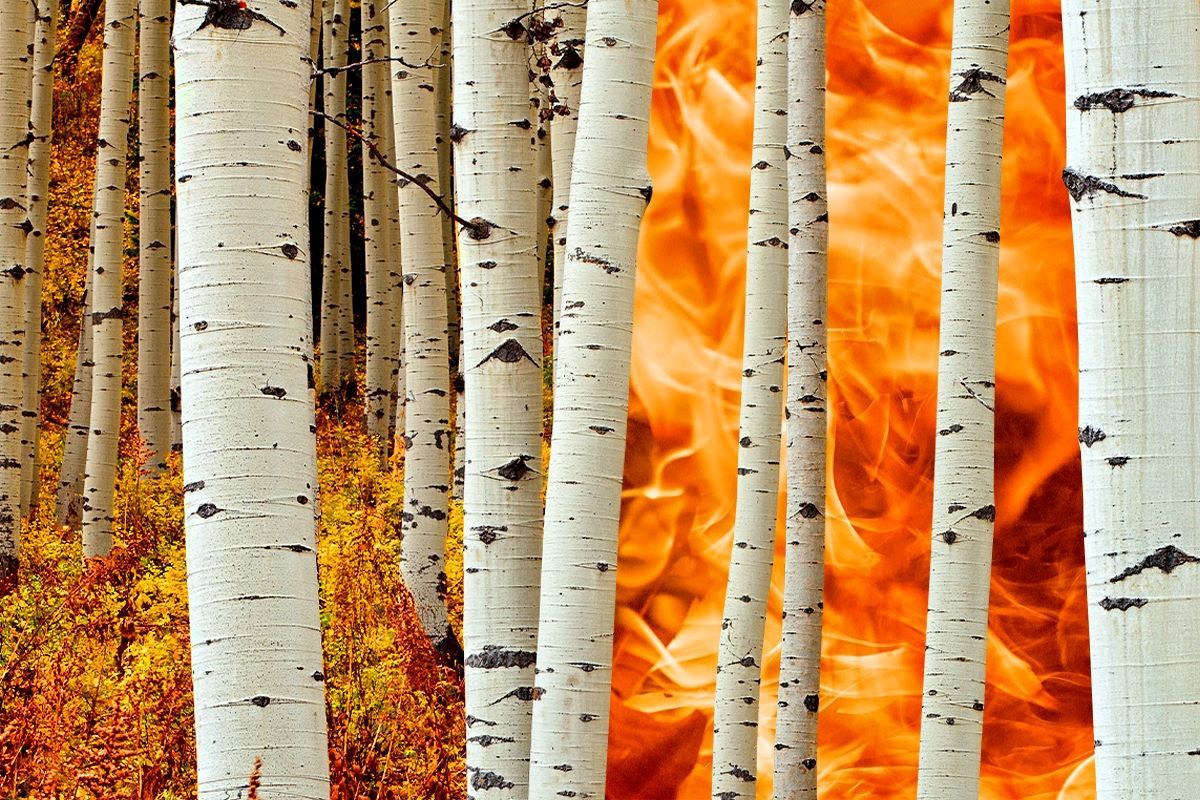
Colorado’s Aspen Acres Fire is named after a quiet RV campground located high in the San Isabel Mountains, about a five-hour drive due southeast of the state’s better-known Aspen. Both places, however, are named after the iconic deciduous tree known for its golden leaves in the fall. While the start of monsoon season may yet prevent the Aspen Acres Fire — the seventh-largest in Colorado’s history — from joining Utah’s Babylon Fire as the second 100,000-acre “megafire” of the season, the conflagration has been aided in its rampage not by aspens, but rather by dead, downed, and blighted ponderosa pines, spruce, and Douglas firs. The wildfire has now burned over 98,000 acres and nearly 300 homes, and is only 36% contained due to steep terrain that has hampered firefighting efforts, along with extreme drought conditions and beetle infestations that have greatly degraded the forest health of the region.
But what about its aspens? Though the extent of the damage at the campground remains unknown, according to a recent study of Populus tremuloides, Colorado’s iconic golden trees could be one of the keys to more wildfire-resistant forests in the future.
Flavie Pelletier, a recent PhD graduate of McGill University’s Natural Resource Sciences program, told me she first became interested in aspens while working as a tree planter in British Columbia. “The historical assumption on aspen is that stands are very good at stopping fire progression. But the paradox is that if you take an aspen by itself, it’s going to burn at high severity,” Pelletier, who published her findings in Forest Ecology and Management, told me.
By creating near-real-time maps of fires using satellites and comparing them against the Canadian Forest Service’s newly available maps of dominant tree species in the boreal, Pelletier and her colleagues discovered that aspen were almost two and a half times more common at the perimeter of a burned area than inside it. The finding suggests that despite the flammability of a single aspen with its thin bark, stands of aspen act as a kind of barrier when wildfire ran up against them, likely because they lack the flammable resins of conifers and their high foliage helps force running crown fires back toward the ground. Pine and spruce, by contrast, showed a near-zero or even negative effect.
When aspen stands did burn, Pelletier found they did so more slowly: A tree cover of 50% aspen burned at about 224 hectares per day, compared to 717 hectares per day in areas where aspen made up less than 10% of the cover. That’s the equivalent of about 1,000 FIFA-regulation soccer pitches per day in places where aspen are sparser — like Aspen Acres.
Even more surprising, though, was that the pattern held true in the early season, when the trees are still twiggy and have yet to grow their moisture-filled leaves, and despite the severity of fire weather. “Aspen still showed resilience even when the fire weather was very intense, [like in 2023, when] we had all the fires,” Pelletier said.
But she was also the first to admit that seasons are getting more extreme, and that there’s no guarantee the pattern will hold for the next 10 or 20 years.
Pelletier was reluctant to make a policy recommendation based on her research, noting that she’s not a forest manager. But in Alberta and British Columbia, timber companies spray hundreds of thousands of acres of timber with glyphosate, an herbicide, to kill off aspens because the trees outcompete the more commercially valuable conifers. Her findings are “a big argument to stop the spreading of herbicides because you’re increasing the risk of fire in your forest by removing aspen,” Pelletier said.
Despite her hesitation, Pelletier is explicit in her paper about one thing: that aspens “should be encouraged — specifically around key landscape positions, such as population centers” — given that they are a proven means of hardening the wildland-urban interface against wildfires. It might be too late for the idyllically named Aspen Acres, of course; any of the aspens that once drew tourists to the area are likely now ash.
But this not be Colorado’s last fire, either.