GLOBALVARS
0

We got a look at another major tech company’s latest energy and carbon emissions data — and it’s a doozy. On Wednesday, Microsoft released its annual sustainability report, giving us another year’s worth of energy and emissions data for a company that Heatmap’s annual insiders poll once judged to be one of the best hyperscalers for climate change.
The headline: Microsoft’s climate pollution surged last year. Its carbon emissions increased 25% year-over-year, the biggest single-year rise since at least the pandemic. The company emitted the equivalent of 21 million tons of carbon dioxide in 2025, under standard measurement methods. (It emitted slightly less under its own bespoke measurement system, which counts fuel credits and customer energy use differently.)
Electricity, which the company is buying in larger amounts than ever before to power AI data centers, is driving a good share of that increase. In 2024, carbon pollution produced by generating electricity (as well as from making chilled water and steam) was responsible for 2% of Microsoft’s total corporate carbon footprint. In 2025, that same category made up 13% of its overall emissions. The company’s power use rose by more than 24% over the same period.
That means Microsoft’s power use isn’t rising as fast as other companies’. Google’s most recent sustainability report said itsown electricity consumption leapt 37% during the same period.
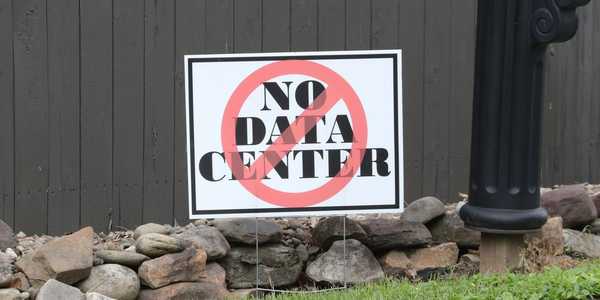
The report suggests, too, that Microsoft is increasingly wary of local fights over data center development — and how water has come to play an outsize role in those battles. The company reports that 2025 was the first year ever that it “replenished” more water on global scales than it withdrew. But “the next phase of our work is increasingly local,” write Brad Smith, the company’s vice chair and president, and Melanie Nakagawa, its chief sustainability officer. That line is clearly in reference to water, specifically — Smith and Nakagawa add that the company hopes to “restore more water to the watersheds where we operate than we withdraw” — but it could also cover the widespread local opposition to data centers that has exploded over the same period.
There’s one more thing to flag about this report: Although it just came out, it covers Microsoft’s 2025 fiscal year, which began in July 2024 and ended more than a year ago. That means it’s inherently an out-of-date view — it shows us what Redmond was doing as the AI and data center boom got underway, but not what it’s doing now. We’ve known for some time that the company is struggling to meet booming AI power demand while maintaining its power commitments; it paused carbon removal buying in April and revised its own clean energy commitments in May.
I should add that Microsoft would prefer that we look at other numbers in the report. First, under its in-house measurement scheme, the company says it released only 20 million tons of carbon pollution over the past year, a figure that appears in its top-line charts. Second, Microsoft estimates that it would have done even more harm to the climate — producing 34 million tons of climate emissions — if not for its corporate policies of buying zero-carbon electricity, using renewable fuels, and improving the energy efficiency and carbon footprint of its XBox game consoles and Surface tablets.
We asked Microsoft for a follow-up interview, but unfortunately they didn’t make anyone available. I’ll be back tomorrow to look at Microsoft’s report in context with other hyperscalers.
Speaking of a sudden rise in gaseous emissions, the Trump administration today named a new leader of the federal government’s marquee in-house climate research office, the U.S. Global Change Research Program. Per Politico, the new top dog is Matthew Wielicki, a UCLA PhD who (1) has a Substack, (2) refers to himself (in the third person) as a “beacon of rational thought” and “professor in exile” on said Substack, and (3) has suggested on X that climate change belongs in the “Department of Imaginary Problems.”
What can I say? Back during President Trump’s first term, his administration tried to bury the publication of the National Climate Assessment by dumping it on a holiday weekend. Now it seems to have taken another strategy. All I can say is, Dr. Wielicki, from one beacon of rational thought to another: I look forward to following your work.