GLOBALVARS
TEST TEST TEST
0
Products

Current conditions: A large storm is roaring across the Northeast that will shower Michigan and Upstate New York with rain and snow by tomorrow • AccuWeather declared an early end to the 2026 Atlantic hurricane season, which saw 10 named storms and only one hurricane in October, breaking a 121-year record for the latest first hurricane • It’s a mild, cloudy day at the Rethondes Clearing in France’s Forest of Compiègne, where the armistice that ended World War I was signed 108 years ago today.
THE TOP FIVE
1. Electricity prices jumped again last month
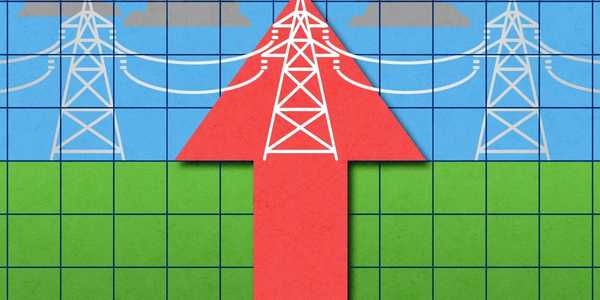
Inflation is ticking up again, and faster than expected. That’s my colleague Matthew Zeitlin’s read on the latest numbers from the Bureau of Labor Statistics. Preliminary data from Heatmap and MIT’s Electricity Price Hub shows that electricity prices in particular spiked nearly 8% to 19.9 cents per kilowatt-hour in October from 18.5 cents in the same month last year. But that’s largely due to a change in the timing of a bill credit in California. Without that, the year over year price jump was just under 4%.
2. The Canadian utility building the rich world’s first SMR says the job is taking more money and time than expected

Ontario Power Generation, the state-owned utility in Canada’s most populous province, admitted in a public filing Wednesday that its megaproject to build the first small modular reactor in the rich world is costing a lot more than planned. The company is constructing the world’s first BWRX-300, the flagship reactor from GE Vernova Hitachi Nuclear Energy, at its Darlington plant. The project is an attempt to revive construction of atomic power stations in North America, Europe, and Japan by building the inevitably costly first-of-a-kind unit that can then be replicated at what the developers say will be a decreasing price. Using billions in Canadian ratepayers’ money to essentially de-risk an American-Japanese technology ruffled some feathers among the country’s nuclear boosters, who told me last month they want to see Ottawa approve construction of more of the Canucks’ homegrown reactor. In its latest earnings report, OPG said the BWRX-300, known as DNNP Unit 1, “is no longer expected to achieve the previously disclosed commercial operation date target of October 2030 or be completed with the previously disclosed estimated cost of $7.7 billion.”
3. Green cement startup Sublime Systems says the Trump administration is refusing to cooperate in lawsuit
Amid a flurry of funding cuts in the early days of the current Trump administration, the Department of Energy canceled an $87 million grant to the green cement startup Sublime Systems. In response, the company sued for damages. This week, the Somerville, Massachusetts-based firm filed legal documents accusing the agency of “refusing to comply with its basic discovery obligations and the schedule” for the case.
“The government has repeatedly delayed responding to Sublime’s discovery requests, and now the government is refusing to even meet and confer with Sublime until some indefinite date in the future,” read the joint status report filed with the U.S. Court of Federal Claims. “The upshot is that, as of today, the government has not produced a single document in response to Sublime’s requests for production (served nearly two months ago), it has provided no timeline by which productions will be completed, and it is refusing to search for core documents related to the May 2025 mass termination at the heart of this case.”
Sign up to receive Heatmap AM in your inbox every morning:
Email Address *Our Privacy Policy & Terms Apply.
4. Energy Department gives $480 million for offshore drilling in the Gulf
The Energy Department’s Office of Energy Dominance Financing, formerly the Loan Programs Office, closed a $480 million loan for a Texas-based company’s effort to modernize and boost production from 22 offshore oil and gas platforms in the Gulf of Mexico. Arena Energy, the Woodlands, Texas-based company behind the initiative dubbed Project Elkhorn, said that the initiative will add 38,600 barrels of oil per day and up to 77 million cubic feet of natural gas per day to U.S. energy output.
“The United States is the world’s largest producer and exporter of oil and natural gas, and thanks to President Trump, American energy production will continue to grow,” Secretary of Energy Chris Wright said in a statement. “By providing financing for projects like Project Elkhorn, the Energy Department is expanding domestic production and strengthening our energy security to power American prosperity for decades to come.”
5. The frontrunner in the solid-state battery race rolls out next-generation cells
QuantumScape emerged years ago as the frontrunner in the race to commercialize solid-state batteries that last longer, charge more quickly, and function better under harsh conditions than liquid-based lithium-ion packs. On Wednesday, the San Jose, California-based startup unveiled what it called in a press release its “next-generation open platform for all-solid-state batteries.” Dubbed Osprey, the cells “deliver the world’s first public data demonstrating a sulfide-based cathode cycling 1,000 times under just one atmosphere of pressure.” In other words: “an unmatched capability that is necessary for automotive solid-state batteries.”
“Osprey is a next-generation platform that is built on our same core technology, the ceramic separator and anode-free design,” Siva Sivaram, QuantumScape’s chief executive, told me in an email last night. “It will allow us to provide the unique benefits of our ceramic separator to developers of all-solid-state batteries using sulfide-based cathodes.” The company plans to start mass producing its cells in 2028, he said.
THE KICKER
Bill Gates boasts that he has committed more of his fortune to fighting climate change than virtually any other rich man in the world. But a new investigation by ProPublica found that he’s ramped up his investments in a landfill company, Republic Services, that spews millions of tons of greenhouse gases into the atmosphere. “It seems very likely that Bill Gates has the power to influence Republic’s behavior to make it more climate-friendly, even if that costs the company profits,” Ann Lipton, a legal scholar who studies corporate governance at the University of Colorado, Boulder, told the outlet.