
National Republican political leaders are beginning to intervene in local battles over battery storage, taking the side of activists against developers. It’s a worrisome trend for an industry that, until recently, was escaping the culture clashes once reserved only for solar and wind energy.
In late July, Texas Congressman Chip Roy sent a letter to energy storage developer Peregrine Energy voicing concerns about a 145 megawatt battery project proposed in rural Gillespie County, an area one hour north of San Antonio that sits in his district. Roy, an influential conservative firebrand running to be state attorney general, asked the company more than a dozen questions about the project, from its fire preparation plans to whether it may have ties to Chinese material suppliers, and stated that his office heard “frustrations and concerns” about the project from “hundreds of constituents – including state and local elected officials.”
“Gillespie County is subject to extreme drought, wildfires, and flash flooding events,” Roy wrote. “Naturally, residents are concerned about the environmental risks a battery storage facility poses to one of [the] most vulnerable areas in Texas, among other things.”
Peregrine told me in an email that the company then sought to assuage the congressman’s concerns, speaking with his staff over the phone. But Roy remained unmoved, now fully backing the local opposition to the project. “My office has met with representatives from Peregrine Energy, and while we appreciate the dialogue, we believe that this project warrants scrutiny,” Roy said in a statement provided by his staff when reached for comment. “We look forward to remaining engaged with Peregrine Energy and continuing to represent the people of Harper who feel strongly that this battery facility poses more harm than good.”
Republican interventions like these may feel out of the ordinary to many in the energy sector. Historically, conservative politicians like Roy often vote against writing new regulations governing the environment and public safety, and Texas has often been a bastion for that kind of policymaking. Not to mention Texas is a major hub for battery storage development, second only to California in total capacity installed onto the grid. The Lone Star state’s strained grid means there is no shortage of demand for excess back-up power.
Unfortunately for battery storage developers, national Republicans are now increasingly open to attacking individual battery storage projects in the same way they’ve sometimes fought solar and wind farms, especially when activists on the ground feel they’ve lost the fight with municipal and state regulators.
Last year, we launched The Fight with a story about the unincorporated town of Acton, California, where a battery project was approved by county officials in an area with high risk of experiencing wildfire. Local opponents of the facility, feeling that county and state courts would not fairly adjudicate their concerns, lobbied their elected representative in Congress – then-Rep. Mike Garcia – to do something, anything in response to the situation. And while Garcia was stymied from halting that individual battery project, he then tried to block the Energy Department from streamlining federal permits for the entire battery storage system sector. (The rulemaking was completed before the start of the Trump 2.0 administration. Garcia lost re-election last year.)
At the time, this was the first full-fledged example I could find of a Republican in Congress really picking up the mantle of the “BESS bomb” panic around large-scale battery facilities potentially posing an unacceptable risk to surrounding host communities. Sure, there’d been scares around lithium-ion batteries in e-bikes, for example. But battery storage in general? The sector has enjoyed bipartisan support at the national level, and definitely still does to some extent given that GOP lawmakers declined to pare back the industry’s Inflation Reduction Act credits in their recently-passed tax megabill.
But now there’s a very clear battery fire “butterfly effect” occurring in which local rage fails to get the attention of government officials focused on energy capacity so activists will just go to whatever ears are most sympathetic to them. This is resulting in percolating Republican ire against battery storage, point blank.
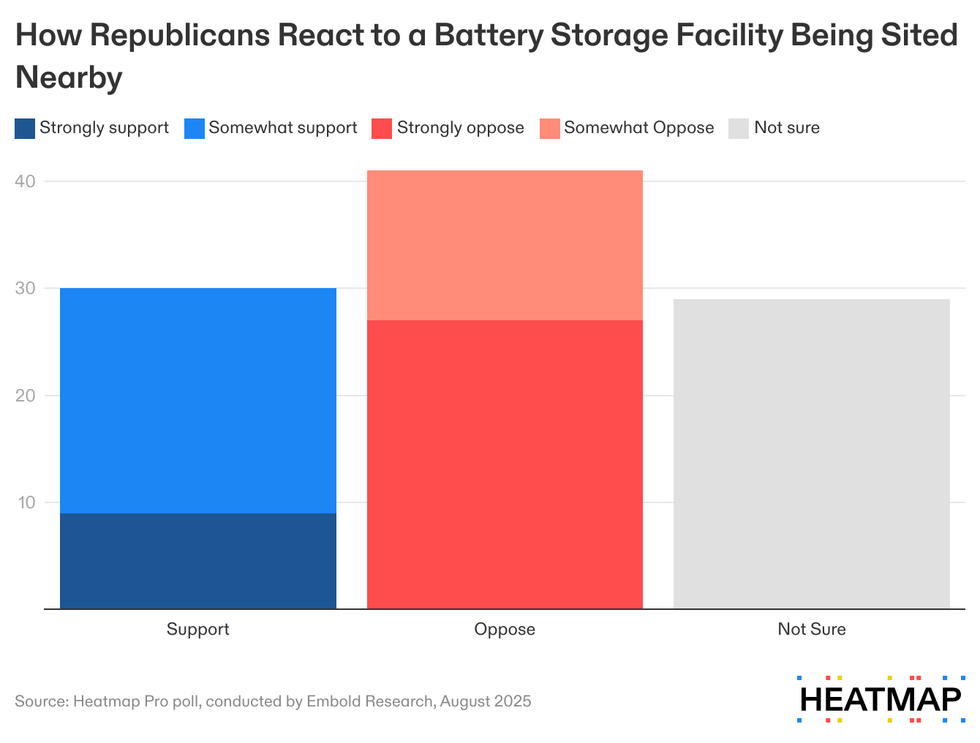
Indeed, Heatmap Pro’s August poll of 3,741 registered voters found that there are now three times as many strong opponents of battery storage facilities among Republicans than strong supporters.
Less than a month after Roy’s letter to Peregrine, EPA Administrator Lee Zeldin personally visited his native Long Island, New York, to voice his support for those campaigning against a Key Capture Energy battery project in Hauppauge, a hamlet within the town of Islip. The EPA has no role in whether the project is built or not. But the endorsement – coupled with a New York Post op-ed declaring “battery sites are too risky for New York” – came right before a 12-month battery moratorium Islip had enacted was set to expire.
This week Islip extended the moratorium, indefinitely stopping the battery project. Next week, the New York City Council’s committee on fire and emergency management will be holding a public hearing to specifically address the local fears about storage projects.
As for Roy and Peregrine Energy, it’s unclear how the Texas Republican could stop the facility on his own. It has the permits necessary to build and Texas doesn’t have the kind of stringent environmental regulation that creates opportunities to stall construction.
But the lawmaker’s existing political clout in Washington and motivation to win the Republican primary nomination in a heated statewide contest make him a dangerous enemy for any company to have, especially energy developers linked in some way to the transition. As Garcia showed a year ago and Zeldin demonstrated over the summer, someone with a national platform and a megaphone could do a lot of damage to a single project, or worse. We’ve yet to truly see what will come from the flapping of this butterfly’s wings.