0
What did you do for Earth Day this year? I spent mine visiting a notoriously loud artificial intelligence campus in Virginia’s Data Center Alley. The experience brought home to me just how big a problem noise can be for the communities adjacent to these tech campuses – and how much further local officials have to go in learning how to deal with them.
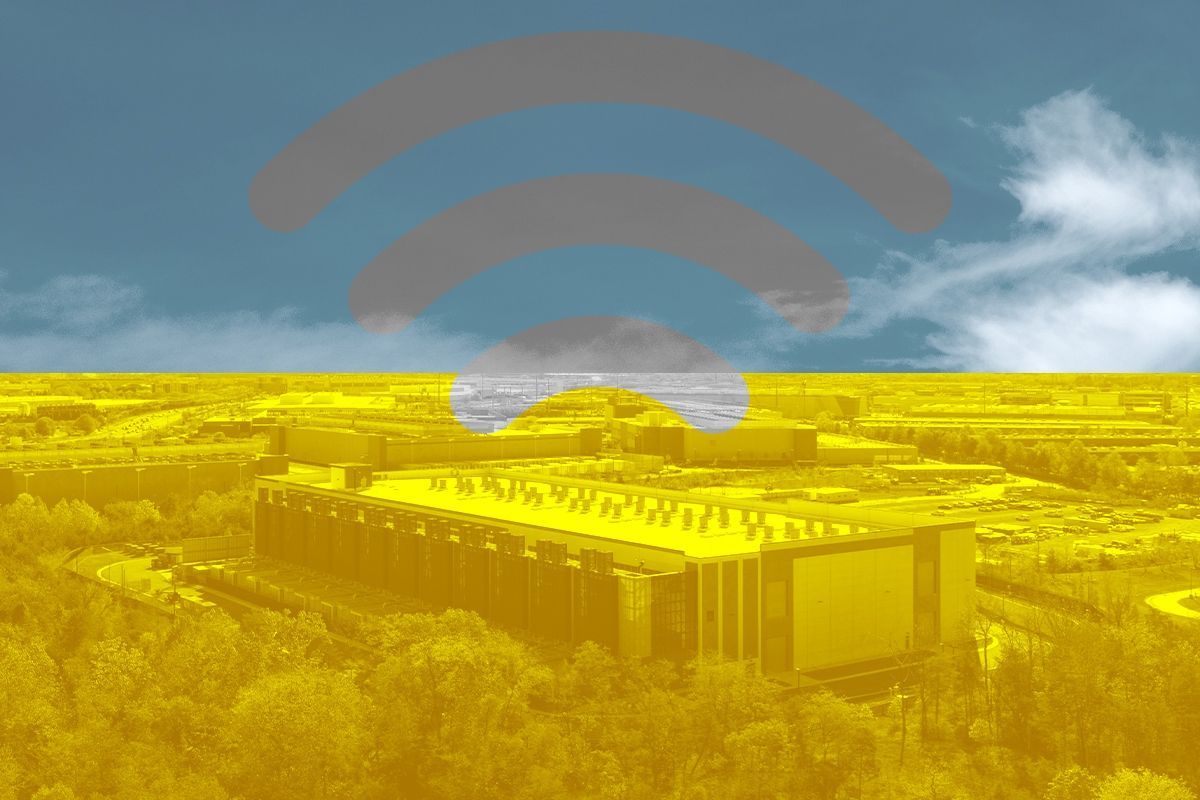
The morning of April 22, I jumped into a Toyota Highlander and drove it out to the Vantage VA2 data center campus in Sterling, Virginia, smack dab in the middle of a large residential community. The sensation when I got out of the car was unignorable – imagine an all-encompassing, monotonous whoosh accompanied by a low rumble you can feel in your body. It sounds like a jet engine that never stops running or a household vacuum amplified to 11 running at all hours. It was rainy the day I visited and planes from nearby Dulles International Airport were soaring overhead, but neither sound could remotely eclipse the thudding, multi-resonant hum.
If you want to hear the sound for yourself, this video accurately sums it up.
After parking nearby I walked to one of the residential enclaves adjacent to VA2. One resident of a home across the street, who declined to give me her name, said she moved there before the project was completed. When asked how she felt about the noise, she told me, “It’s not as bad as it could be on the other side [of the data center], where all the equipment is.” (While the sound does get louder on the other side, I could clearly hear VA2 from her driveway.)
VA2’s noise has been causing problems for months, as documented by numerous social media posts, local news clips, and a feature published in Politico. It’s doubtful many of those living near the data center wanted it there. The project was built quite quickly – so quickly that Google Earth still shows undeveloped woodlands on the site. Per public filings, Vantage first proposed the facility in 2022 under the county’s fast-track commercial incentive program, an expedited permitting process for specific preferred industries. It was under construction as recently as October 2024, according to images captured by Google Street View.
Noise is one of the most common issues associated with data centers. At least a third of all conflicts over data centers are over noise complaints, and noise is the number one reason for opposition in cases where projects were ultimately canceled, according to Heatmap Pro data.
This issue goes back almost a decade. In 2019, residents of the Phoenix ex-urb Chandler, Arizona, became irate after a loud monotonous hmmmm began emanating from a CyrusOne data center. In that case, CyrusOne traced the noise back to chilling fans, and the company reduced the sound with muffling devices.
Chandler wound up adopting a new ordinance in 2023 requiring sound mitigation measures to prevent companies from exceeding certain ambient noise levels in the surrounding areas. That did nothing to improve the mood of the people who live there, however. Now Chandler, once known as a potential data center development hub, is now firmly in the anti- camp. The city council unanimously rejected a proposed $2.5 billion data center campus in December over noise concerns, despite an expensive lobbying push backed by former Arizona Senator Kyrsten Sinema.
As data centers spread across the U.S., noise is becoming an ever-more-common complaint. You can hear the familiar hum at a DataOne data center project in Vineland, New Jersey. DataOne told us they “understand concerns about ambient noise in the area” and are operating within the limits of local noise ordinances.
The hum is also in Dowegiac, Michigan, where people living nearby are calling their new Hyperscale Data facility a “noise trap,” with little explanation to date for the issue. Hyperscale Data did not respond to a request for comment.
And the hum is in Mount Pleasant, Wisconsin, where the sound from a new Microsoft data center campus rises above any din from rain. The hyperscaling giant is doing more to mitigate the issue than I’m used to seeing from data center developers, however.
On April 15, the company published an update on its own internal investigations into noise complaints. “Although the facility noise levels meet the requirements set by local ordinance, we take this feedback seriously and understand the impact this has had on our neighbors,” the update read. “We anticipated that our systems would need adjustments and create some noise as part of the datacenter startup, but we did not expect the tonal quality of the sound to travel as far as it has.”
To address the noise, Microsoft said it was “manually adjusting the cooling fans” to reduce noise, and that “we expect this change to address community concerns about the tonal humming.” On top of that, the company said it will install “additional sound reduction components” to “provide even further reductions in measured sound levels.” A Microsoft spokesperson told me in an email: “We’ve identified the source of the noise concerns and have implemented changes to significantly reduce sound from our facility.”
It isn’t cooling fans causing the noise at Vantage’s VA2 in Virginia, however. The sound, according to media reports, is coming from gas turbines powering the data center.
VA2 is one of the first in Virginia to function entirely off-grid, a design companies are adopting in order to avoid lengthy grid connection processes. Company spokesman Mark Freeman told me the facility is “fully compliant with all local noise ordinances, and this has been verified by third-party sound studies.”
“Additionally, in line with our commitment, we are actively working with third-party engineers to explore additional sound mitigation options,” Freeman continued. Freeman said “Our goal is to further reduce noise levels where possible and continue to foster a positive environment for everyone.”
Here’s the thing, though: I visited the Vantage campus after initially hearing from the company, and it was loud. Very loud.
I did not bring a decibel meter with me, so I cannot know whether they were operating within legal limits that day. What I do know is that noise ordinances struggle to properly capture sounds in multiple frequency ranges, making high and low frequencies challenging to regulate, according to the Environmental and Energy Study Institute, a bipartisan non-profit think tank. Officials representing Loudon County, where VA2 is located, have acknowledged that the local ordinance may need to change in order to address the most distressing frequencies from the data center campus.
“We can change the zoning ordinance and noise ordinance,” Loudon County supervisor Mike Turner told local TV station WUSA9 last week. “Noise can be mitigated. I just don’t believe that the noise problem cannot be solved.”
I wrote Freeman, the Vantage spokesman, to tell him I had visited the VA2 campus and found the noise to be “quite foul.” He replied soon after, telling me that Vantage is going “above and beyond what is required in order to address concerns from nearby residents.” The company is using “targeted enhancements to turbine-related equipment such as dampening equipment, enclosure inlets and enclosure exhausts.” These measures “represent meaningful progress and will help us better evaluate the effectiveness of the broader solutions under consideration.” Freeman also said the company is “actively assessing additional options” focused on “targeted frequency ranges.”
As we continue to track local regulation of data centers, I’m we’ll see many more cases like VA2, in which obtrusive sound prompts forms of regulation we may have never seen before.
Or, people will just hear these noises and say no to more data centers.