GLOBALVARS
0
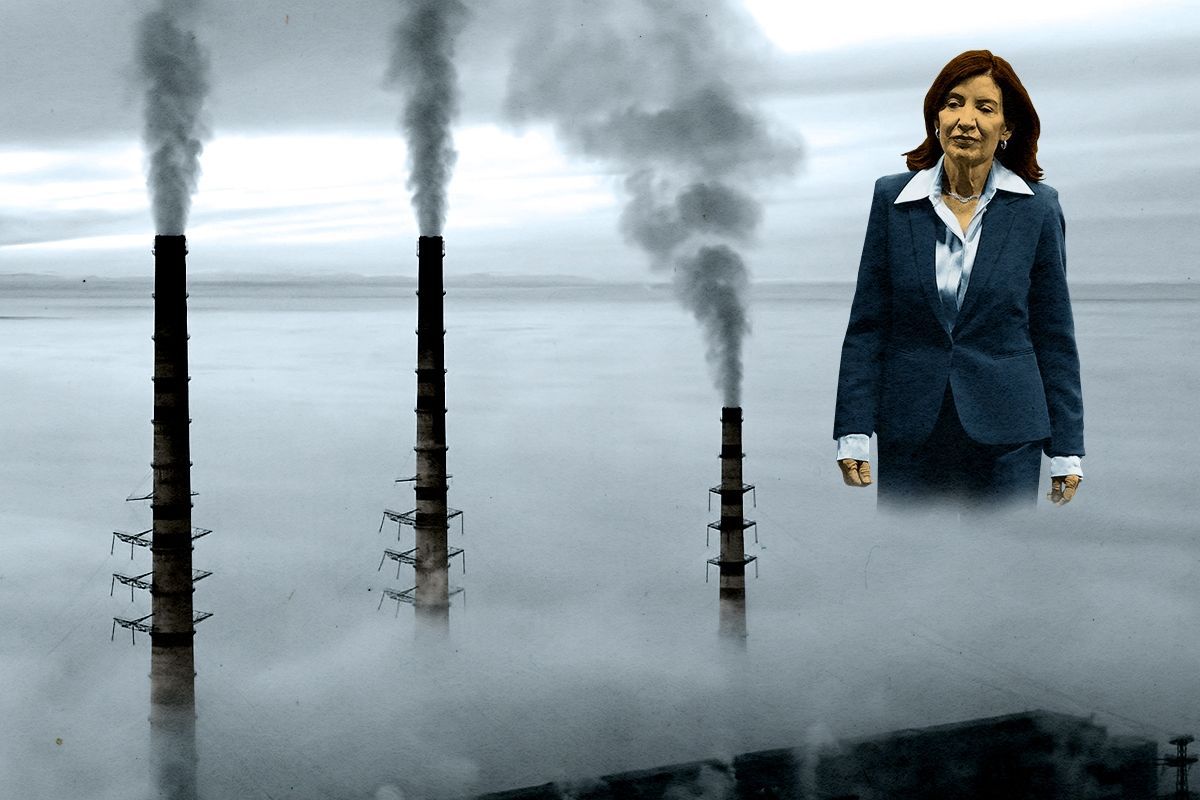
A wave of climate action swept the country’s statehouses in the early 2020s, with nearly two dozen states setting targets to slash their emissions. New York was ahead of the pack and among the most ambitious, passing the Climate Leadership and Community Protection Act, or CLCPA, in the summer of 2019 to achieve net zero emissions by 2050.
Now, however, the Empire State will distinguish itself as the first of the bunch to walk back its landmark climate law in the wake of Trump’s re-election.
The New York legislature released the text of the deal it reached with Governor Kathy Hochul to reform the state’s climate law on Tuesday. The deal includes two consequential changes: delaying a plan to regulate carbon from 2024 (it was already behind schedule) until 2028, and modifying how the state accounts for the powerful greenhouse gas methane in a way that will look like the state has accomplished deeper reductions than under the current method.
The governor has been signalling her intent to weaken the CLCPA for months, arguing that as written, it would have imposed untenable costs on New Yorkers. “Reality has been harsh,” she said during a press conference about the budget agreement in early May, before the text was released. “We cannot meet the current timelines without driving energy costs higher.”
Local environmental groups were widely critical of the deal, with New York Renews calling it a “major blow for New Yorkers and for the country” that would set “a dangerous precedent,” and Environmental Advocates NY deeming the rollbacks “bad politics and bad policy.”
Some remained hopeful that the changes would not derail the state’s progress by much, however. “There’s no way to sugarcoat it, this is a setback,” Jackson Morris, the director of state power sector, climate and energy for the Natural Resources Defense Council, told me. “At the same time, I don’t think it’s a setback that we can’t recover from.”
2040 is the new 2030
The CLCPA set targets to cut economy-wide emissions 40% by 2030 relative to 1990 levels, and achieve net zero emissions by 2050. It also codified an earlier plan to source 70% of the state’s electricity from renewable sources by 2030 and power the state entirely with zero-emissions resources by 2040.
New York didn’t make up these targets. They’re based on reports from the U.S. Global Change Research Program and the United Nations Intergovernmental Panel on Climate Change, which mapped out how the world could minimize the risks of climate change in line with the Paris Agreement. After Donald Trump announced he would pull the U.S. out of the Paris Agreement when he first took office in 2017, a number of Democratic governors banded together to show that America was still “all in” to achieve the pact’s goals, leading to a flurry of state climate laws in the years that followed.
Hochul’s budget deal doesn’t change the renewable electricity targets or the overall trajectory of the original law. Instead, it delays the regulations that would make the economy-wide emissions reductions possible to achieve.
The CLCPA directed state agencies to promulgate rules and regulations by 2024 that would put New York on the path to achieve the 2030 and 2050 targets. In the years since the law passed, the state has been developing a cap-and-invest program that would tax carbon emissions progressively over time, and use the proceeds to fund clean energy programs throughout the state. This program was the crux of Hochul’s affordability concerns, as it would make energy more expensive for some New Yorkers in the near term.
The budget deal moves the deadline for the regulations to the end of 2028. Crucially, it also does not require that those regulations help the state achieve the 2030 emissions target. Instead, it specifies that the regulations be designed to achieve a new goal of reducing emissions 60% by 2040, in addition to the original net zero by 2050 target.
Morris, of the NRDC, was quick to note that the deal does not get rid of the 2030 target. While there will be no state programs aimed at achieving it, it still provides a statutory foundation that agencies such as the Department of Environmental Conservation can point to as a reason to reject fossil fuel project permits, for example, he said. Meanwhile, Morris is optimistic that the new 2028 deadline and 2040 target can keep the state on track.
“We obviously prefer that none of this is happening,” he said. “But because it’s happening, I think that’s one aspect of this deal that we see as providing some ground to stand on.”
Methane math
One of the aspects of the CLCPA that made it more ambitious than other state climate laws was the way it required New York to account for methane. The budget deal will eliminate this edge.
There were two key components to New York’s unique methane rules. The first was that they forced the state to take responsibility for methane emissions that occurred outside its borders that were nevertheless tied to its natural gas use. For instance, a major source of methane emissions is leakage from the infrastructure used to drill, process, and transport natural gas. New York banned fracking in 2014, and the state gets most of its natural gas via pipeline from Pennsylvania and West Virginia. Under Hochul’s changes, the state can take these “imported” emissions off its books.
The second is a bit more convoluted and has to do with how methane behaves in the atmosphere. When governments or companies set emissions targets, they typically convert all greenhouse gases into “carbon dioxide equivalents” so that they can set one round number goal for all emissions, like New York’s 60% reduction by 2040. There’s no single way to do this, since unlike carbon dioxide, which remains in the atmosphere for centuries, methane breaks down quickly. Over 20 years, one metric ton of methane has a similar effect to about 80 metric tons of carbon, but over 100 years, it’s more akin to 25 metric tons of carbon. New York uses the 20-year effect as its conversion factor, but under the budget deal, it will switch to the 100-year method. That will make its methane emissions suddenly appear much lower, and thus make the state look further along in fighting climate change without actually changing anything about its strategy.
This will ease the pressure on the state to electrify buildings, clean up landfills, and take other difficult steps to cut methane emissions. It will also, however, align New York’s methane math with that of most U.S. states and much of the rest of the world.
What’s next
The national climate advocacy group Evergreen Action, which focuses on state policy, is less concerned about the changes to the climate law and more concerned about how they happened. Justin Balik, the nonprofit’s vice president for states, told me that Hochul never brought her concerns to environmental stakeholders or asked for policy proposals for how to accelerate clean energy while lowering costs.
“We need to see more urgency from the governor and the legislature to actually do the things that will result in emissions reductions and cutting costs for people,” Balik told me, “and less fretting about the targets that are written into law.”
Balik argued that the changes will do nothing to address the factors that are increasing energy rates. He cited the state’s dependence on natural gas as a key driver, as natural gas prices can fluctuate dramatically due to geopolitics and supply and demand. If anything, he said, delaying the cap-and-invest regulations will delay clean energy deployment and exacerbate affordability by deferring the revenue the state would have collected to and used to fund emissions-cutting programs and rate relief.
The budget deal attempts to make up for the shortfall with a $1 billion allocation to the state’s Sustainable Future Fund, which will support state programs to cut emissions from buildings and roads with heat pumps, thermal energy networks, electric school buses, and fast-charging stations.
Evergreen, NRDC, and other groups now have their sights set on the 2028 regulations.
“If we can move forward quickly with a robust process to stand up that cap-and-invest construct in New York State, and get it cutting pollution and generating billions of dollars in revenue for reinvestment in communities, that's going to be a huge breakthrough for the state of New York,” Morris said.