GLOBALVARS
TEST TEST TEST
0
Products
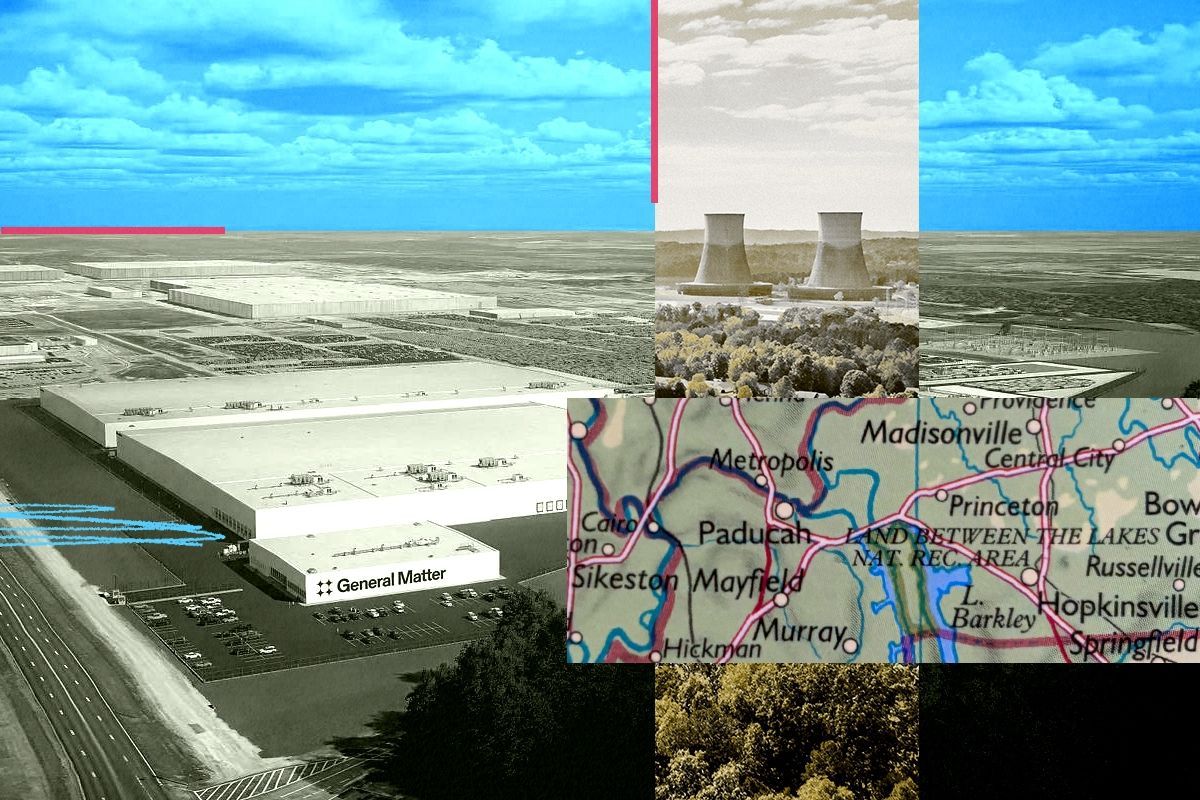
General Matter, the secretive nuclear enrichment startup led by one of the first employees at Elon Musk’s SpaceX, emerged last month by publicly unveiling its plans to convert a Superfund site in Paducah, Kentucky, into the nation’s newest plant transforming raw uranium into fuel for reactors. Backed by both tech billionaire Peter Thiel and former White House climate czar John Kerry, the Los Angeles-based company chose the location, which until 2013 served for over six decades as an enrichment facility for the United States government, as a symbol of American reindustrialization. The startup stuck to a straightforward pitch: honing the cheapest, fastest, and most efficient technology to enrich uranium, following the path SpaceX took to engineer its rockets.
Now General Matter is set to announce its most significant public regulatory progress to date. On Thursday, Heatmap can exclusively report that the Nuclear Regulatory Commission accepted the company’s application, clearing a path to begin construction at the Department of Energy-owned Paducah site by next year.
“The U.S. used to be more than 80% of global enrichment; now we’re less than 1%,” Scott Nolan, General Matter’s chief executive, told me by phone Thursday from Paducah. “As a company, we’re not only bringing enrichment back to the U.S. to meet our needs and our allies’ needs, but also dropping the cost so nuclear is not just the safest and cleanest but the cheapest baseload power.”
The NRC gave its approval for General Matter to begin the application process just one month after the company filed its paperwork. In its acceptance letter, the NRC said it had completed the initial review in half the normal time and will consider other ways to expedite the process, a benefit owed in no small part to General Matter’s pre-application engagement with the agency.
“We’ve been told it’s due to the completeness and quality of our application,” Nolan said. “That application really followed over 100 different interactions with the NRC to coordinate on what we were planning to submit. We believe that pre-work has helped us.”
The company expects to receive approval from the NRC on its initial application by next year, allowing for construction to begin beyond the early work of clearing space and grading soil. If that goes according to schedule, Nolan said equipment installation can begin in 2028, with the first commercial output the following year.
The dominant technology for uranium enrichment is a gas centrifuge — giant vertical cylinders that spin tens of thousands of times per minute and push heavier Uranium-238 molecules toward the outer wall of the machine, leaving behind the Uranium-235 needed to sustain a chain reaction of atom splitting. Newer technologies involve using lasers to separate U-235 through electromagnetic properties. General Matter has not yet said what kind of technology it’s pursuing.
“We are developing novel technology but not novel physics or novel engineering,” Nolan said, adding that the company has “coordinated very closely” with the Energy Department as it demonstrates its hardware.
This first application would allow General Matter to produce the low-enriched uranium used in conventional nuclear reactors. Next year, the company plans to submit a second application that would allow it to churn out high-assay low-enrich uranium, a more potent fuel needed for next-generation reactors like the small modular reactors that startups Oklo, TerraPower, and X-energy are developing.
The milestone on General Matter’s inaugural application comes as the U.S. nuclear industry is anxiously seeking new sources of fuel. Russian nuclear fuel has dominated the American industry since the 1990s, when the Clinton-era “megatons to megawatts” program agreed to buy any reactor fuel made from materials extracted from dismantled atomic weapons. As a non-proliferation effort, it helped divert material that might have otherwise ended up in bombs or sitting around in the chaos of post-Soviet Russia. But the cheap imports all but put the domestic enrichment industry out of business.
That scarcely mattered in the decades when nuclear power was in decline. Now that the U.S. is forecast to build at least 10 gigawatts of new nuclear capacity over the next 14 years, companies are looking to shore up the supply of fuel. And that supply is shrinking. At the end of next year, federal law passed in the wake of the Kremlin’s invasion of Ukraine will ban any imports of Russian nuclear fuel. Industry sources familiar say following through would almost certainly mean the U.S. will run short on enriched uranium, suggesting Washington might seek to ease sanctions in much the same way the Trump administration just did for Russian diesel.
“The Russia ban is partly why we’re trying to move quickly to meet U.S. industry demand,” Nolan said.
The problem illustrates the market need General Matter aims to serve. It’s not alone: BWX Technologies, a chief supplier of nuclear fuel to the U.S. military, has ramped up production. Centrus Energy, another major enrichment company that spun out in the 1990s from federal ownership, has also begun a major expansion, shipping new centrifuges to its Ohio facility just this morning.
U.S. utilities have sufficient inventories of uranium to make it through the end of the decade, Nolan said. And even if Russian material is allowed in, the U.S. has historically capped Moscow’s share of the American market at 25%.
“Our mindset is not just to displace Russia from the U.S. market, but to restore U.S. self sufficiency on enrichment and help fuel allied countries with U.S. fuel instead of having them purchase from an adversary,” Nolan said.
He drew a parallel to SpaceX. Space launch, he said, “was an industry the U.S. once led in and had fallen behind on. We stopped launching the space shuttle and were unable to take astronauts and cargo to the International Space Station. One of SpaceX’s early missions was to take us back to the space station and end reliance on Russia.”