GLOBALVARS
TEST TEST TEST
0
Products
If you were born the year the United States gave up on finding a place to store its spent nuclear fuel, you’d almost be eligible to vote. Since 2009, when the Obama administration halted work on Yucca Mountain, the Nevada site designated under federal law as the nation’s first nuclear waste repository, the country has had no formal plan in place.
Russia, France, China, and Japan all reprocess highly radioactive spent fuel that comes out of reactors to extract usable materials and recycle them into more fuel. The process still leaves behind some nasty, dangerous radioisotopes that form during fission, but there remains a lot less that needs to be stored for centuries. The U.S. attempted to set up a commercial nuclear recycling industry in the 1970s, before President Jimmy Carter pulled the plug as a sop to the nonproliferation movement. No one has really attempted to invest in the industry since.
Over the past decade, a new slate of startups has promised to revive the dream — or, to some, nightmare — of recycling spent fuel. The Biden administration put up funding. The Trump administration proposed “nuclear lifecycle campuses” where recycling would be just one part of future complexes that process, enrich, and reprocess reactor fuel, and dozens of states stepped up to serve as hosts. In a sign of growing momentum, one such company formed last year in Washington, D.C., with former Nuclear Regulatory Commission Chairman Chris Hanson as its head of implementation.
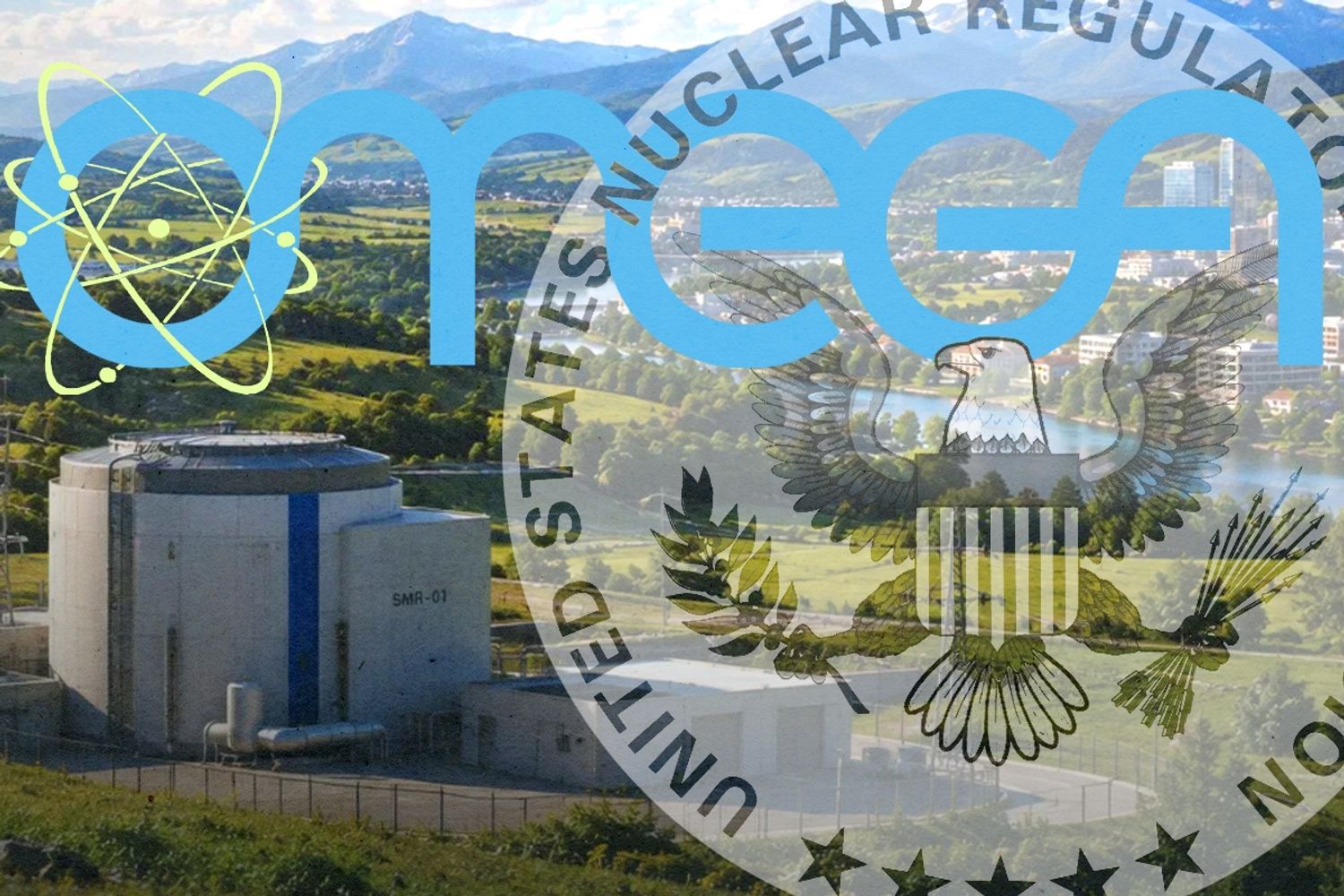
Now that company, Project Omega, has taken a big step toward actually commercializing its technology, Heatmap can exclusively report. The company submitted its “letter of intent” to the NRC, giving the agency a formal heads up that it plans to submit a full application within the next few years.
“Waste is the biggest challenge in the nuclear industry,” Staff Sheehan, Project Omega’s chief executive, told me. “We exist to take the amount of nuclear waste and the hazard of that nuclear waste and drastically decrease it.”
The NRC has, over the past year, ramped up efforts to streamline and modernize its regulatory process, and has greenlit permits for new reactors in record time. But the most successful applications have largely come from companies that carried out a lot of legwork with the NRC before submitting paperwork, so that the formal documents provide answers to questions the regulators expect to ask.
Since the NRC has never permitted or licensed a commercial nuclear reprocessing facility, companies are lining up to engage with the agency early. Oklo, the Silicon Valley startup seeking to deploy its own small modular reactors and reprocess the fuel its future power stations will run on, held a “pre-application meeting” with the NRC just last month. Curio, another Washington-based company specializing in nuclear waste reprocessing, submitted its letter of intent to the NRC in May.
Reprocessing, as a concept, draws fierce opposition from nonproliferation advocates who say the technology lays the groundwork for greater production of materials for bombs. Plutonium, which is used in some of the most powerful nuclear weapons, does not occur in nature, but forms during fission. The world’s only commercial nuclear recycling facilities, such as La Hague in France or the Mayak Production Association in Russia’s Ural Mountains, rely on a technology called aqueous reprocessing, which involves dissolving spent nuclear fuel in acid, then using a solvent to separate reusable uranium and plutonium from the other waste products. What little remains is then typically put into glass through a process called vitrification, which keeps the radiation from emanating, and stored long term. But the issue for policymakers and advocates seeking to thwart the growth of the world’s nuclear arsenal is that plutonium is among the key extracted materials.
Project Omega, by contrast, is pursuing an approach called pyroprocessing. Under that technology, developed in U.S. national laboratories and pursued by Oklo as well, spent fuel is chopped up and dunked in a bath of molten salt, often heated to temperatures around 930 degrees Fahrenheit. An electrical current then separates out useful materials, such as uranium and various isotopes that can be used for medical purposes.
“You can’t separate out pure plutonium, so you don’t get any streams that are usable for weapons,” Sheehan said. “That’s a big regulatory advantage, I would say.”
The biggest disadvantage, he admitted, is that nobody has tried to do pyroprocessing at scale. La Hague in France “has been operational for 50 years or something like that.”
“The disadvantage going in with a new technology is you have to educate regulators, and you have to get them comfortable with some of the novelties about it. It hasn’t been done before,” Sheehan said. “But the advantage of using a new technology is you can do things way more efficiently, way more safely, and way more economically.
Project Omega emerged from stealth back in February. Sheehan founded the company after leaving his previous startup, Air Company, where he had invented a novel process to convert carbon dioxide into hydrocarbons and alcohols that could be used for sustainable aviation fuel. Among the early hires to the new company was Hanson, whom President Donald Trump fired from the NRC last year in a dramatic show of control over an independent federal agency.
That doesn’t mean the company has faced the Trump administration’s wrath. Since then, Project Omega has won funding from the Department of Energy to carry out work at the Idaho National Laboratory and the U.S. military to conduct research with the Pacific Northwest National Laboratory. Last week, Project Omega raised $80 million in a Series A, pitching its reprocessing facilities as “nuclear refineries for the next industrial revolution.”
“I believe Project Omega is addressing one of the most critical gaps in our nuclear industrial base,” Tommy Hendrix, general partner at the venture firm Decisive Point, which invested in the Series A, told me over email. “Omega is taking a fundamentally different approach by transforming used nuclear fuel into valuable resources for advanced reactors and long-duration power systems.”
Asked whether he would pitch his company differently to Democrats, who traditionally opposed nuclear reprocessing and will command sizable majorities in Congress next year, Sheehan swiftly answered, “Not at all.”
“They call me the climate guy in all the circles I have walked in. Whether it was the White House under the Trump administration or D or R offices in Congress,” Sheehan said. “And I have a reputation for sticking to my guns.”