GLOBALVARS
0
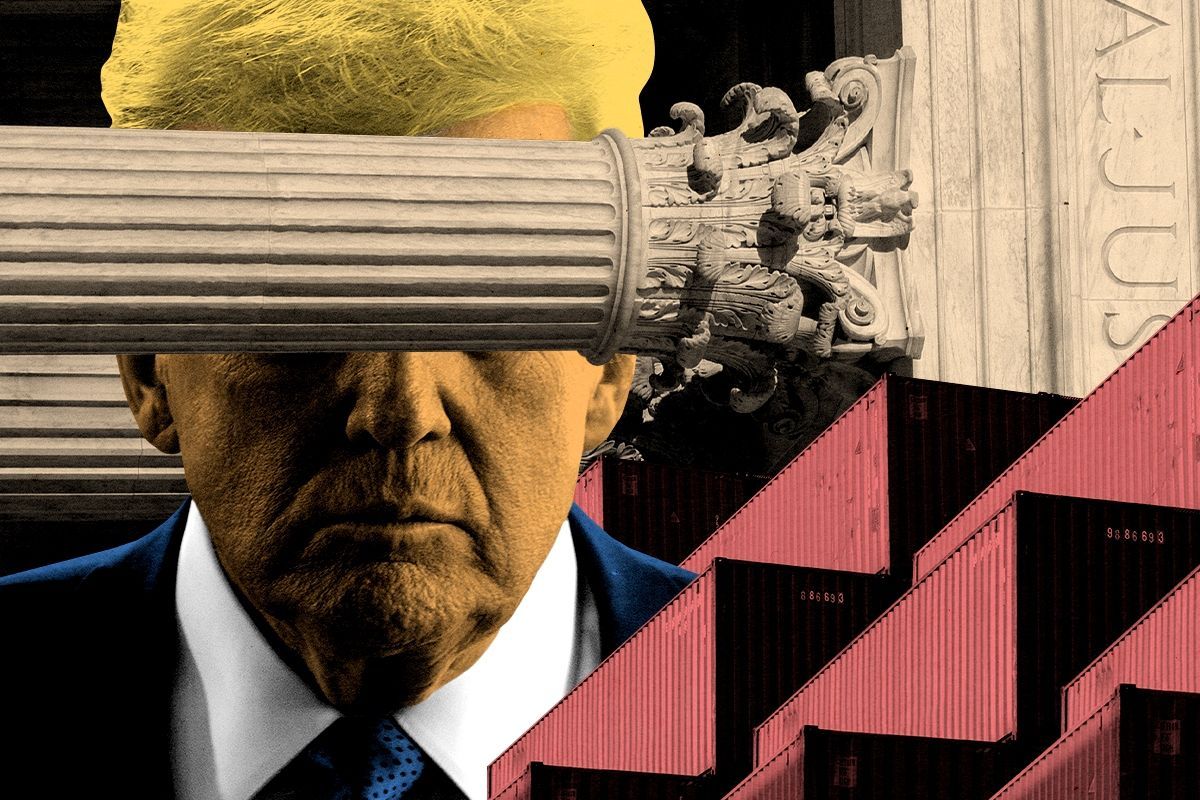
Things are never simple when it comes to tariffs. While the Supreme Court’s decision on Friday finding that the International Emergency Economic Powers Act, better known as IEEPA, did not authorize Donald Trump’s “fentanyl” tariffs on Canada, China, and Mexico, and “reciprocal” tariffs on the rest of the world was unambiguous, tariff policy is still complex and evolving.
Already Trump has said he would use a separate authority to impose a 10% global tariff that can extend as long as 150 days. The administration is also pursuing a number of investigations that will likely result in new tariffs under more well-established authorities.
And none of this changes the fact that the clean energy industry has been tangling with tariffs for years and will continue to do so after today. While companies will likely experience some relief, it may or may not make a material difference.
Here are just some of the factors in play:
Lawyers will be busy
One thing today’s court ruling did not clarify is how companies should go about recovering the funds they’ve already paid toward these tariffs — which, if the tariffs were illegal all along, is money they’re now owed.
The confusion goes deeper than the mere mechanism, however, because while developers may be feeling the impact from tariffs in terms of higher prices from their suppliers — for, say, solar modules — it’s the suppliers they’ve contracted with who are likely entitled to refunds.
“The existing tariffs that are in place as of the date of that contract signing are built into the contract price. And then there’s a provision in there that if new tariffs are introduced, the supplier is entitled to readjust,” Stefan Reisinger, a partner at the law firm Norton Rose Fulbright, told me.
While contracts often have provisions for what to do when a new tariff comes in, they don’t tend to have provisions for tariffs being refunded.
“The agreements don’t have provisions in them that actually deal with the prospect of tariffs being ruled invalid with the supplier getting a refund, so they’re technically not obligated under the contract to flow those refunds down,” Reisinger said.
“I had some preliminary discussions today with suppliers that are in that position, and for business reasons, they’ll likely pass along some portion of the refund,” he added. “There’s going to be countless disputes over who gets the refund and how much.”
Solar tariffs go far beyond IEEPA
The clean energy supply chain is global. Especially for the backbone of the energy transition — solar and storage — China dominates. For some components, like wafers, China has a near monopoly on production. Over 90% of the market for solar cells comes from China. The U.S. lacked even the capacity to produce all components of a solar system domestically until late last year.
Trade restrictions on solar go far beyond the baseline tariffs and the China-specific tariffs addressed in today’s Supreme Court decision, however. There are China-specific restrictions and other tariffs imposed on companies that tried to evade them by setting up manufacturing abroad. The Trump administration is investigating polysilicon, a first step to imposing tariffs. The Biden administration extended and increased tariffs on Chinese solar cells and modules that had been first imposed in 2018. Meanwhile, another set of solar tariffs expired earlier this month.
Still, “I think the biggest impact of the ruling will be for solar and batteries, because they face some of the largest tariffs, and so we’ll see the biggest cost reductions,” Oliver Kerr, North America managing director at Aurora Energy Research, told me. Some manufacturers have already made refund requests — though again, who knows how that will play out.
Solar investors responded with cautious optimism to the court’s tariff ruling. Shares in Canadian Solar, a solar manufacturing company that has been whipped around by tariffs, shot up after the decision was released.
Other solar manufacturers have a more ambiguous relationship to tariffs. First Solar, the leading U.S. solar manufacturer, took a hit following the initial “liberation day” tariffs, as they affected the company’s operations in Vietnam, India, and Malaysia. In regulatory filings with the Securities and Exchange Commission, First Solar has said that, “as it pertains to the countries where we manufacture solar modules, reciprocal tariff rates apply to Vietnam (20%), India (25%), and Malaysia (19%),” and so “as a result, our operating results have and may continue to be adversely impacted by these tariffs.” (Since “liberation day,” the Trump administration has reached trade deals with Vietnam and India.)
When it comes to the tariffs on China, though, First Solar has a clear point of view: They’re good. “Our operating results could be adversely impacted if the IEEPA tariffs on China were to be terminated or reduced,” the company has said in its regulatory filings.
Tax credits make things complicated for batteries
A similar story applies to batteries. China dominates the supply chains for the minerals used in batteries, including cobalt, lithium, and graphite, particularly in the refining stage. Much of the anode graphite material manufacturing sector simply moved to Indonesia in response to the tariffs on China, according to battery analyst Henry Sanderson.
At the same time, battery manufacturers and developers of battery energy storage systems will want to comply with foreign entities of concern rules, which restrict the use of Chinese material and Chinese companies’ involvement in the supply chain for technologies that receive tax credits.
“For storage in particular, they will have the foreign entity of concern, so they will still have to source a meaningful proportion of the content domestically,” Kerr told me. “That matters a little more for batteries because batteries still have access to tax credits through the early 2030s and those tax credits are pretty valuable.”
Another wrinkle: Unrelated to the Trump “reciprocal” tariffs, the Department of Commerce last week finalized punishingly high tariff rates on Chinese active anode material as part of an antidumping investigation.
Advanced technologies are the biggest winners
Many emerging technologies are likely to benefit from tariffs being lifted.
“Anything that relies on industrial inputs, I think there’s a big impact here,” David Yellen, director of climate policy innovation at the Clean Air Task Force, told me.
While protection can work for some industries like steel and aluminum, it doesn’t help much for anyone — including manufacturers — who have to use inputs.
“The blanket policy was that putting tariffs on downstream products and inputs doesn’t actually really protect your domestic industry. It raises prices across the board,” he said, pointing to advanced nuclear and geothermal as high tech industrial processes that have a global supply chain. Drill bits, sensors, and power electronics may all see some price relief.
“To the extent that removing some of these blanket tariffs in the aggregate allows the input prices to go down,” Yellen told me, “I think it may benefit a lot of the capital intensive technologies.”