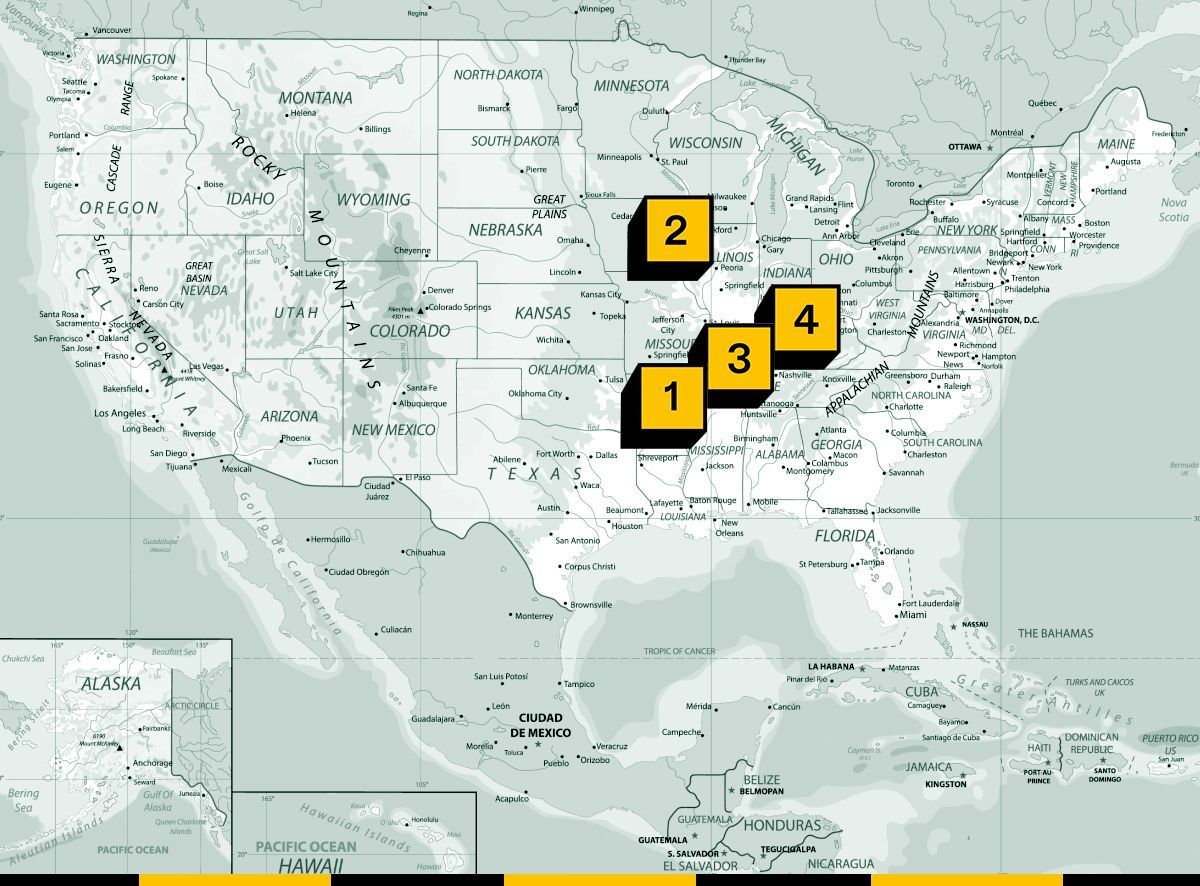
1. Pulaski County, Arkansas – The attorney general of Arkansas is reassuring residents that yes, they can still ban wind farms if they want to.
- As I chronicled earlier this month, the backlash to wind energy in this state is fierce, motivated by a convergence of environmental frustrations and conservative cultural splashback. It bears repeating: there really isn’t much renewable energy in operation here right now.
- The state passed legislation putting restrictions on wind development that was intended to assuage local concerns. But it seems frustrations have boiled to a point where the state attorney general has had to clarify this new law will not get in the way of towns or counties going further, and that the law was merely to create a minimum set of guardrails on wind development.
- “In my opinion, [the law] broadly delegates authority to municipalities and counties, enabling them to enact local laws that address their specific needs, including the possibility of moratoriums on wind development,” Arkansas attorney general Tim Griffin wrote in a letter released this week. “No state or federal law prohibits or preempts a local unit of government from passing moratoriums on the construction and installation of wind turbines.”
2. Des Moines County, Iowa – This county facing intense pressure to lock out renewables is trying to find a sweet spot that doesn’t involve capitulation. Whether that’s possible remains to be seen.
- An opposition group named Des Moines County NO! CWECS successfully got county officials earlier this year to issue a moratorium on wind energy until updates could be made to its ordinance. The county, which is relatively rural and doesn’t include the actual city of Des Moines, extended the moratorium last week for at least another 30 days.
- One of the targets here: AES’ Big River Wind project, which is expected to submit paperwork for approval from the county next year.
- Apparently a major issue is mitigating harm to wildlife. At activists’ urging, the county will consult with both state regulators and the U.S. Fish and Wildlife Service on how best to protect eagles and bats from wind turbines. We’ll be watching to see whether Trump’s more politically-hostile FWS indeed gets involved.
- But an even larger concern here is the risk of turbine failure impacting farmland. Opposition routinely references a situation in Mechanicsville, Iowa, north of Des Moines County, where a farmer last year dealt with a large turbine fire that wrecked their cropland. This is the sort of one-off event that, while an aberration, can scare communities into opposing wind farms.
- Heatmap Pro ranks Des Moines as one of Iowa’s riskiest counties to build in, with survey modeling showing it’s overindexed for concerns about harms to wildlife.
3. Fayette County, Tennessee – This county just extended its solar energy moratorium for at least the next 18 months after pressure from residents.
- Per public records, the county’s planning commission is in the process of developing a workable ordinance that would increase property line setbacks and require approval from the county commission to approve any requests from solar projects for rezoning land (currently, they just ask the zoning board).
- This didn’t fly with folks in this incredibly conservative and mostly rural county. Before a packed hearing room, the commission unanimously voted to extend its moratorium set to expire at the end of September through at least March 2027.
4. McCracken County, Kentucky – It’s not all bad news this week, as a large solar project in Kentucky appears to be moving forward without fomenting difficulties on the ground.
- An AES facility known as “McCracken Solar” is purportedly advancing without much in the way of public complaints. This is a big deal because McCracken County carries a high risk of local opposition cropping up.
- The developer appears to think it is at least in part because of an existing county-level solar ordinance requiring at least 150 feet of distance from any residential property line.
- That being said, McCracken Solar will still need to go through an approval process before the county commission. We’ll be waiting and seeing with this one.