GLOBALVARS
TEST TEST TEST
0
Products
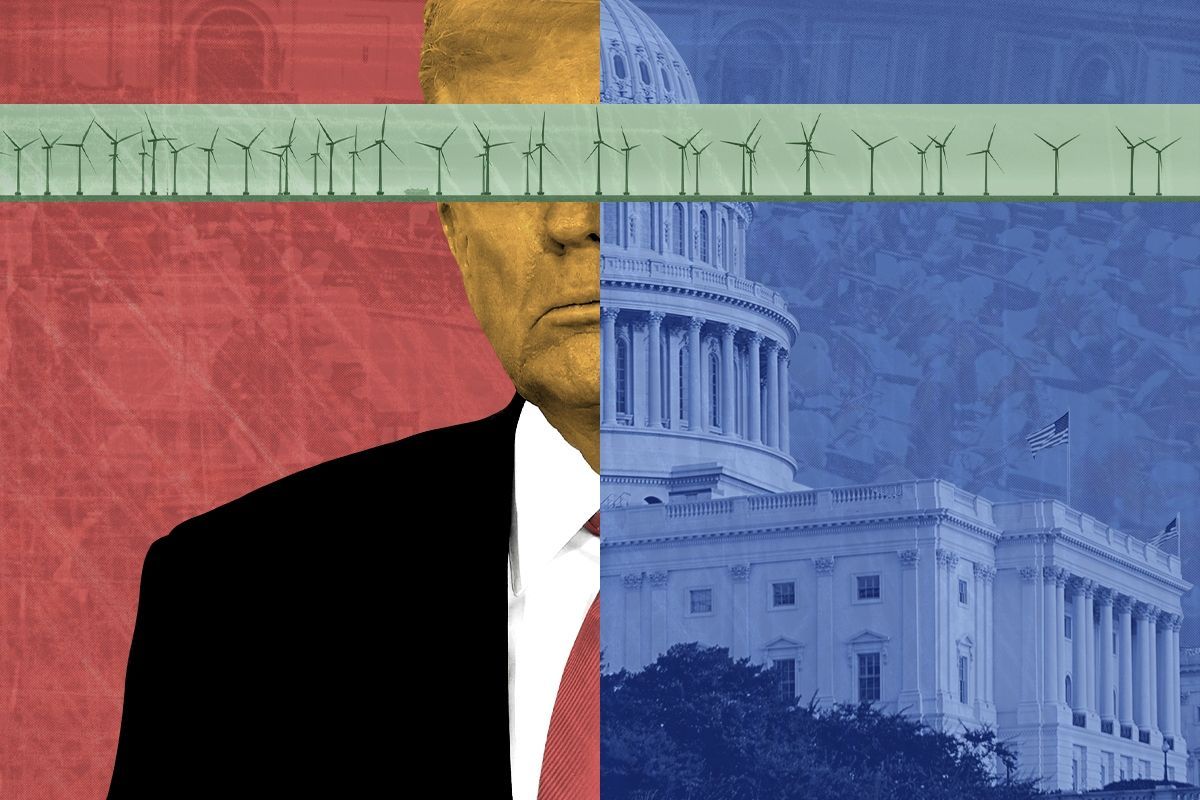
Any bipartisan bill to update the nation’s permitting laws was always going to be a compromise, with advantages for the oil and gas industry as well as clean energy. Proponents of the Senate’s latest attempt at permitting reform have painted it as a delicate balance, a hard-won opportunity, and an all-or-nothing deal.
What, then, to make of drafting errors, or unintended consequences?
In the weeks since senators released the text of the Bipartisan American Affordability and Jobs Act, lawyers have been doing what lawyers often do, which is scour the bill for loopholes and ambiguous language. Many have raised concerns about the risks of one section in particular titled “Project Certainty” that’s designed to prevent presidents from discriminating against projects they dislike, such as by throttling projects that are already under construction, or outright refusing to permit certain types of energy — both of which Trump has tried to do to wind farms.
The red flags range from what were clearly accidental oversights, like that the bill would exempt projects that have obtained all their permits from complying with future regulations, to much more nitpicky, hypothetical issues, like that it might enable a company to orchestrate a permitting delay in order to win a big payout in court.
The question now in front of Senate negotiators before they put the whole package to a vote on November 9 is which of these issues are possible, or even desirable, to address in an amendment without destabilizing the whole package.
“I think there are legitimate legal readings of the bill that are not what was intended, and I think those are where you can make technical fixes,” Nat Keohane, the president of the Center for Climate and Energy Solutions, which supports the bill, told me. “I think there’s some of it that was worked out as part of the broader package that was negotiated over months. And so, which things fall into which bin? That’s up to the authors.”
It’s no secret that getting politics out of permitting was table stakes for the bill’s Democratic authors, Senator Sheldon Whitehouse of Rhode Island and Senator Martin Heinrich of New Mexico. Neither responded to questions about whether they were aware of critics’ concerns about these provisions or open to revising the language, although many sources I spoke to for this story told me they were aware of efforts underway on the Hill to make corrections to this section.
Heinrich’s office instead forwarded my inquiry to the American Council on Renewable Energy. In an interview, ACORE’s CEO Ray Long argued that some of the concerns lawyers have raised are valid, and tweaks and technical corrections are “fine” — but only if they don’t hold back the bill from a vote this year. He stressed that between the bipartisan permitting bill debated by the previous Congress and BAAJA, the Hill has been working on this issue for four years. “I think we should stop trying to make this bill perfect,” he said. “Consider it for what it is, which is a well-intentioned bill on both sides to get to a compromise that addresses a whole range of things and move forward with that.”
Certainty for existing permits
The “Project Certainty” section of the bill has two key components that critics are concerned about. The first is a set of provisions meant to prevent an administration from yanking permits or otherwise messing with projects that have all of their approvals, such as when the Trump administration revoked the Lava Ridge wind farm’s right-of-way, or when it issued stop-work orders on five offshore wind farms that were under construction.
The main issue here is that the text is written very broadly. It doesn’t just say that agencies can’t revoke permits; it says they can’t take any action “to interfere with or prevent the construction or operation at full capacity of a project” that has secured all of its federal approvals.
“That ‘operation at full capacity’ language seems to prevent any future action that could require existing facilities to modernize their technology or take steps to reduce their pollution,” Liz Zeleda, the federal regulatory director at the Southern Environmental Law Center, told me.
Of all the issues critics of the bill have raised, this one seems to have pretty unanimous support for a correction. “Nobody, I think, wanted to negotiate some kind of regulatory freeze here, and it’s a pretty clear technical fix,” Jane Flegal, a senior fellow at the Searchlight Institute, told me. “I have confidence that the negotiators will fix it.”
Then there are concerns that the bill would render any permits or authorizations issued by the Trump administration irrevocable, even if they were issued illegally. John Podesta, Biden’s former senior climate advisor, recently raised that possibility during a fireside chat at the University of Colorado Boulder. “They’re going to have a permit gorge like you’ve never seen, not really caring about whether they’re going through the legal steps to do it, and under this bill that’s not going to be reversed,” he said. His comments quickly ignited a fierce debate on social media over whether this was an accurate reading of the text.
The bill does list several exceptions that would allow agencies to revoke permits or authorizations, such as under a court order, or when the developer has violated the terms of the permit or another applicable law, or if the developer obtained the permit under false pretenses, or if revoking the permit is necessary to prevent imminent harms that were not identified in the original review process. Notably, “when the government’s authorization violates the law” is not on the list.
Nonetheless, a harmed party would still be able to make the case that Trump violated the Administrative Procedure Act in issuing a permit and get a court to vacate it, Ben Schifman, a senior technology fellow at the Institute for Progress and former Department of Justice lawyer, told me. The only edge case where that would not be true, as far as he can tell, is if the sole legal infraction in the permitting process was a violation of the National Environmental Policy Act or the National Historic Preservation Act, and no other applicable law. In that situation, the bill would, in fact, restrict the court from vacating the permit. However, a case like that is unusual, he said. “I will tell you, in all of my 10 years of practicing this kind of law at DOJ, it was very rare, and I’m struggling to think if there was even a single case that literally only brought one claim that was a NEPA claim.”
On the other hand, Sambhav Sankar, the senior vice president of programs at Earthjustice, argues that this interpretation assumes groups like his have the means to challenge all of the potentially illegal permitting decisions Trump makes. “We don’t have anywhere near the resources required,” he wrote in a blog post about Podesta’s comments, “and this legislation is explicitly aimed at making our challenges much harder to bring.” It’s not like the next administration will be able to sue itself to get a court order to vacate permits, he noted.
When I asked Shifman about this, he suggested the agency might be able to sue the permit holder, but admitted this was an ambiguity in the bill and “a good candidate for a few-word technical amendment.”
Certainty for permit applicants
The second component of the “Project Certainty” title that’s raising alarm is a series of provisions meant to prevent unfair delays or denials for projects trying to obtain permits. The Trump administration, for example, has subjected wind and solar projects applying for permits to heightened reviews at the Interior Department, and simply stopped providing Department of Defense clearances to wind farms altogether.
The bill sets up a new legal pathway for project developers to sue the government for delaying or denying permits if they can demonstrate they are being targeted as part of a larger “pattern of disparate treatment.” To bring such a case, the developer would have to show its specific project type — a wind farm, for example — has seen a “substantial increase” in delays or denials compared to the previous five years. It may, but doesn’t have to, also produce supporting evidence, such as statements made by federal officials demonstrating a bias.
The choice of five years is the first thing that caught lawyers’ attention. Shortly after the bill came out, Matthew Littleton, a former deputy assistant attorney general at the U.S. Department of Justice’s Environment and Natural Resources Division, argued on LinkedIn that this baseline would be unlikely to help clean energy projects in the near term, since once the law goes into effect, the preceding five years will be dominated by Trump administration obstruction.
If you’re optimistic that the next administration will be less hostile to renewable energy, that’s only a short-term problem. But by that same token, imagine a Democrat takes the White House in 2029, and for entirely legal reasons, their administration rejects more natural gas plant permits than Trump did. Perhaps the previous Environmental Protection Agency didn’t account for some newly significant risk. Under BAAJA, developers would have grounds to sue the government for exhibiting a “pattern of disparate treatment.”
While the choice of five years has been debated, a lot of the risks with this provision actually stem from the bill’s limits on what the government can do to defend its actions. While the text gestures at “improper” denials, “unreasonable” delays, and a show of government intent, it doesn’t actually require the plaintiff to prove any of those things to win a case. It specifically limits the court’s review to three things: the evidence produced by the project sponsor; the administrative record for the particular project in question (i.e. the permit application and agency response); and raw, statistical data from the government showing the number of projects of the same type that received approvals over the past year compared to the previous five, as well as the number that received denials or got delayed.
Per Littleton’s interpretation, the developer need not prove the agency acted in bad faith, and the court can’t even take into account a potentially well-reasoned explanation by the government for why the data display a certain pattern. Schifman mostly agreed with this, but noted that it’s possible the administrative record would contain evidence about why the disparity occurred.
It’s possible that technical fixes to this section requiring “credible evidence of intentional targeting” for claims and that courts review the entire evidentiary record, as the Natural Resources Defense Council has suggested, could go a long way toward addressing this issue. Scholars at Columbia University’s Center on Global Energy Policy have recommended limiting these claims to delays, which are tied to clear timing benchmarks, and removing the provision for denials. “Courts can already overturn unlawful denials, so the denial provision adds little protection while creating most of the risk,” they wrote.
But there are other complications.
The bill specifies that if a developer wins a “disparate treatment” case, the government has to fork over 50% to 100% of the project’s total costs, in addition to any attorney fees and monetary damages resulting from the permitting delay or denial.
Justin Pidot, a law professor at the University of Arizona who served as General Counsel to Biden’s Council on Environmental Quality, told me that this could have the effect of “putting handcuffs on the government,” in that agencies will be under pressure to make decisions that avoid a legal challenge. That is, of course, the point of the provision, but to Pidot, it impinges too much on agency discretion. The Columbia scholars raised this concern as well, writing, “Facing that risk, agencies may approve projects they would otherwise reject, potentially including projects they consider unsafe.”
At the same time, the prospect of such a big payout may tempt developers to test agencies’ limits. “It just creates all sorts of perverse incentives,” Pidot said. “In that world, a project sponsor would be wise to try to figure out how to get the government to delay approving their projects so that they could bring this lawsuit.”
What’s more, the project sponsor is only allowed to keep its winnings if it actually completes the project, but nothing in BAAJA requires the government to approve a permit in these cases. A court might order an agency to make a decision on a delayed permit or reconsider an application it rejected, but the administration could just go on delaying or denying the project until the developer runs out of financing and can’t hold on any longer.
“As far as I can tell, if you have to abandon the project before you can build it, you don't get anything,” Littleton said. “I'm just sort of flummoxed by the way this is set up.”
Are technical fixes enough?
While everyone I spoke to seemed to agree that the project certainty title in the bill could use some redlining, there was a split between those who believed small “technical fixes” would do the trick and those who were skeptical the provisions would be successful without an overhaul.
The Environmental Protection Network, a group of former EPA staffers, recently published a number of suggested technical changes to improve the section on revoking existing permits. They called for adding several more exceptions for when an agency can revoke or amend a permit, such as when the action is “authorized by Federal law and brought by the Federal department or agency alleging a violation of Federal law.” The challenge with adding more exceptions is that it will give the government more wiggle room to justify revoking permits — a slippery slope.
EPN also suggested adding a clause specifying that “nothing in this title affects the applicability of any requirement under” the Clean Water Act, the Clean Air Act, and the like, and protecting taxpayers “from potentially hundreds of billions of dollars” in fines paid out to litigants by limiting the financial remedies to “actual damages and court costs.”
The NRDC suggested changing the five-year baseline in the disparate treatment section, and eliminating the “disproportionate” stipulated financial awards, although it did not specify how. The Columbia scholars urged Congress to consider tying the financial awards “more closely to a developer’s actual losses while keeping enough of a penalty to deter deliberate abuse.”
While these kinds of changes may “curb some of the worst excesses” of the project certainty provisions, Littleton told me, that’s not his preferred outcome. “Ultimately, I think they need to be rethought in order to accomplish their purpose.”
Long, of ACORE, held that concerns about project certainty “aren’t a reason to hold up all the work that’s been done so far,” and suggested that Congress could pass a corrections bill down the line should they turn out to be real problems.
One funny thing about this “project certainty” part of the permitting bill is that critics and proponents both seem to accept that there is no foolproof way to stop a president who is truly hell-bent on messing with an industry from doing so. The question is, is it worth trying?