
Current conditions: Winter Storm Fern may have caused up to $115 billion in economic losses and triggered the longest stretch of subzero temperatures in New York City’s history • Temperatures across the American South plunged up to 30 degrees Fahrenheit below historical averages • South Africa’s Northern Cape is roasting in temperatures as high as 104 degrees.
THE TOP FIVE
1. Trump takes an equity stake in another rare earth company
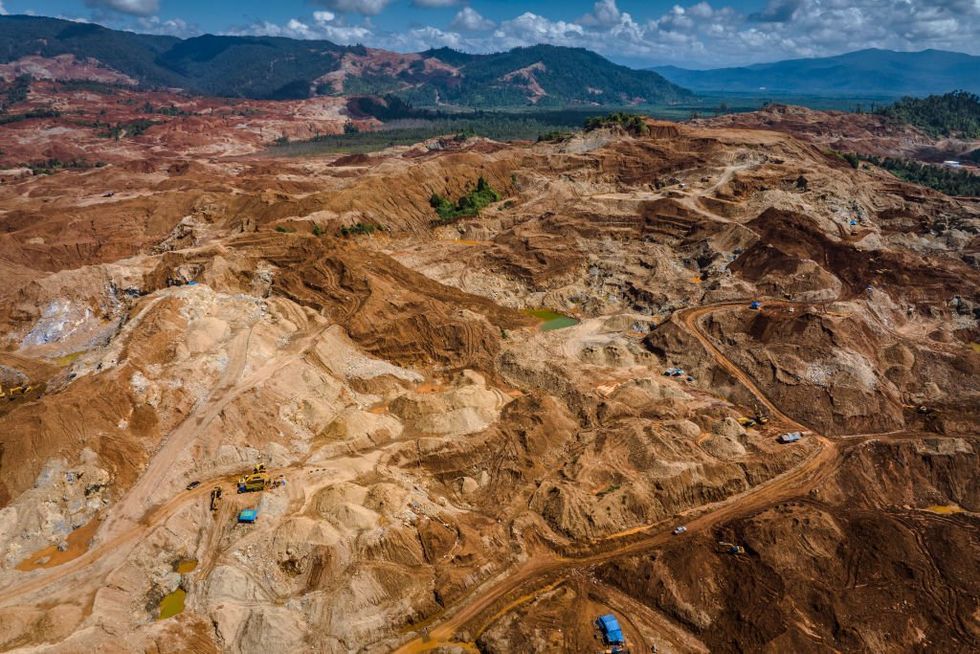
President Donald Trump has been on quite a shopping spree since taking an equity stake in MP Materials, the only active rare earths miner in the U.S., in a deal Heatmap’s Matthew Zeitlin noted made former Biden administration officials “jealous.” The latest stake the administration has taken for the American taxpayer is in USA Rare Earth, a would-be miner that has focused its attention establishing a domestic manufacturing base for the rare earth-based magnets China dominates. On Monday, the Department of Commerce announced a deal to inject $1.6 billion into the company in exchange for shares. “USA Rare Earth’s heavy critical minerals project is essential to restoring U.S. critical mineral independence,” Secretary of Commerce Howard Lutnick said in a statement. “This investment ensures our supply chains are resilient and no longer reliant on foreign nations.” In a call with analysts Monday, USA Rare Earth CEO Barbara Humpton called the deal “a watershed moment in our work to secure and grow a resilient and independent rare earth value chain based in this country.”
2. Century Aluminum overhauls plans for to build America’s first smelter in 50 years
After two years of searching for a site to build the United States’ first new aluminum smelter in half a century, Century Aluminum has abandoned its original plan and opted instead to go into business with a Dubai-based rival developing a plant in Oklahoma. Emirates Global Aluminum announced plans last year to construct a smelter near Tulsa. Under the new plan, Century Aluminum would take a 40% stake in the venture, with Emirates Global Aluminum holding the other 60%. At peak capacity, the smelter would produce 750,000 tons of aluminum per year, a volume The Wall Street Journalnoted would make it the largest smelter in the U.S. Emirates Global Aluminum has not yet announced a long-term contract to power the facility. Century Aluminum’s original plan was to use 100% of its power from renewables or nuclear, Canary Media reported, and received $500 million from the Biden administration to support the project.
3. Federal mining watchdog restricts public access to inspection data
The federal Mine Safety and Health Administration has stopped publishing data tied to inspections of sites with repeated violations, E&E News reported. At a hearing before the House Education & the Workforce Subcommittee on Workforce Protections last week, Wayne Palmer, the assistant secretary of labor for mine safety and health, said the data would no longer be made public. “To the best of my knowledge, we do not publish those under the current administration,” Palmer said. He said the decision to not make public results of “targeted inspections” predated his time at the agency. The move comes as the Trump administration is pushing to ramp up mining in the U.S. to compete with China’s near monopoly over key metals such as rare earths, and lithium. As Heatmap’s Katie Brigham wrote in September, “everybody wants to invest in critical minerals.”
Sign up to receive Heatmap AM in your inbox every morning:
4. South Korea announces 2 new large-scale nuclear plants
South Korea’s center-left Democratic Party has historically been staunchly anti-nuclear. So when the country’s nuclear regulator licensed a new plant earlier this month — its first under a new Democratic president — I counted it as a win for the industry. Now President Lee Jae-myung’s administration is going all in all on atomic energy. On Monday, NucNet reported that the state-owned Korea Hydro & Nuclear Power plans to open bidding for sites for two new large reactors. The site selection is set to take up to six months. The country then plans to begin construction in the early 2030s and bring the reactors online in 2037 and 2038. Kim Sung-whan, the country’s climate minister, said the Lee administration would stick to the nuclear buildout plan authored in February 2025 under former President Yoon Suk Yeol, a right-wing leader who strongly supported the atomic power industry before being ousted from power after attempting to declare martial law.
5. Geoengineering nonprofit launches database to bolster research
Reflective, a nonprofit group that bills itself as “aiming to radically accelerate the pace of sunlight reflection research,” launched its Uncertainty Database on Monday, with the aim of providing scientists, funders, and policymakers with “an initial foundation to create a transparent, prioritized, stage-gated” roadmap of different technologies to spray aerosols in the atmosphere to artificially cool the planet. “SAI research is currently fragmented and underpowered, with no shared view of which uncertainties actually matter for real-world decisions,” Dakota Gruener, the chief executive of Reflective, said in a statement. “We need a shared, strategic view of what we know, what we don’t, and where research can make the biggest difference. The Uncertainty Database helps the field prioritize the uncertainties and research that matter most for informed decisions about SAI.” The database comes as the push to research geoengineering technologies goes mainstream. As Heatmap’s Robinson Meyer reported in October, Stardust Solutions, a U.S. firm run by former Israeli government physicists, has already raised $60 million in private capital to commercialize technology that many climate activists and scientists still see as taboo to even study.
THE KICKER
Often we hear of the carbon-absorbing potential of towering forest trees or fast-growing algae. But nary a word on the humble shrub. New research out of China suggests the bush deserves another look. An experiment in planting shrubs along the edges of western China’s Taklamakan Desert over the past four decades has not only kept desertification at bay, it’s made a dent in carbon emissions from the area. “This is not a rainforest,” King-Fai Li, a physicist at the University of California at Riverside, said in a statement. “It’s a shrubland like Southern California’s chaparral. But the fact that it’s drawing down CO2 at all, and doing it consistently, is something positive we can measure and verify from space.” The study provides a rare, long-term case study of desert greening, since this effort has endured for decades whereas one launched in the Sahara Desert by the United Nations crumbled.