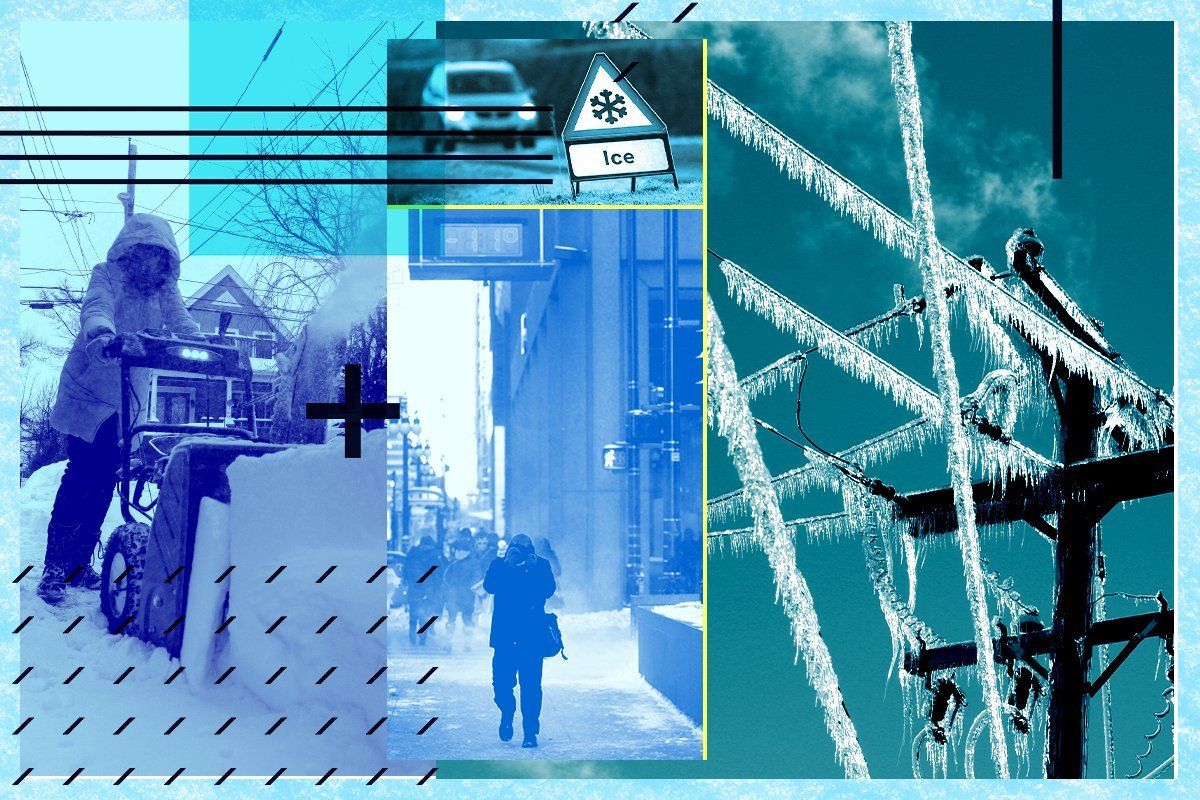
Winter Storm Fern made the final stand of its 2,300-mile arc across the United States on Monday as it finished dumping 17 inches of “light, fluffy” snow over parts of Maine. In its wake, the storm has left hundreds of thousands without power, killed more than a dozen people, and driven temperatures to historic lows.
The grid largely held up over the weekend, but the bigger challenge may still be to come. That’s because prolonged low temperatures are forecasted across much of the country this week and next, piling strain onto heating and electricity systems already operating at or close to their limits.
What issues there have been were largely due to damage in the transmission and distribution system, i.e. power lines freezing or being brought down by errant branches.
The outages or blackouts that have occurred have been the result of either operational issues with plants, scheduled maintenance, or issues specifically with snow affecting the distribution system. As yet there’s been no need for rolling blackouts to relieve grid congestion and preserve the system as a whole. Speaking about the country’s largest electrical grid, Jon Gordon, a director at Advanced Energy United, told Heatmap: “So far, so good.”.
But this is all assuming we just get more cold weather. We could be in for another storm. Since late last week, the forecasting model maintained by the European Centre for Medium-Range Weather Forecasts — one of the two primary computer forecasting models, and generally considered more accurate than its analogue, the American model — has suggested there could be another major winter storm headed toward the Eastern U.S. next weekend. Whether it hits the Eastern Seaboard, clips it, or stays offshore, it’s still early to say with any confidence.
Should that storm hit, here’s what it’ll be barreling into.
More cold will test the grid
Temperatures will likely remain below 0 degrees Fahrenheit across swaths of PJM Interconnection — the country’s largest regional transmission organization, covering the Mid-Atlantic through portions of the Midwest — with parts of Pennsylvania and Ohio not expected to see a day above freezing for the next two weeks.
Put simply, cold temperatures stress the grid. That’s because cold can affect the performance of electricity generators as well as the distribution and production of natural gas, the most commonly used grid fuel. And the longer the grid has to operate under these difficult conditions, the more fragile it gets. And this is all happening while demand for electricity and natural gas is rising.
Forced outages — which happen when power is pulled offline due to some kind of unexpected event or emergency — peaked on Sunday in PJM at just over 17,000 megawatts, while total outages were over 22 gigawatts on Monday, according to Grid Status’s Tim Ennis, who said some of them may have been due to ice “ice accumulation across Virginia.”
The market has also been serving more than its own 13-state territory. Already on Saturday — after the fierce cold had set in across its territory but before snow arrived — PJM noted to the Department of Energy that it had been asked to provide up to 3,000 megawatts to neighboring grids, and that it had already seen outages of around 20,000 megawatts — enough to serve 16 million people.
Kentucky, Virginia, and West Virginia reported the highest number of customers without power in the PJM region as of Monday afternoon, largely due to ice and snow that brought down tree branches on power lines or toppled utility poles.
Meanwhile, snow was still falling across New England on Monday afternoon, where parts of Massachusetts have received up to 20 inches. Another 8 inches could still accumulate on the Atlantic coast due to the ongoing lake effect, a common winter pattern in which cold Canadian air picks up moisture over the warmer Great Lakes, resulting in heavy snow downwind.
Though there were minimal blackouts in New England’s electricity market as of Monday morning, natural gas has fallen to just 30% of the grid’s fuel supply, from more than half at the same time a week earlier, with nearly 40% of its electricity output coming from oil-fired plants, Reuters reports. Solar generation peaked at less than a gigawatt on Sunday due to cloud cover, compared to over 4 gigawatts on Saturday and over 3 gigawatts on Friday. During the summer, ISO-NE’s combined behind-the-meter and utility-scale solar production can get as high as eight gigawatts.
The Department of Energy granted ISO New England, emergency permission to operate generators at maximum capacity, regardless of air quality and environmental standards. (It also granted the same dispensation to PJM and Texas’ grid operator, ERCOT.)
The most widespread outages in the country were concentrated in Tennessee, with some 230,000 customers in Nashville Electric Service’s area without power at one point. The disruptions were largely caused not by grid demands, but rather by nearly 100 broken utility poles and more than 70 distribution circuits taken down by the snow and ice, Utility Dive reported.
Mississippi and Louisiana also had outages, with around 4% of Energy customers offline according to Jefferies data, and around 10% of Entergy customers in Mississippi being affected by blackouts. By contrast, Jefferies data shows, less than 1% of Texas electricity customers were offline.
Fuel will be expensive
Typically, cold weather means higher natural gas prices, as the demand for home heating goes up alongside demand for electricity. The 44.2 billion cubic feet of natural gas forecast to be burned today would be the fifth highest January burn of all time in the U.S., according to Matthew Palmer, executive director at S&P Global Energy, in an email. The extended cold weather is expected to push natural gas stockpiles to their lowest since the winter of 2021 to 2022, according to S&P data.
Benchmark natural gas prices have shot up to $6.50 per million British thermal units, up from $5.28 on Friday. Crude oil prices by contrast were down slightly today, while heating oil prices were up around 5%.
High natural prices means that power markets are also expecting higher prices. Day-ahead average wholesale prices in Texas for 9 a.m. were almost $1,500 per megawatt-hour, compared to just $100 in the real-time market. In PJM, average real-time prices were around $270 at 9 a.m. compared to $482 in the day-ahead market.
“The worst is over, but we are expecting bitterly cold temperatures throughout the week. Please continue to avoid unnecessary travel and be vigilant about ice.” New Jersey Governor Mikie Sherrill, who had made electricity prices the centerpoint of her election campaign as well as her early days in office, said in a statement.
No immediate relief
“While the worst of the snow is over, prolonged cold is still expected,” Jefferies analyst Julien Dumoulin-Smith wrote in a note to clients Monday. That can lead to “resource adequacy events,” i.e. blackouts, “as fuel supplies get strained and plants face operational strains from more significant run-time.”
There’s particular pressure and attention during this cold snap on ERCOT, the Texas grid operator, after 2021’s Winter Storm Uri, which brought ice, snow, and below-0 temperatures to much of the state. Natural gas wellheads froze up as much of the system for pumping and distributing natural gas lost power. Power plants were “unprepared for cold weather,” a report from the Federal Energy Regulatory Commission found, “and thus failed in large numbers.” ERCOT had to order power plants to shut down for several days in order to protect the system as a whole from falling perilously out of frequency, which would have risked a complete blackout. Around 60% of the state’s households rely on electricity for heating, and the long freeze-out left 4 million homes and businesses without power. More than 200 people died.
In the intervening years, Texas has introduced new capacity and reforms meant to prevent a similar tragedy. While ERCOT “does not anticipate any reliability issues on the statewide electric grid,” per a spokesperson, the operator flagged for the DOE that low temperatures in the week ahead could raise demand to an “extreme level” that poses “significant risk of emergency conditions that could jeopardize electric reliability and public safety.” So far, though, it’s been holding up, with peak demand expected Monday morning and outages mostly limited to East Texas due to downed power lines.
The Tennessee Valley Authority, which operates a vertically integrated grid centered in Tennessee and spanning several neighboring states, warned of “extreme cold” in the coming days, but said that its generation fleet — which includes coal, natural gas, and nuclear power plants — was “positioned to meet rising demand.” As of Monday morning, TVA said that 12 of the 153 power companies it serves had “distribution issues” related to the storm.
One Mississippi power company in the TVA system said that it had “suffered catastrophic damage” to its distribution system, specifically a 161 kilovolt transmission line operated by the TVA. The cold weather has dealt a double blow to the system, with TVA officials reporting ice on transmission and distribution lines as well as icy conditions making it difficult to service lines in need of repair.
Currently, TVA is forecasting that demand will peak Tuesday at just over 33,000 megawatts, according to EIA data. The system’s all-time winter peak is 35,430 megawatts.
PJM also expects several more days of tight conditions on the grid thanks to forecasted cold weather. The grid operator issued a “maximum generation emergency/load management alert” on Monday morning through at least the end of the day Tuesday, indicating that it needed to maintain high levels of generation throughout the system. It also asked generators for specifics on when any scheduled maintenance would be over in order to more carefully schedule operations to maintain reliability.
Over the weekend, PJM told the Energy Department that peak demand could exceed 130,000 megawatts “for seven straight days, a winter streak that PJM has never experienced.” The grid operator expects project peak demand over 147,000 megawatts on Tuesday, exceeding the previous record of 143,700 megawatts set last January. Demand peaked at 135,000 megawatts on Saturday and 129,000 megawatts on Sunday.