GLOBALVARS
TEST TEST TEST
0
Products
Nicholai Allen, a Southern California wildland firefighter, opened his Instagram DMs this summer to find a photo of a beautiful A-frame home set against a backdrop of mountains and pine forests. At first glance, it looked almost like an advertisement for a vacation rental. But the amazing thing about the picture was not the cozy mountain scene, but the fact that the house was still standing. “Very thankful this product works,” read the accompanying text. “Saved our house and all our outbuildings. Little Giant Fire.”
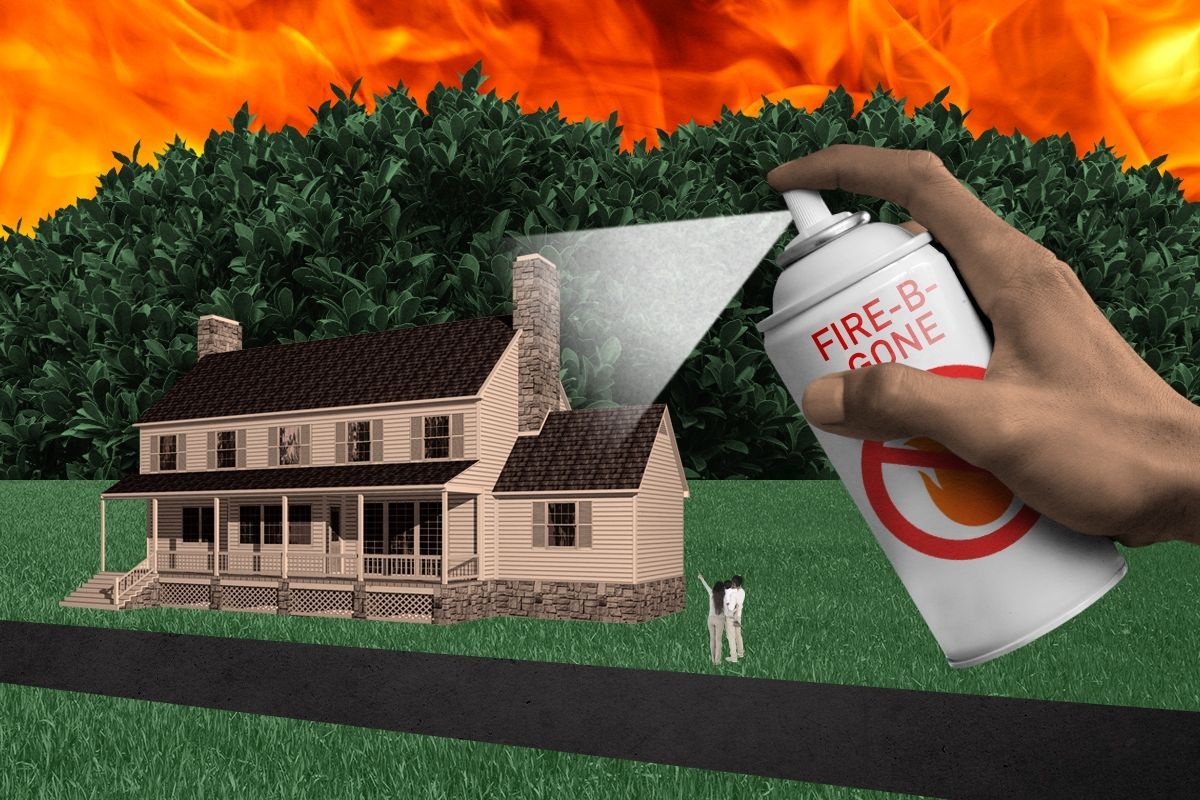
Allen is a firefighter — he was on the scene when the Pacific Palisades burned in 2025 — and a wildfire survivor, having evacuated his family from the deadly Woolsey Fire near Malibu in 2018. He’s also the founder of Safe Soss, a home-hardening company advertising a “three-step supplemental wildfire defense system,” which includes a carbon filter ember guard, ember tape, and the company’s marquee product: an ammonium phosphate-based wildfire risk-reduction spray. They’re all sold at Lowe’s, where you can get the whole kit for less than $200.
“In the aftermath [of the Woolsey fire], I kept asking: How come some homes survived, and some didn’t?” Allen recounted to me. “Some get retardant dropped on them, and some don’t. I thought, ‘Why don’t homeowners just do their own fire‑retardant drops so we’re not leaving that to chance?’”
The Little Giant Fire was Washington’s biggest fire of the 2026 season, and hearing from the homeowner who made it through intact “made my whole year, frankly,” Allen told me. But one happy customer doesn’t settle the lively and ongoing debate in the fire safety world about the effectiveness of wildfire mitigation products, which can range from lumber and vegetation treatment sprays to rooftop sprinkler systems and mesh vent covers. Some products — like a Class A metal roof resistant to ordinary combustible material like wood — are widely agreed to be effective, but can cost $10,000 or more. An off-the-counter mesh vent, spray, or treated wood is vastly cheaper — and certainly less overwhelming to install — but also a grayer area in terms of efficacy.
“To me, the concept of treating wood because you think it’s going to be fire-resistant or not ignitable is fooling yourself,” Beth Burnam, the Firewise USA Regional Coordinator for California’s Mono and Inyo counties, told me.
No single certification, organization, or agency vets new home-hardening treatments and systems before they hit the market, even as that market continues to grow; one estimate puts the wildfire home retrofit industry at $4.8 billion by the end of 2033, up from $2.1 billion in 2024. The stakes are high for homeowners, too, who not only put their faith in the hands of such products to protect what’s likely their largest asset, but who might spend $2,000 to $87,000 on a full hardening retrofit, a 2025 study by Earth Economics found.
Burnam’s assessment of the burgeoning home hardening market was blunt. “There’s a lack of knowledge base, and then there’s all the shysters out there trying to sell you the next best, greatest product that will let people pretend to sleep at night,” she said.
At the same time, it’s not the Wild West for home hardening products. The California State Fire Marshal tests wildfire-resistant building products and publishes a handbook of approved materials. The Insurance Institute for Business & Home Safety, a scientific research group that operates a large-scale ember lab for lighting things on fire, has also published a series of white papers on mitigation product categories, including one on flame retardant coatings.
In that report, the IBHS found that sprays and paints could potentially provide “enhanced protection to buildings during a wildfire” — but its researchers also raised concerns about the products’ durability. “It’s really hard to have something that you spray or paint onto a wooden surface maintain its fire-resistant or retardant capacity in a period that’s longer than a year,” Spencer Eusden, the curriculum developer of Living With Fire, a wildfire preparedness and education program based out of the University of Nevada, Reno, explained to me. “There’s so much UV exposure; there’s moisture. Wood contracts and expands as it changes temperature, so it’s hard to maintain a treatment.”
That conclusion is consistent with similar research by the U.S. Forest Service around flame-resistant paints. Laura Hasburgh, a materials research engineer at the Forest Service’s Forest Products Laboratory in Madison, Wisconsin, and one of the authors of that study, told me in an email that while flame-retardant vegetation treatments fell out of the scope of that particular research, she’s skeptical about them, too. “A vegetation spray might temporarily alter fuel moisture or flammability under particular conditions, but its performance could be affected by time since application, rainfall, irrigation, heat, wind, plant growth, uneven coverage, and the intensity of an approaching fire,” she said.
“In general, a product’s marketing claims should not be treated as proof that it can protect a home or stop a wildfire,” Hasburgh added. In general, she encouraged customers to “look for independent test results” and find out whether a company’s claims are “supported by a recognized testing organization or fire-safety authority.”
That doesn’t mean all sprays and foams are worthless, though. Stuart Mitchell, the founder of Wildfire Mitigation Advisors, a Santa Rosa-based home hardening consultancy, told me they have a time and place. “A simple example is: I would say, don’t have a fence connected to your home,” he said. “But if you say, ‘Well, my dad made that fence and gate, and it’s really dear to me,’ I’d say let’s keep it. Let’s go to plan B: Give that fence or gate defensible space, and then coat it in a long-lasting flame retardant coating.” Eusden, the Living With Fire curriculum developer, likewise said vegetation treatments can be useful when done by professionals, though he echoed Hasburgh’s urging that most homeowners are likely to find their time and energy better spent on other treatments such as moving vegetation back from a house.
Safe Soss’ spray, notably, is intended as a temporary treatment rather than a long-term solution. It’s designed to be applied during a red flag warning or when a home is under a pre-evacuation notice, which Allen said means it doesn’t need to last as long as a once-a-decade paint job. (He told me that a single application can last up to three months.) The product was self-certified by its Japanese manufacturer in a standard UL crib test, which is used to test fire extinguishers against a standardized pile of burning sticks (a “crib”) in a lab. But it also means it was only formally lab-tested as a “wetting agent,” i.e. basically a fire extinguisher, rather than as a retardant used to treat wood or vegetation before a fire. It’s a distinction that Allen is conscious of, since he doesn’t want Safe Soss to encourage people to stay behind and use it to fight fires themselves.
Instead, Allen told me he’s field-tested Safe Soss by using it himself on prescribed burns — that is, to help contain controlled intentionally set fires ignited by other fire professionals, sans the chaos of an actual wildfire but under real world conditions in a forest or field, rather than in a lab. The results were enough to give him the confidence to launch the product for commercial sale. “I can pursue more certifications as time goes on,” he told me. “But if I can help people right away, I’m not going to hold it up until I get some arbitrary number.”
Another company, CitroTech, produces what it boasts is the “only long-term fire inhibitor recognized by the EPA Safer Choice program,” a voluntary certification that is focused not on fire resistance but on the use of safe chemicals. While the company also makes an outdoor vegetation treatment spray, its chemicals are primarily designed for treating interior lumber, where concerns about weathering are less of a factor, Aaron Good, the company’s director of sales, told me. (California State Fire Marshal has not certified CitroTech, but the company is working to get it onto the Forest Service’s Qualified Products List.)
CitroTech also installs rooftop sprinklers on homes, which can activate during a wildfire to saturate a roof and surrounding vegetation with, in this case, CitroTech's proprietary fire inhibitor. But many home-hardening experts I spoke with expressed doubt about sprinkler systems more generally, which often rely on water mains and electrical grids that are prone to fail during major disasters. “After you’ve done all your other home hardening and defensible space work that you need to do, if you still have money left over, go ahead and buy a sprinkler system,” Burnam said. “But understand, it probably won’t work.”
Other experts warned that the water or chemical treatment likely won’t go where you need it to, could be blown away by the high winds that often accompany major conflagrations, or cause water damage to the home. Good himself acknowledged that fires can burn for weeks, offering the example of the 2025 Palisades fire, which burned for 28 days. “If you’re trying to protect a home or a property, that means you need access to water and power for the full 28 days throughout.” CitroTech’s chemical applicant uses no water, insulating it from the water failure problems its competitors face in a disaster like Palisades, though it still relies on working electricity.
Burnam told me that one of the fundamental problems with home hardening is a misunderstanding of how homes actually ignite. For too long, she said, experts — and firefighters in particular — have focused on direct flame contact as a source of ignition, such as when a bush or tree alongside an exterior wall of a home catches fire, and it spreads to the house. Direct flame contact makes creating a defensible space important — that is, the all-important buffer zones around your home where vegetation is removed in order to slow the progress of a wildfire. But it’s also why sprays and plant treatments can be so seductive to a concerned homeowner browsing the shelves of their local hardware store: It’s probably how you’d imagine a home catching in a wildfire, but you’d mostly be wrong.
Homes can also ignite from radiant heat, when materials exposed to a nearby fire get so hot they combust. But it’s the third ignition pathway, embers, that causes an estimated 90% of housing loss and damage during wildfires. Embers can travel two miles or more from the main fire front and drift into garages and attics through vents, igniting a house from the inside out. They also tend to accumulate in gutters or at meeting points between materials, such as an angle on a roof or at the edge where a house meets a deck. This is why roof replacements and covered gutters, while extraordinarily costly, are some of the best money you can spend to protect your home.
In fact, when Allen received the DM about the home in the Little Giant Fire, the homeowner didn’t credit the company’s smoke-filtering vent cover or its wood- and vegetation-treatment spray directly. Rather, they sent photos of the company’s “ember tape,” which the homeowner used to keep flammable material out of potential access points as the fire encroached.
Along with vent covers featuring eighth-of-an-inch holes of noncorrosive metal mesh — such as those sold by Wildfire Defense Mesh, which Burnam called “absolutely the gold standard” — it is the nitty-gritties of stopping embers from entering or accumulating on a house that seem to be the best hardware store-derived trick to preventing your house from burning down.
The risk, according to many of the researchers I spoke with, is that off-the-shelf or unvetted products could lull homeowners into a false sense of security. Allen, the Safe Soss founder, said his primary goal is the exact opposite: He wants people to leave their homes as early as possible. “I’ve witnessed loss of life from people staying behind during active evacuation orders because they had a trash pump and a fire hose from their pool,” he told me.
“If you don’t feel like you can evacuate because you haven’t given your home that fighting chance,” he added, “I’m hoping that these tools will provide you enough comfort to leave and save your life.”