GLOBALVARS
0

Current conditions: A foot of snow piled up on Hawaii's mountaintops • Fresh snow in parts of the Northeast’s highlands, from the New York Adirondacks to Vermont’s Green Mountains, could top 10 inches • The seismic swarm that rattled Iceland with more than 600 relatively low-level earthquakes over the course of two days has finally subsided.
THE TOP FIVE
1. New bipartisan bill aims to clear nuclear’s biggest remaining bottleneck
Say what you will about President Donald Trump’s cuts to electric vehicles, renewables, and carbon capture, the administration has given the nuclear industry red-carpet treatment. The Department of Energy refashioned its in-house lender into a financing hub for novel nuclear projects. After saving the Biden-era nuclear funding from the One Big Beautiful Bill Act’s cleaver, the agency distributed hundreds of millions of dollars to specific small modular reactors and rolled out testing programs to speed up deployment of cutting-edge microreactors. The Department of Commerce brokered a deal with the Japanese government to provide the Westinghouse Electric Company with $80 billion to fund construction of up to 10 large-scale AP1000 reactors. But still, in private, I’m hearing from industry sources that utilities and developers want more financial protection against bankruptcy if something goes wrong. My sources tell me the Trump administration is resistant to providing companies with a blanket bailout if nuclear construction goes awry. But legislation in the Senate could step in to provide billions of dollars in federal backing for over-budget nuclear reactors. Senator Jim Risch, an Idaho Republican, previously introduced the Accelerating Reliable Capacity Act in 2024 to backstop nuclear developers still reeling from the bankruptcies associated with the last AP1000 buildout. This time, as E&E News noted, “he has a prominent Democrat as a partner.” Senator Ruben Gallego, an Arizona Democrat who stood out in 2024 by focusing his campaign’s energy platform on atomic energy and just recently put out an energy strategy document, co-sponsored the bill, which authorizes up to $3.6 billion to help offset cost overruns at three or more next-generation nuclear projects.
Nuclear generation set a new global record in 2025, the International Energy Agency said in its latest electricity outlook published last Friday. That’s largely thanks to Japan restarting reactors idled after Fukushima, France ramping up generation at its fleet, and China and India opening new plants. By 2030, however, China will account for 40% of the global increase in nuclear generation. You can see the difference in the growth rate already. Nuclear power worldwide is on track to grow by an average of 2.8% per year, more than double the 1.3% pace of the previous four years. China’s nuclear capacity, by contrast, will grow by an average of 6% per year through the end of the decade.
2. Hybrids accelerate as electric vehicles stall out
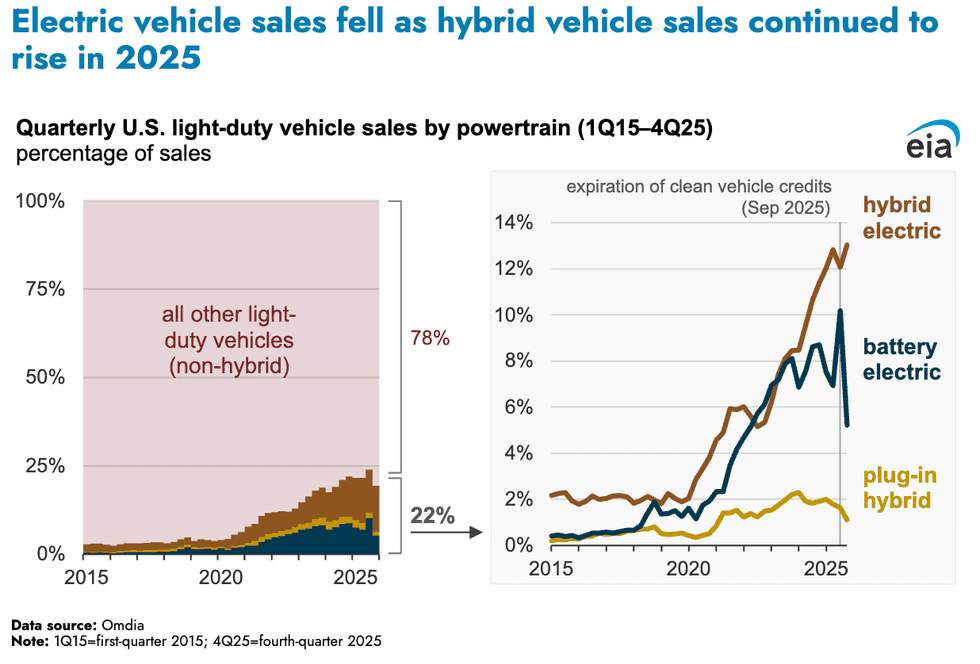
Roughly 22% of light-duty vehicles sold last year in the U.S. were hybrid and battery electric, up from 20% in 2024. While sales of battery-powered vehicles have fallen, demand for hybrids has only increased, according to estimates from the research firm Omdia that the U.S. Energy Information Administration highlighted in a new analysis. Electric vehicles accounted for just 2% of all registered light-duty vehicles on U.S. roads in 2024, the most recent year for which annual data is available. Sales for 2025 will show a spike, especially around September when Americans rushed to cash in on electric vehicle tax credits before Trump’s phaseout took effect.
The Department of Transportation, meanwhile, proposed boosting the domestic content requirements for federally funded electric vehicle charging stations from 55% to 100%. The Biden administration had waived some “Buy American” requirements for the $5 billion federal program to fund the infrastructure buildout. The proposal would set steep hurdles for projects, likely slowing the rollout of chargers. The agency, Reuters reported, said it believes it must “protect Americans from foreign-made EV charger components that use technology with cybersecurity vulnerabilities.”
Sign up to receive Heatmap AM in your inbox every morning:
* indicates required
Email Address *Our Privacy Policy & Terms Apply.
3. Equinor scales back on carbon capture
Equinor is scaling back its near-term investments in carbon capture and sequestration projects as prices go up and customer demand stagnates. Despite its reputation as what the Carbon Herald called “one of the global standard-bearers for carbon capture and storage,” the Norwegian energy giant said the commercial conditions needed to justify more large-scale investments in carbon pipelines and wells were not yet there. CEO Anders Opedal said during the company’s latest earnings call that, because CCS markets were growing more slowly than previously thought, Equinor would hold off on committing more capital to new projects.
CCS had something of a moment last fall when Google agreed to finance construction of a gas plant equipped with carbon capture technology, as Heatmap’s Matthew Zeitlin wrote. But Trump’s plan to go for the climate killshot, repealing the legal underpinning of all federal regulations on planet-heating emissions, would really dampen demand for CCS in the U.S.
4. India’s trade deal with the U.S. is a ‘strategic turning point’ for its solar industry
The new U.S.-India trade deal that will lower tariffs on Indian goods to 18% from 25% is set to bolster the country’s booming solar manufacturing industry. The pact represents what Prashant Mathur, chief executive of the solar manufacturer Saatvik Green Energy, described to PV-Tech as a “strategic turning point.” Cutting tariffs by seven percentage points “materially improves cost competitiveness, making U.S. projects more profitable and creating new demand for high-efficiency, Made-in-India products.” Gyanesh Chaudhary, the managing director of Vikram Solar, called the deal a “structural inflection point.” But the trade agreement won’t fix all the problems for Indian solar exporters. New restrictions known as Section 232 tariffs, which raise prices on imports that threaten national security by undercutting domestic manufacturers, are expected to come into effect on India’s exports of polysilicon. A separate antidumping and countervailing duty investigation into whether India is unfairly flooding the U.S. market with cheap crystalline silicon solar cells called for a duty of 123.04%, though nothing has yet been imposed.
The Trump administration, meanwhile, is setting the stage for more coal in the U.S. On Wednesday, according to Bloomberg, Trump plans to sign an executive order directing the military to buy more power from coal-fired plants in a bid to prop up the sector.
5. Orsted is charging ahead with an offshore wind project in Australia
Despite Trump’s best attempts to stop it, Orsted is finishing its offshore wind farms in New England and, after that, is expected to save its money for new projects overseas. In its native Europe, the energy giant is preparing for a big multinational buildout in the North Sea. Now the Danish developer is charging ahead in a new market. Australia does not have any operating offshore wind farms. But Orsted just submitted an application for an environmental review of a 2.8 gigawatt project proposed off the coast of Gippsland, Victoria. Together with a second site Orsted started lining up in 2024, the area could host a combined 4.8 gigawatts of turbine capacity, according to Renewables Now.
THE KICKER
Yet another fusion energy startup has officially entered the race. Inertia Enterprises, a fusion startup aimed at mimicking the technology that managed for the first time in history to generate more energy than it took to start the reaction, has raised $450 million in a Series A round. The venture firm Bessemer Venture Partners led the round, with backing from Google Ventures, Modern Capital, and Threshold Ventures. “Inertia is building on decades of science and billions of dollars invested to reach the ignition milestone that proved the science,” Jeff Lawson, the co-founder and chief executive of Inertia, said in a statement.