
GLOBALVARS
0
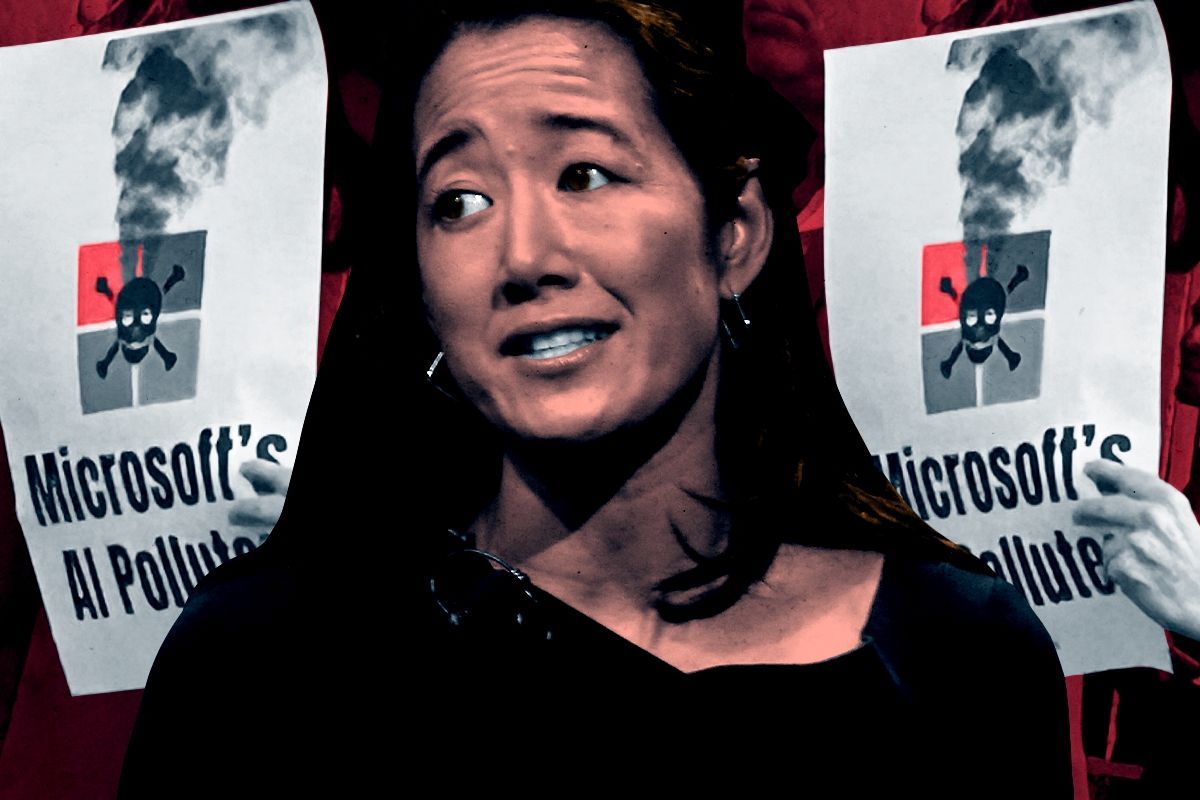
Protestors interrupted one of the final sessions of PNW Climate Week — a conference that brings together climate leaders across Washington, Oregon, and British Columbia — objecting to Microsoft’s rising carbon emissions from data centers and partnerships with oil and gas companies. The company’s Chief Sustainability Officer Melanie Nakagawa was having a one on one conversation with GeekWire climate reporter Lisa Stiffler at Seattle’s City Hall when protestors carrying signs reading “Microsoft’s AI pollutes” and other slogans began shouting from the audience.
I was there, having just moderated the prior panel on how to finance Washington’s clean energy ambitions. Early on there were some rumblings in the crowd from up front. “Climate leaders don’t build gas pipelines in Moses Lake,” was the first objection I heard clearly. It came shortly after Nakagawa kicked off the conversation by highlighting Microsoft’s partnership with sustainable aviation fuel startup Twelve, which recently opened its first commercial-scale SAF plant in Moses Lake, Washington. The tech giant has supported the project through a strategic investment from its Climate Innovation Fund, as well as an offtake agreement for the fuel that will help offset its emissions from employee travel.
Whether Microsoft is building a gas pipeline in this particular community I haven’t been able to determine, though it seems irrelevant to Twelve’s SAF facility, which doesn’t rely on natural gas. But it is true that Microsoft is one of the largest power consumers in Grant County, Washington, home to Moses Lake, where a natural gas pipeline operator is looking to expand its network to accommodate data center load growth.
Another audience interruption was more pointed. “How does signing a 20-year deal with Chevron help you reach your clean energy goals?,” one protestor asked, referring to Microsoft's recently announced power purchase agreement with Chevron for nearly 2.7 gigawatts of natural gas-fired power to supply a West Texas data center. The project represents one of the largest gas-powered artificial intelligence developments in the U.S., and Stiffler acknowledged that she had been planning to ask about it, herself.
Nakagawa answered the question. at least in part, saying “that project with Chevron is initially using natural gas and it’s a natural gas contract,” before emphasizing that the company has built “over 4.5 gigawatts of clean energy already today,” and remains committed to balancing speed-to-power with its clean energy goals. She added that, “with this deal in particular, we’re looking at a range of tools in our toolbox to ensure that we can continue to grow our power, but also do so in a way that is responsible and sustainable.” She stopped short, however, of making any commitments to transitioning the project to renewable energy over time.
The session became more chaotic from there. Another protestor stood up, shouting that “Microsoft is enabling genocide in Palestine.” Other activists joined in, while still other audience members shouted back. As Nakagawa recovered and resumed answering a question from Stiffler about Microsoft’s recent decision to pause its carbon removal purchases after years of dominating the nascent industry, protestors throughout the crowd began a chant of “Microsoft, you can’t hide, we can see your dirty side.” Security eventually shepherded many of them out.
Stiffler continued speaking with Nakawaga about the company’s clean energy efforts, touching on many of the protestors’ concerns as she asked about community opposition to data centers, the role of large corporations in the clean energy transition, and whether Microsoft can realistically achieve its goal of becoming carbon negative by 2030.
Nakawaga emphasized that the company must, “first and foremost, listen to where the communities are and what they are calling for.” Regarding the concerns she hears most often, she explained that “first has been transparency. Second has been around resource uses and what are we doing about those resource uses. We’re hearing about jobs and employment and investments in education, investments in housing.”
If this session was any indication, those concerns won’t go away anytime soon.