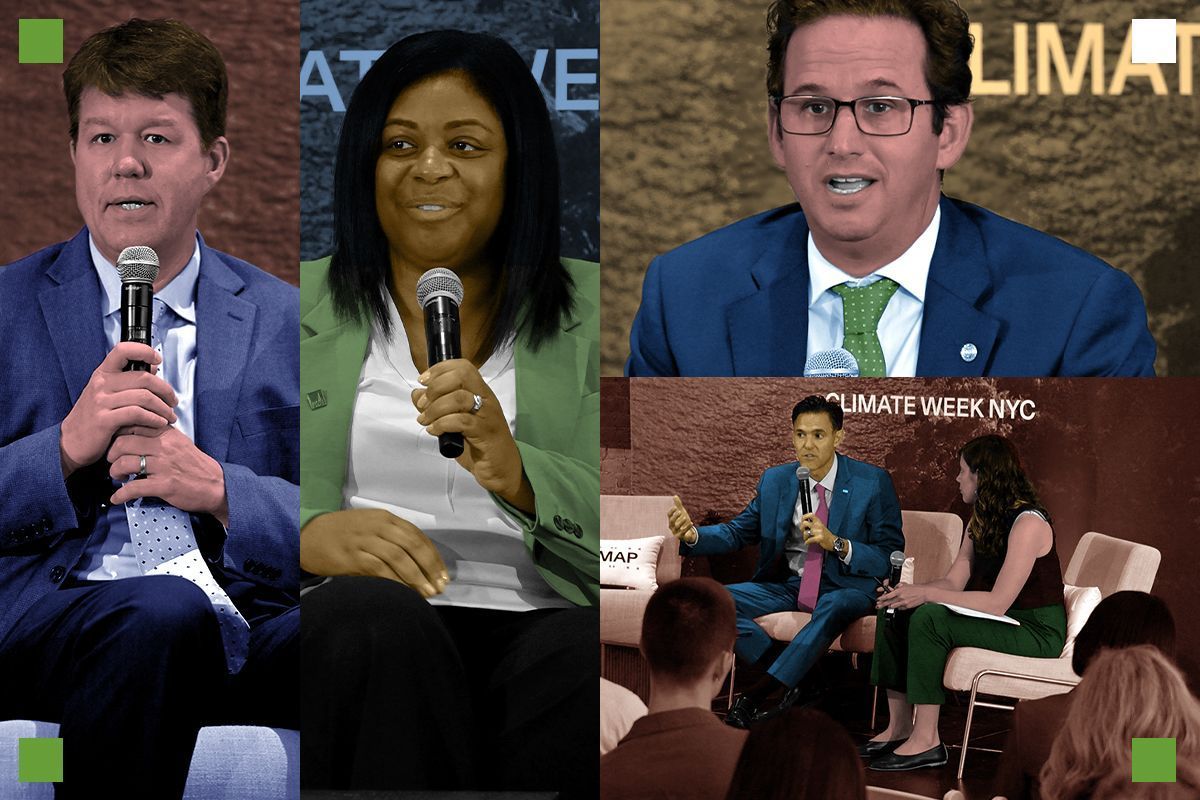
None of the speakers at Heatmap House’s second session at New York Climate Week, “Built to Scale,” minced words when it came to describing the current U.S. policy environment. The global fight to decarbonize is still happening, our guests emphasized — but it might happen without the U.S.
Senator Brian Schatz of Hawaii emphasized in his discussion with Heatmap’s Robinson Meyer. Schatz that in previous years, he would assure his international colleagues that the U.S. was still fully invested in the climate fight. What about now? “I would say we will be back — but do not wait for us,” Schatz said.
Ricardo Falu, executive vice president and chief operating officer at AES corporation, touched on a similar point while speaking with my colleague Emily Pontecorvo. His company, which invests in clean energy projects in addition to natural gas at home and abroad, has found particular success in Chile, where the regulatory environment has proved especially fruitful for renewables. “In many other countries, you don't need incentives for renewables. They are competitive,” Falu pointed out. “You don’t need the government financing or the government to be involved.”
This isn’t to say that there’s no hope whatsoever for climate progress in the U.S., our speakers made sure to highlight. We might just have to refrain from calling it “climate progress.” Schatz pointed out that the language of affordability will come to define clean energy projects moving forward, echoing what Senator Chuck Schumer said earlier in the day. “Cheap is clean, and clean is cheap,” said Schatz. “We don't have to make a complicated argument.”
This framing from Schatz and Schumer makes perfect sense in the context of the new package of energy proposals from House Democrats announced this morning, fittingly called the Cheap Energy Act. As my colleague Robinson wrote today, “Democrats have reoriented to talking about energy chiefly as an affordability problem.” Schatz summed up the strategy thusly: “We have to just say, ‘See that spike in electricity prices? It’s their fault. Solar is cheap.’”
Data centers and the rapid growth of AI were also top of mind for panelists. The tension between AI growth objectives and renewables didn’t seem to be an issue, however. Rather, our speakers pointed out, data center growth could be an opportunity to invest in a stronger renewables rollout. Jake Oster, director of sustainability at Amazon, told Heatmap’s Katie Brigham that “the first thing we're focused on is energy efficiency in our facilities.”
Carla Peterman, executive vice president at PG&E, was even more unequivocal in her support. “We know that our communities, our society will benefit from having that load and having those data centers,” she remarked. “We don’t want to block bringing them on.”