Current conditions: The monster snow storm headed eastward could dump more than a foot of snow on New York City this weekend • An extreme heat wave in Australia is driving temperatures past 104 degrees Fahrenheit • In northwest India, Jammu and Kashmir are bracing for up to 8 inches of snow.
THE TOP FIVE
1. Fervo and General Fusion are going public
Last month, Fervo Energy raised another $462 million in a Series E round to finance construction of the next-generation geothermal startup’s first major power plant. Pretty soon, retail investors will be able to get in on the hype. On Thursday, Axios reported that the company had filed confidential papers with the Securities and Exchange Commission in preparation for an initial public offering. Fervo’s IPO will be a milestone for the geothermal industry. For years, the business of tapping the Earth’s molten heat for energy has remained relatively small, geographically isolated, and dominated by incumbent players such as Ormat Technologies. But Fervo set off a startup boom when it demonstrated that it could use fracking technology to access hot rocks in places that don’t have the underground reservoirs that conventional geothermal companies rely upon. In yesterday’s newsletter, I told you about how Zanskar, a startup using artificial intelligence to find more conventional resources, and Sage Geosystems, a rival next-generation company to Fervo, had raised a combined $212 million. But as my colleague Matthew Zeitlin wrote in December when Fervo raised its most recent financing round, it’s not yet clear whether the company’s “enhanced” geothermal approach is price competitive. With how quickly things are progressing, we will soon find out.
Fervo isn’t the only big IPO news. General Fusion, the Canadian fusion energy startup TechCrunch describes as “struggling,” announced plans for a $1 billion reverse merger deal to go public on the Nasdaq. The move comes almost exactly a month after President Donald Trump’s social media company, the parent firm of Truth Social, inked a deal to merge with the fusion startup TAE Technologies and create the first publicly-traded fusion company in the U.S. Analysts I spoke to about the deal called it “flabberghasting,” and warned that TAE’s technology represented a more complex and dubious approach to commercializing fusion than that taken by rival companies such as Commonwealth Fusion Systems. Still, the IPO deals highlight the growing excitement over progress on generating power from a technology long mocked as the energy source of tomorrow that always will be. As Heatmap’s Katie Brigham artfully put it in 2024, “it is finally, possibly, almost time for fusion.”
2. GM is moving production from China to the U.S.
General Motors plans to move manufacturing of the next generation of its Buick Envision SUV from China to the U.S. in two years and end production of the all-electric Chevrolet Bolt. The Detroit auto giant makes just one of its four SUV models in the U.S., leaving the cars vulnerable to Trump’s tariffs. The worst hit was the Envision, which is currently built in China. Starting in 2028, the latest version of the Envision will be produced in Kansas, taking over the assembly line that is currently churning out the Bolt.
It's a blow to GM's electric vehicle line. Chevy just brought back the Bolt in response to high demand after initially canceling production in 2023, because as Andrew Moseman put it in Heatmap, it's “the cheap EV we've needed all along.” While Chevy had always framed the return as a limited run, it was not previously clear how limited that would be.
Get Heatmap AM directly in your inbox every morning:
3. Energy Department announces changes affecting $83 billion of loans
The Department of Energy said Thursday its newly rebranded Office of Energy Dominance Finance, formerly the Loan Programs Office, is “restructuring, revising, or eliminating more than $83 billion in Green New Scam loans and conditional commitments.” The move comes after “an exhaustive first-year review” of the $104 billion in principal loan obligations the Biden administration shelled out, including $85 billion the Trump administration accused of being “rushed out the door in the final months after Election Day.” In a statement, Secretary of Energy Chris Wright said the changes are meant to “ensure the responsible investment of taxpayer dollars.” While it’s not yet clear which projects are affected, the agency said the EDF eliminated about $9.5 billion in support for wind and solar projects and redirected that funding to natural gas and nuclear energy. But as Heatmap’s Emily Pontecorvo noted last night, the Energy Department hasn’t yet said which loans are set to be canceled as part of the latest cuts. The announcement may include loans that have already been canceled or restructured.
Sign up to receive Heatmap AM in your inbox every morning:
4. California expects EVs to drive more demand growth than data centers
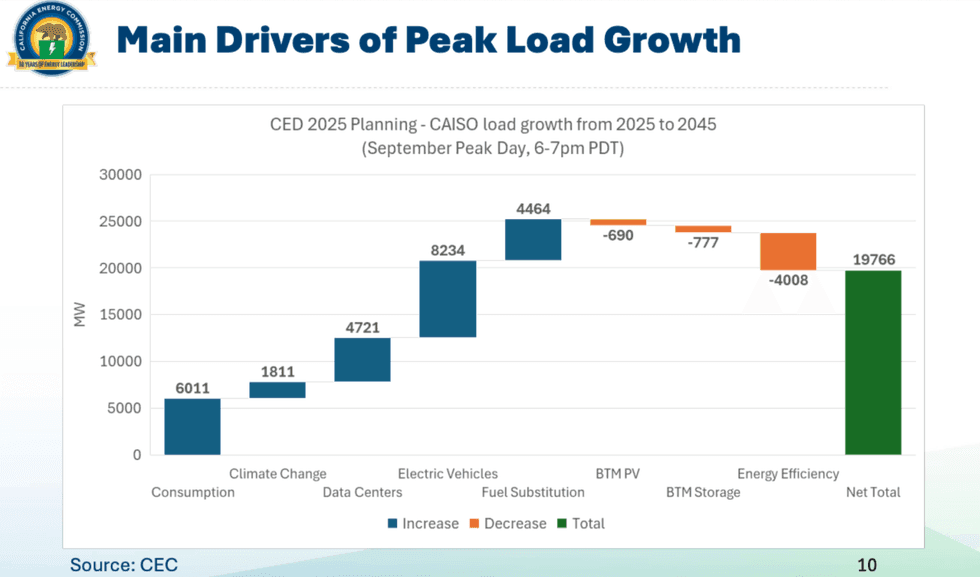
If you know anything about surging electricity demand, you’re likely to finger a single culprit: data centers. But worldwide, air conditioning dwarfs data centers as a demand driver. And in California, electric vehicles are on pace to edge out data centers as a bigger driver of peak demand on the grid. That’s according to a new report from the California Energy Commission. Just look at this chart:
As the Golden State tries to get a grip on its electricity system, Representative Ro Khanna, the progressive Silicon Valley congressman often discussed as a potential 2028 presidential candidate, has doubled down on his calls to break up the state’s largest utility. On Thursday, Khanna posted on X that PG&E “should be broken up and owned by customers, not shareholders. They are ripping off Californians by buying off politicians in Sacramento.” The Democrat has been calling for PG&E’s demise since at least 2019, when the utility was on the hook for billions of dollars in damages from a wildfire sparked by its equipment. But the idea hasn’t exactly caught on.
5. A global mining boom is underway — at existing mines
New energy technologies such as batteries, solar panels, and wind turbines are driving demand for minerals and spurring a controversial push for new mines on virgin lands. But a new study by researchers at the University of Queensland’s Sustainable Minerals Institute found that a production boom is already underway at existing mines. The peer-reviewed paper, which is the first comprehensive global analysis of brownfield mining expansion, found that existing mines are growing in size and scale. Just because the mines are already there doesn’t mean the new production doesn’t come with some social cost. Nearly 78% of the 366 mines analyzed in the study “are located in areas facing multiple high-risk socioeconomic conditions, including weak governance, poor corruption control, and limited press freedom,” the study found.
THE KICKER
The Department of the Interior has a new coal mascot. On Thursday, the agency posted an animated picture of a cartoonish, rosy-cheeked, chicken nugget-shaped lump of coal clad in a yellow hardhat and construction gear. His name? Coalie. The idea isn’t original. Australia’s coal-mining trade group rolled out an almost identical mascot a few years ago — same anthropomorphic lump of coal, same yellow attire. The only difference? His name was Hector, and he wore glasses.