
Current conditions: Cold temperatures continue in Europe, with thousands of flights canceled at Amsterdam Schiphol Airport, while Scotland braces for a winter storm • Northern New Mexico is anticipating up to a foot of snow • Australia continues to swelter in heat wave, with “catastrophic fire risk” in the state of Victoria.
THE TOP FIVE
1. Trump withdraws U.S. from United Nations climate change treaty
The White House said in a memo released Wednesday that it would withdraw from more than 60 intergovernmental organizations, including the United Nations Framework Convention on Climate Change, the international climate community’s governing organization for more than 30 years. After a review by the State Department, the president had determined that “it is contrary to the interests of the United States to remain a member of, participate in, or otherwise provide support” to the organizations listed. The withdrawal “marks a significant escalation of President Trump’s war on environmental diplomacy beyond what he waged in his first term,” Heatmap’s Robinson Meyer wrote Wednesday evening. Though Trump has pulled the United States out of the Paris Agreement (twice), he had so far refused to touch the long-tenured UNFCCC, a Senate-ratified pact from the early 1990s of which the U.S. was a founding member, which “has served as the institutional skeleton for all subsequent international climate diplomacy, including the Paris Agreement,” Meyer wrote.
Among the other organizations named in Trump’s memo was the Intergovernmental Panel on Climate Change, which produces periodic assessments on the state of climate science. The IPCC produced the influential 2018 report laying the intellectual foundations for the goal of limiting global warming to 1.5 degrees Celsius above pre-industrial levels.
2. Details emerge on U.S. plan to sell Venezuela’s oil
More details are emerging on the Trump administration’s plan to control Venezuela’s oil assets. Trump posted Tuesday evening on Truth Social that the U.S. government would take over almost $3 billion worth of Venezuelan oil. On Wednesday, Secretary of Energy Chris Wright told a Goldman Sachs energy conference that “going forward we will sell the production that comes out of Venezuela into the marketplace.” A Department of Energy fact sheet laid out more information, including that “all proceeds from the sale of Venezuelan crude oil and oil products will first settle in U.S. controlled accounts,” and that “these funds will be disbursed for the benefit of the American people and the Venezuelan people at the discretion of the U.S. government.” The DOE also said the government would selectively lift some sanctions to enable the oil sales and transport and would authorize importation of oil field equipment.
As I wrote for Heatmap on Monday, sanctions are just one barrier to oil development among a handful that would have to be cleared for U.S. oil companies to begin exploiting Venezuela’s vast oil resources.
3. Key Democrat lays out permitting reform conditions
In a Senate floor speech, Senator Martin Heinrich of New Mexico blasted the Trump administration’s anti-renewables executive actions, saying that the U.S. is “facing an energy crisis of the Trump administration’s own making,” and that “the Trump administration is dismantling the permitting process that we use to build new energy projects and get cheaper electrons on the grid.” Heinrich, a Democrat, is the ranking member of the Senate Committee on Energy and Natural Resources and a key player in any possible permitting reform bill. Though he said he supports permitting reform in principle, calling for “a system that can reliably get to a ‘yes’ or a ‘no’ on a permit in two to three years — not 10, not 17,” he said that “any permitting deal is going to have to guarantee that no administration of either party can weaponize the permitting process for cheap political points.” Heinrich called on Trump officials “to follow the law. They need to reverse their illegal stop work orders, and they need to start approving legally compliant energy projects.”
He did offer an olive branch to the Republican senators with whom he would have to negotiate on any permitting legislation, noting that “the challenge to doing permitting reform is not in this building,” specifying that Senators Mike Lee, chair of the ENR Committee, and Shelly Moore-Capito, chair of the Senate Committee on Environment and Public Works, have not been barriers to a deal. Instead, he said, “it is this Administration that is poisoning the well.”
4. New report ranks “billion-dollar disasters”
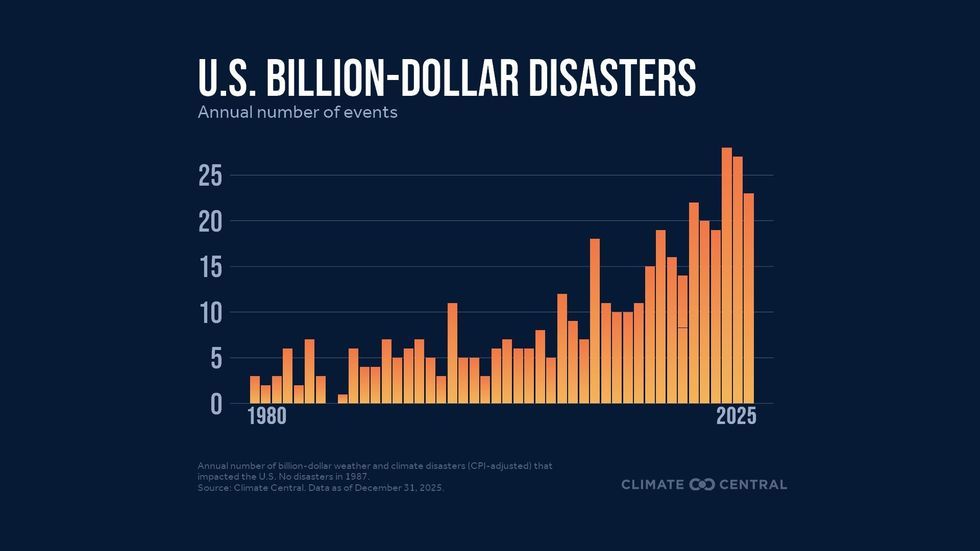
The climate science nonprofit Climate Central released an analysis Thursday morning ranking 2025 “as the third-highest year (after 2023 and 2024) for billion-dollar weather and climate disasters — with 23 such events causing 276 deaths and costing a total of $115 billion in damages,” according to a press release.
Going back to 1980, the average number of disasters costing $1 billion or more to clean up was nine, with an average total bill of $67.9 billion. The U.S. hit that average within the first weeks of last year with the Los Angeles wildfires, which alone were responsible for over $61 billion in damages, the most economically damaging wildfire on record.
5. Nuclear ❤️ New York
The New York Power Authority announced Wednesday that 23 “potential developers or partners,” including heavyweights like NextEra and GE Hitachi and startups like The Nuclear Company and Terra Power, had responded to its requests for information on developing advanced nuclear projects in New York State. Eight upstate communities also responded as potential host sites for the projects.
New York Governor Kathy Hochul said last summer that New York’s state power agency would go to work on developing 1 gigawatt of nuclear capacity upstate. Late last year, Hochul signed an agreement with Ontario Premier Doug Ford to collaborate on nuclear technology. Ontario has been working on a small modular reactor at its existing Darlington nuclear site, across Lake Ontario from New York.
THE KICKER
“Sunrise Wind has spent and committed billions of dollars in reliance upon, and has met the requests of, a thorough review process,” Orsted, the developer of the Sunrise Wind project off the coast of New York, said in a statement announcing that it was filing for a preliminary injunction against the suspension of its lease late last year.