Current conditions: Juneau, Alaska, is blanketed under a record 80 inches of snow, equal to six-and-a-half feet • A heat wave stretching across southern Australia is sending temperatures as high as 104 degrees Fahrenheit • Arctic air prompted Ireland’s weather service to put out a nationwide warning as temperatures plunge below freezing.
THE TOP FIVE
1. The U.S. raid in Venezuela isn’t shaking up oil markets just yet
When The Wall Street Journal asked Chevron CEO Mike Wirth about his oil giant’s investments in Venezuela back in November, he said, “We play a long game.” Then came President Donald Trump’s Saturday morning raid on Caracas, which ended in the arrest of Venezuelan President Nicolas Maduro and appeared to bring the country’s vast crude resources under the U.S.’s political influence. Unlike the light crude pumped out of the ground in places like the Permian Basin in western Texas, Venezuela’s oil is mostly heavy crude. That makes it particularly desirable to American refineries along the Gulf Coast, which can juice more profit out of making fuels from heavy crude than from lighter grades. Still, don’t expect America’s No. 2 oil producer to declare victory just yet. Shares in Chevron inched up by just a few percentage points over the weekend.
“Saturday’s operation didn’t hinge on nuanced assessments of crude grades or the U.S. refining sector’s appetite for heavy supply,” according to Landon Derentz, the energy chief on the White House’s National Security Council during Trump’s first term. In a blog post for the Atlantic Council, where he now serves as the think tank’s vice president of energy and infrastructure, Derentz called it “misguided” to claim that the military intervention was predicated on access to oil. “Venezuelan oil supply is unlikely to move global energy markets meaningfully in the near term. For now, the country remains under an oil embargo imposed by the Trump administration. Even under optimistic assumptions, it will take years to rehabilitate the country’s energy sector and achieve a sizable increase in oil exports.” Oil access was an “enabler” for Trump’s policy of hemispheric domination, he wrote, “not the prize” in itself. And as Heatmap’s Matthew Zeitlin wrote in June, when the U.S. and Israel bombed Iran, oil prices shrugged off the possibility of prolonged geopolitical crisis crippling the shipment of fuel.
2. Orsted fights back against Trump’s halt to offshore projects
In my final newsletter of 2025, I told you about Trump’s December 22 order to halt construction on all offshore wind projects in the U.S., including those that had hitherto been spared the administration’s “total war on wind,” on supposed national security grounds. Last week, Orsted filed a court order to challenge Trump’s suspension of its lease, calling the move illegal. The Danish wind giant has been here before. Trump first yanked the permits for Revolution Wind, a joint venture between Orsted and the private equity-owned Skyborn Renewables, back in August, when construction was nearly 80% complete. Orsted fought back. By the end of September, a federal judge lifted Trump’s stop-work order. And as I reported exclusively in this newsletter at the time, New England trade unions signed an historic agreement guaranteeing organized labor jobs in maintaining offshore turbines.
Orsted isn’t the only developer pushing back. On Friday, Bloomberg reported that Norwegian developer Equinor was “engaging with U.S. authorities over security concerns.” Even if Trump’s latest push is overturned in court, the move will come at costs. During an appearance on Bloomberg TV last month, Connecticut Governor Ned Lamont warned that the delay in building new turbines was “blowing a hole in our efforts to bring down the price of electricity.” At least one key turbine-equipment manufacturer remains bullish on the future of wind. The Financial Times reported that German hardware producer Siemens Energy had fended off calls from activist investors to spin out its wind division.
3. Energy Department orders two more big coal plants to remain open
The Department of Energy asked Santa for more coal last month. On the day before Christmas Eve, the agency ordered two coal-fired plants in Indiana to postpone retirement. The orders directing the R.M. Schahfer and F.B. Culley generating stations to continue operating past their closure dates at the end of December mark what E&E News clocked as the third and fourth times, respectively, that the Trump administration has used its emergency powers to prevent coal plants from shutting down. “Keeping these coal plants online has the potential to save lives and is just common sense,” Secretary of Energy Chris Wright said in a statement. “Americans deserve reliable power regardless of whether the wind is blowing or the sun is shining during extreme winter conditions.” While it’s true that coal plants boast a higher capacity factor than many cleaner generating sources, that depends on the units actually running. As Matthew wrote in November, American coal plants keep breaking down.
Sign up to receive Heatmap AM in your inbox every morning:
4. South Korea’s nuclear regulator issues license for a new plant
South Korea’s nuclear regulator approved a license for the long-delayed Saeul-3 reactor in Busan. The country emerged in recent years as the democratic world’s leading nuclear exporter after successfully building the United Arab Emirates’ first plant largely on time and on budget. But in 2017, then-President Moon Jae-in of the center-left Democratic Party adopted a national plan to dismantle the nuclear industry, prompting delays on Saeul-3. His conservative successor, Yoon Suk Yeol, reversed the phaseout policy. Since President Lee Jae Myung won back the Blue House for the Democrats last year, questions have swirled over whether his administration would revive the anti-nuclear effort. The Nuclear Safety and Security Commission’s decision last week to license the new reactor, a state-of-the-art APR1400 like the ones the Korea Hydro & Nuclear Power built in Abu Dhabi, marked nearly 10 years since the Saeul-3 received its initial construction permit, according to The Chosun Ilbo, the country’s newspaper of record.
All the new reactors underway across North America, Europe, South Korea, and Japan, combined would still fall far short of what China is building. In its latest tally, the trade publication NucNet pegged the total number of reactors under construction in People’s Republic at 35.
5. Left-wing militants claim responsibility for sabotaging Berlin’s power grid
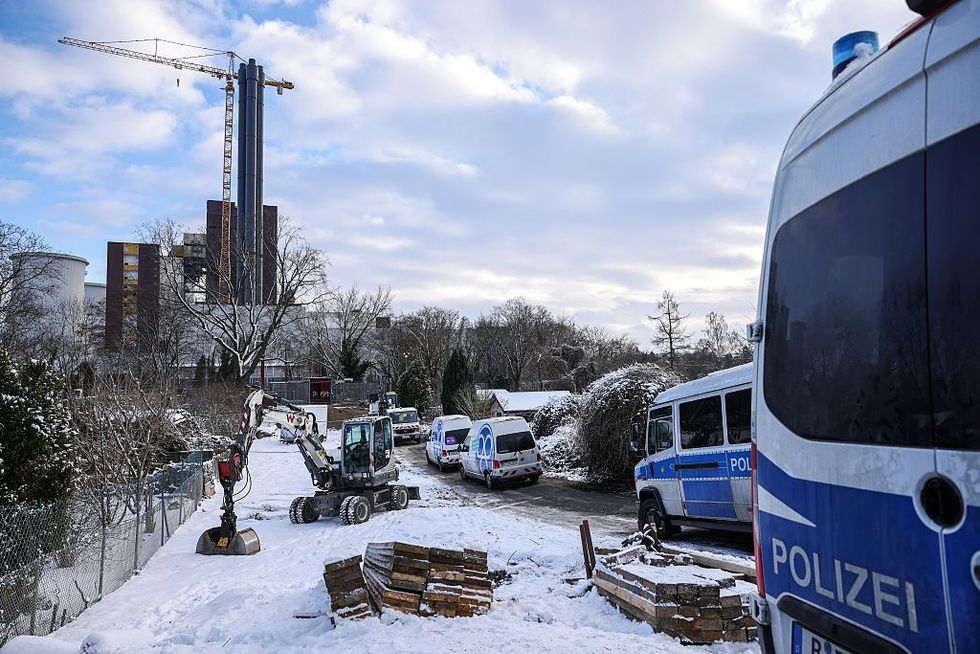
A left-wing militant group whose 2024 arson attack halted production at the Tesla Gigafactory in Germany has claimed responsibility for setting fire Sunday to equipment near high-voltage power in Berlin. The attack, which the head of Germany’s Senate called an act of “terrorism,” triggered a blackout across more than 35,000 households and nearly 2,000 businesses in the German capital that could last days, Der Tagesspiegel reported. In a 2,500-word manifesto that The Guardian confirmed with police, the Vulkangruppe, or Volcano Group, condemned a “greed for energy” produced from fossil fuels, calling the attack an “act of self-defense and international solidarity with all those who protect the earth and life.” A previous arson attack by the same group knocked out power in southeastern Berlin for nearly three days in September, marking the longest outage since World War II.
THE KICKER
A parched stretch of farmland is set to produce something new: Solar power. The board of California’s Westlands Water District that serves the San Joaquin Valley has adopted a plan that would add 21 gigawatts of solar power on land fallowed by water shortages. The infrastructure strategy document called for a “major land-repurposing initiative” across the nation’s largest agricultural water district, which spans 1,000 miles and provides freshwater to 700 farms near Fresno. Legislation passed in California’s big climate package last fall (Heatmap’s Emily Pontecorvo has a good writeup here) gave water districts the power to develop, construct, and own solar generation, batteries, and transmission facilities.