Current conditions: After walloping Bermuda with winds of up to 100 miles per hour, Hurricane Imelda is veering northeast away from the United States • While downgraded from a hurricane, Humberto is set to soak Ireland and the United Kingdom as Storm Amy in the coming days and bring winds of up to 90 miles per hour • Typhoon Matmo is strengthening as it hits the Philippines and barrels toward China.
THE TOP FIVE
1. Energy Department kills West Coast hydrogen hubs
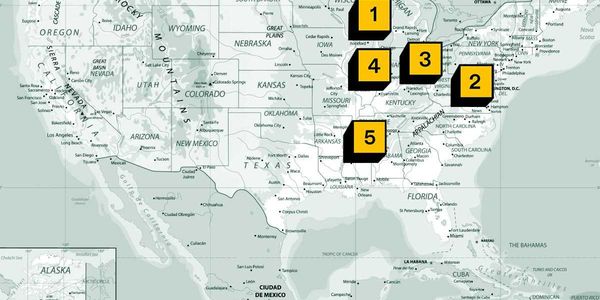
The Department of Energy is canceling two regional hydrogen hubs in California and the Pacific Northwest as part of a broader rescinding of 321 grants worth $7.5 billion for projects nationwide. Going after the hydrogen hubs, which the oil and gas industry lobbied to keep open after President Donald Trump came back to office, “leaves the agency’s intentions for the remaining five hubs scattered throughout the Midwest, Midatlantic, Appalachia, the Great Plains, and Texas unclear,” Heatmap’s Emily Pontecorvo wrote yesterday.
The list of canceled projects that Emily got her hands on “does seem to confirm that blue state grants were the hardest hit,” she wrote. But, she found, “many would actually have benefitted Republican strongholds,” including a $20 million grant for a manufacturing plant in Texas that was slated to create 200 jobs.
2. Tesla hits a sales record
Tesla’s global deliveries rose 7% in the third quarter, hitting a new record as Americans rushed to buy electric vehicles before the federal tax credit expired on September 30. The automaker delivered 497,099 vehicles in the three months leading up to that date, up from 462,890 in the same period last year, according to the Financial Times. That was well above analyst forecasts of 444,000.
That may do little to turn around the headwinds blasting the EV giant. While the company benefited from buyers scrambling to tap the federal EV tax credit, Tesla sank to its lowest-ever share of the electric vehicle market in August as drivers flocked to offerings from other automakers. It’s not just a problem in the U.S. As Heatmap’s Matthew Zeitlin wrote last month, “Thanks to CEO Elon Musk’s association with right wing politics in the U.S. and abroad, and to fierce competition from Chinese EV leader BYD, Tesla’s sales have fallen dramatically in Europe. Globally, BYD overtook Tesla in sales last year.”
Get Heatmap AM directly in your inbox every morning:
3. The British Tories vow to repeal landmark climate law

Kemi Badenoch, the leader of the British Conservatives, has vowed to repeal the United Kingdom’s landmark climate law if her party, colloquially known as the Tories, wins the next election. Eliminating the Climate Change Act, passed almost unanimously under a Tory government in 2008, would dismantle controls on greenhouse gas emissions and remove what The Guardian described as “the cornerstone of green and energy policy for successive governments” for the past 17 years.
The move rankled past Tory leaders. Former Prime Minister Theresa May condemned the campaign pledge as a “catastrophic mistake.” Calling it a “retrograde” step, she said that “while consensus is being tested, the science remains the same.” Alok Sharma, the former Tory minister who led the COP26 climate summit in Glasgow in 2021, told The Guardian in a separate article that a repeal risked “many tens of billions of pounds of private sector investment and accompanying jobs.”
4. Antarctic sea ice shrinks to third-lowest winter peak
Sea ice in Antarctica reached its third-smallest winter peak extent since satellite records began 47 years ago, according to a new analysis by Carbon Brief. Provisional data from the U.S. National Snow and Ice Data Center showed Antarctic sea ice reaching a winter maximum of just under 6.9 million square miles as of September 17. That’s nearly 350,000 square miles below the average between 1981 and 2010, the historical baseline against which recent changes in sea ice extent are compared. The “lengthening trend of lower Antarctic sea ice poses real concerns regarding stability and melting of the ice sheet,” one expert told the publication.
The finding comes as a “groundbreaking” study the European Geosciences Union published Thursday in the journal Earth System Dynamics found that Antarctic sea ice has emerged as a key predictor of accelerated ocean warming. Using Earth system models and satellite images from 1980 to 2020, the researchers found higher sea ice extent enhances cloud cover, which has a cooling effect overall by reducing incoming solar radiation. As a result, ongoing sea ice loss is linked to larger reductions in clouds, stronger surface warming, and even more ocean heat uptake, accelerating the cycle.
5. Duke Energy extends coal use in new electricity plan
Duke Energy plans to meet surging demand for electricity by increasing its natural gas and battery capacity, keeping coal plants open for up to four years longer than previously estimated, and evaluating new sites for nuclear reactors. The 100-page biennial proposal published this week dials back plans for more renewables such as wind and solar. It also pushed back the earliest start date for a new reactor to 2037, declined to commit to either small modular reactors or large traditional units, and said the utility still needs extra protections against cost overruns before embarking on construction.
In the meantime, the added years of coal burning “will result in millions of tons in additional greenhouse gases over the next decade when combined with other proposed changes to the utility’s fuel mix,” Inside Climate News reported. In a statement to Axios, North Carolina Governor Josh Stein, a Democrat, called on the state’s utilities commission to “require significant changes” and condemned Duke for “retreating from the state’s clean energy future.”
THE KICKER
New research by a team of scientists from the U.K. and New Zealand has found that new analytical methods could bolster conservation breeding programs by offering a better understanding of why eggs don’t hatch. The researchers used fluorescent dyes to discover that nearly 66% of 174 unhatched eggs examined in the study had been fertilized, whereas previous methods suggested that only 5.2% had been fertilized. “There are many different factors that contribute to breeding success,” Gary Ward, a co-author from the London-based ZSL Institute of Zoology, said in a statement, “and the more understanding we can have into why an egg might not hatch, the more we can refine our care for these birds and the better chance of recovery we can give them.”